Pages

Showing posts with label Literature. Show all posts

Review of Aviya Kushner's "The Grammar of God"

"A Hebrew Speaker's Response to the Bible in English." xxxii.

It is important to note that most of the reading I do is in biblical academia, so my judgment of this book is not based on the same criterion. The reason I mention it is because I read some other reviews of this book in which they were quite unfair, attempting to judge it as a work of biblical or linguistic scholarship. That is not what this book is, nor does the author claim this (see Introduction xxxii); reading the book you will find that to not be the point.

This book was recommended to me and now I am so glad it was; what a fantastic work! I appreciated her insights and background of having been raised in a Jewish home where speaking and reading Hebrew was at the center of the family life.

Again, while it is not a scholarly work, The Grammar of God does contain many trails for the chasing, if the reader possesses the notion. This book will thrill both the grammarian and lover of the Bible, as it is written beautifully and is full of heart. She investigates the histories of English translational difficulties and tells the story of her own personal journey with the realization that "some of the most politically charged issues of our time are rooted in biblical translation." xxiii

Here is one of my favorite quotes from the book:
"It [the Bible] is a story that is part of every man and woman who has ever felt the need to claw against destiny, to insist on a different future than what God appears to be offering. And sometimes, in the Bible, what man wants so passionately is unacceptable to God. What man wants is so destructive that is is a threat to the earth, to the creatures that live on it, to other humans." 114.

Also, the book is available in multiple formats and editions, including audiobook.

Trust and Belief

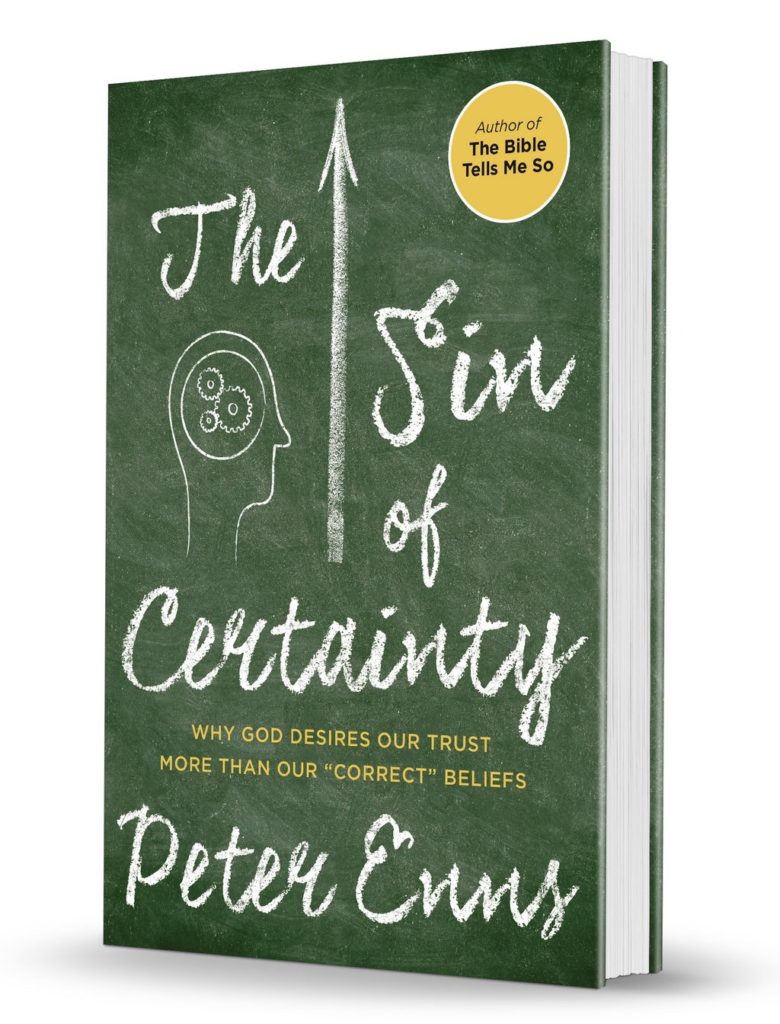
Peter Enns has written a phenomenal book, "The Sin of Certainty." I am not going to take the time to write a review now, but maybe some day in the far, distant future. What I will say, however, is that this book is worth your while to read. If you claim to be a Christian and your heart is still beating, you should definitely plunge in. It is written on a popular level rather than an academic one.

It is an easy read, but it will no doubt challenge certain aspects of your walk with God, and this is a great thing. If you find it heretical (like this group) and decide to burn the book after you finish it (or only begin), then you are all the better for having sharpened your defenses and become more equipped to fight the wiles of the devil, who, apparently, parades through the halls of Eastern University.  

While reading a bit of Hans Küng’s “Christianity” (as I do from time to time for fun), I came across a couple of statements where he had the same critique as Peter Enns in "The Sin of Certainty":
“Jesus nowhere said, ‘Say after me’, but rather ‘Follow me. . . . Faith is now no longer understood, as it is in the New Testament, as primarily believing trust (in God, Jesus Christ) but above all as right belief, as orthodoxy, as a conviction of the correctness of particular doctrinal statements of the church sanctioned by the state.” 

Küng, Christianity: Essence, History, and Future, 50, 198.

So if you don't want to read Enns then read Küng. 

P.S. Enns is funnier.

Supercilious Scripture Snobs or Careful Custodians


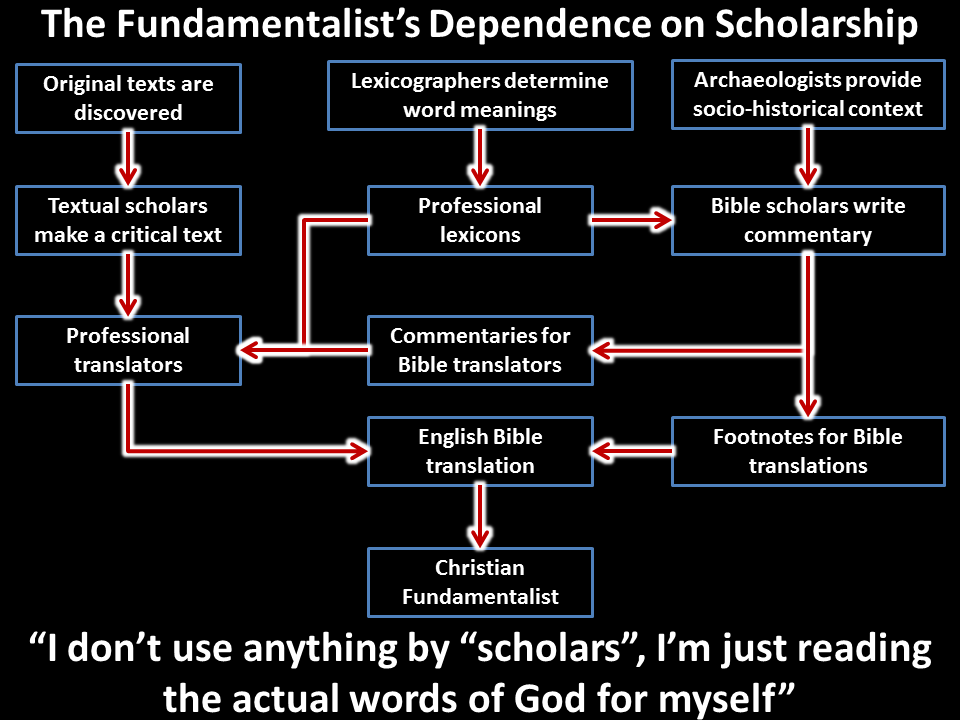
Reading biblical text within its historical, social and literary contexts places it where it was always intended to be, thus bestowing upon it the highest possible honor. Some, who are unacquainted with this as proper treatment of text, choose rather to label it “scriptural elitism” and thereby uncharitably disregard the valiant efforts of multitudes of scholars from varieties of disciplines, stretching years into the past, whose life mission has been to better understand this priceless treasure.

John Walton summarized it well, 

"God is not superficial, and we should expect that knowledge of him and his Word would be mined rather than simply absorbed. This means that all of us will be dependent on others with particular skills to help us succeed in the enterprise of interpretation. This is not elitism; it is the interdependence of the people of God as they work together in community to serve one another with the gifts they have." Walton, The Lost World of Genesis One; Ancient Cosmology and the Origins Debate (IVP Acedemic, 2009), 171.

I have posted this quotation in the past, but James McGrath was also spot on when he said,

"Does someone claim that they simply read the Bible and have no need for scholars, when they are reading the Bible in translation, or reading critical editions of the texts in the original languages, or using manuscripts copied by scribes, having learned Hebrew and Greek with the help of textbooks and lexicons? That person is a liar, plain and simple."

This is not to say that there haven't been or are not irresponsible conclusions or distortions (whether intentional or not is not for me to say). Brent Sandy perhaps has a balanced perspective,

"Evangelicals who support the concept of inerrancy have undoubtedly been guilty at times of claiming too much for the term and claiming that we know too much (e.g., about what historical accuracy demanded and about what authorship entailed). But critical scholarship is not innocent of similar unwarranted certainty and belief in 'assured results' as they apply the surgical knife to biblical books with such self-confidence." Walton and Sandy, The Lost World of Scripture; Ancient Literary Culture and Biblical Authority (IVP Academic, 2013), 276. 

A Free Gift: Romans

You are probably supposing that the title of the post relates to Paul's theological motif in Romans. Well, it does, but not in the way you might expect. Here's the deal, every month, Faithlife Corp. (who has brought us great tools such as Logos Bible Software) generously gives away a free resource (no strings attached, really), such as a digital book or commentary. 

This month (October, 2016) is a phenomenal prize, Craig Keener's Romans commentary. If you aren't familiar with this Asbury distinguished scholar and are a NT biblical studies and research person, you have been missing out. His list of works are extensive. I have used his written and media content and greatly benefited. He is well researched and articulate. Best of all, this is free. Who doesn't like a free gift? Click, and it shall be given.

Buried Deep Blog on Gnosticism

Here is a great introduction to Gnosticism. My friend Kegan Chandler, over at his blog Buried Deep, has a golden pen, so to speak. It would be worth your time to check-out some of his recent posts. Also, tomorrow (August 24, 2016) is the launch of his new book "The God of Jesus in Light of Christian Dogma: The Recovery of New Testament Theology."


"First, what do we mean by “Gnosticism”? Today the term describes a fluid category of spiritual traditions developing in the mid to late first century CE which emphasized the acquisition of gnosis, or secret knowledge of the divine, in order to achieve salvation. While the movement was not exclusive to Christianity, it is best known by its manifestation in various Christian groups deemed “heretical” by the great proto-orthodox polemicists of the second and third centuries. . . . Gnosis-inclined “proto-orthodox” Christians, like Clement of Alexandria (d. 215 CE) and Origen (d. 254 CE), also employed a hermeneutic which assumed a spiritual meaning behind the text reflective of real happenings in a real spiritual world. This affinity may provide a clue to a deeper relationship between the “Gnostic” and the emerging “catholic” Christianity of the third and fourth centuries than many have supposed"

Harnack on the Human Jesus of the Synoptics and the Apocalypse

"That book [Revelation] . . . with its glowing symbolism, and strong colouring of images and descriptions, expressly ascribes the divine attributes to the glorified Jesus. He is, like God, the first and the last, the Alpha and the Omega. He bears upon his forehead a new name, which is none other than the ineffable name of Jehovah. He is called the Word of God. 

But here let us not deceive ourselves. The author of the Apocalypse only means by this that Jesus, victorious over the world and sin, has gained all these titles. They have been conferred upon him from without, as a reward of his victory. He is not therefore the less a created being. 

It is from a certain moment, it is after his death upon the cross, that the divine perfections have been adjudged to him. The name of God, inscribed upon his forehead, will one day be written upon the foreheads of the elect.- His name, 'Word of God,' signifies that he is the revealer of the truth, the announcer of the divine judgments; and it is very far from bearing the metaphysical signification of the 'Logos,' or the 'Word' in the sense of Philo. . . . 

If we return to the three first Gospels, not asking as before what witness Jesus gave to himself, but in order to learn what his historians thought of him, we shall find there the feeling still very strong that Jesus positively belongs to humanity; and if of evangelical documents we only possessed the Gospel of Mark and the discourses of the Apostles in the Acts, the whole Christology of the New Testament would be reduced to this: that Jesus of Nazareth was' a prophet mighty in deeds and in words, made by God Christ and Lord.' 

There would even be no reason to question the favourite dogma of the old Ebionites, the orthodox of the primitive times of whom we shall have to speak again, according to whose opinion Jesus had himself no consciousness of his vocation until the period of his baptism in the Jordan, when the heavens were opened and the Holy Spirit descended upon him.

'A holy man, fully inspired by the divine spirit,' would therefore have been the prescribed Christological formula. With regard to the Gospels of Matthew and Luke, the two genealogies which these books respectively set forth plainly and expressly prove the strength of the primitive belief that Jesus was really man by his nature and birth."

Adolf Harnack, History of the Dogma of the Deity of Jesus Christ, (London: 1878), 31-33.

The Divine, Inerrant, Infallible, Inspired Theory?

I have mentioned this from time to time and continue to do so for the simple reason of it being a misunderstanding that runs deep and wide within the minds of average church-going Christians as well as those who may be classified as post-Christian.

While the "word of God" is a prerequisite in the life a believer, perhaps we've gotten the "word of God" confused with "the Bible" or "the Scriptures." These are not synonymous terms, although the Scriptures do contain the words of people's interaction with God, and his direction to them. Many conservative Christian groups are guilty of creating their own definitions of inspiration, inerrancy and infallibility, then forcing the Bible into that framework. It is demanded that this alone is the way to view the Bible while all others are liberal attacks against God. 

I have seen the modern view of inerrancy shatter too many people's faith - specifically in relation to a failed fundamentalism experience - because it's a wrongly based faith. 

Craig Evans put it: 

"In reading some of the more radical books on Jesus, I find that a loss of confidence in the historical reliability of the New Testament Gospels is often occasioned by misplaced faith and misguided suspicions. By misplaced faith I mean placing one's faith in the wrong thing, such as believing that the Scriptures must be inerrant according to rather strict idiosyncratic standards and that we must be able to harmonize the four Gospels. If our faith depends on these ideas, especially in rigid terms, and scholarly study may well lead to a collapse of faith. . . . Observe the line of reasoning; it is so typical of brittle fundamentalism. I have heard fundamentalists say, 'show me one mistake in the Bible and I will throw out the whole thing'. . . . The truth of the Christian message hinges not on the inerrancy of Scripture or on our ability to harmonize the four Gospels but on the resurrection of Jesus. And the historical reliability of the Gospels does not hinge on the inerrancy of Scripture or on proof that no mistake of any kind can be detected in them." 


It amounts to this; the Bible is not where my my faith nor hope is based. The Bible helps to govern my faith and works in tandem with it by showing what God is like and how he interacts with and through people. We miss the point of the Bible when we make our faith about it. Even those who claim to hold the Bible in the highest regard forget that those very people of whom the Bible speaks had no such book. If no such book existed, how did their faith survive? Perhaps their faith was not textually based and instead reliant upon God. Can God exist without the Bible? It seems as though some Christians are dangerously close to not thinking so.

Believe it or not, there are readers of the Bible today who have been indoctrinated into accepting an unrealistic and uncritical view as to what the Bible is and often means, go figure. Far too many have been convinced that the Bible is incapable of containing even the slightest contradiction or infinitesimal discrepancy. Some have even been convinced that if such things existed to the slightest degree, none of the Bible could be trusted. I have personally heard this stated, "if every single word isn't accurate, none of it is." This is poor logic and entirely ignorant of the way texts were created, copied, dispersed and come to us in the modern era. It also shows an ignorance of the textual variation between the thousands of competing copies in possession today.  Armed with a presupposition of what God is like and concluding that since God is perfect and the ultimate source knowledge, the Bible therefore - through divine inspiration of the prophets - cannot contain "imperfections." 

While this theory is convenient and comfortable for some, forming a tidy and safe God box, it can only be kept intact for the reader who doesn't look too closely at the Bible itself. There have been many conservative Christians (young and old) who have had their Bible-based faith shattered into oblivion due to probing at a deeper level. This is entirely unnecessary not by virtue of shutting ones eyes and ears to the truth about the Bible, but by understanding what the Bible was, is and therefore what our relationship to it should be. Are we fundamentally interested in investigating and being liberated by truth, or rather in error grown old by perpetuating and reiterating a lie? 

Getting into the intricate details of the Bible may be scary for those whose faith has been placed in certain idiosyncratic concepts regarding the Bible's identity. The Bible is inspired and our rule of faith, but what "inspiration" means to some is entirely different than what it means to others. Also words such as "inerrancy" and "infallibility" are often harnessed as though they had a single authoritative standard of definition of unquestionable quality. This is subjectivism masquerading as objectivism. 

God used people to write the content of the Bible. The Bible is messy, written by messy people, about messy people in a messy world that continues to this messy day. It is a messy way to describe a very great God in the business of cleaning things up. They were not early, prehistoric ink-jet printers upon whom the spirit came and dictated the words of God verbatim. Dogmatic theories about who wrote, how they did it and why the Bible has to be this way or that way to be believed, is where the error lies.

The God We Want to See

There are many who hold to the mantra of the reformation, sola scriptura (Scripture alone), but also insist that “one specific” translation of the Bible is a prerequisite to one’s faith and spiritual well-being - God’s only authorized version.

How can it be suggested that a specific translation is alone “God ordained” if one sincerely holds to "Scripture alone"? In order to make the argument of God’s choice of translation being made manifest to man, post-biblical revelation is the only option due to the fact that the Bible (regardless of translation) says nothing of the sort. It also implies that not only is Christianity text-centric, but God is as well. 

The only argument that can be made is entirely outside of Scripture. Hence, the staunchly held belief is not based on Scripture alone, but rather opinion.

They that approve a private opinion, call it opinion; but they that dislike it, heresy; and yet heresy signifies no more than private opinion." Thomas Hobbes

Translation onlyists need to take a little stroll down the textual and manuscript history path. Those who cling earnestly to this mistaken paradigm for a "biblical worldview" seem to be ignorant regarding the logical fallacy of attempting to authenticate a book by quoting from it (done almost exclusively in an anachronistic way). It would be like me quoting myself as proof for why I am correct.

It does not take an experienced historian to make the observation that God is not a patriotic American affiliated with a certain denomination or demographic. He does not have a political designation (save the theocratic party) or a fascination with the English language. He is not a KJV onlyist and certainly does not dislike all the people we do. Re-think what it means to create god in our image and after our likeness.

"Is the inspired Bible the one that we actually use? The King James Version? Some people continue to insist so, even if it does seem to be a rather silly view: do you mean that for all those centuries before the King James translators got to work, Christians did not have access to God’s inspired word? What was God thinking? Some other modern translation then? The Hebrew and Greek texts from which these English translations are made? If one chooses the last option, what does one do about the fact that we don’t have the original Hebrew and Greek texts of any of the books of the Bible, but only later copies of these texts, all of which have mistakes?" 

Bart Ehrman, Jesus Interrupted: Revealing the Hidden Contradictions in the Bible (and Why We Don’t Know About Them) (2009 Harper Collins), 182.

Book Review: The One: In Defense of God

I am honored to say that I am a friend of J. Dan Gill. In the past few months, my family and I enjoyed the fantastic southern hospitality of Dan and his wonderful wife Sharron. Together, with their wide spectrum of combined talents, they run the 21st Century Reformation web site. 

Dan magnanimously provided me with a copy of his new book "The One: In Defense of God," and so I offer this short review.

This apologetic work is a skillfully woven case not only for theism, but something he refers to as monotarianism (p. 98), the existence of one God as one person. He begins his defense in the introduction as though his audience has little to no understanding of who God is or even possesses doubt regarding his existence. Quite naturally then, he begins with atheism and agnosticism, systematically working his way into examining the ways various people groups throughout the ages have thought about the divine and worshipped the “gods.” He investigates and calls into question the traditional ways Christendom has been conditioned to think about God throughout the past two millennia. Not surprisingly, the testimonies of such voices are often found confusing, contradictory and unnecessarily complicated.

The foundation of Hebrew Scriptures and the witness of the New Testament take precedent for Dan over the years of bishop and emperor governed councils and subsequent theological tradition: 

“Multi-personal orthodoxy ultimately triumphed not because it was a good idea or because it was biblical – it was neither. Rather, it prevailed because of persecution. With the coming of Emperor Constantine the Great and his embracing of Christianity, Christians were allowed to exist freely in the Roman world. However, that freedom applied only to people who adhered to the version of Christianity approved by Constantine and his successors” p. 255.

Dan constructs his arguments layer by layer in a clear, direct and understandable way that any layman would be able to fully appreciate. He calls relevant scholarship to the figurative witness stand for the sake of providing testimony, often revealing dubious characters, sinister plots and heinous acts.

Dan writes with a warm, friendly and gentle tone. Great heart and genuineness bleed through the pages as he discusses a plethora of issues that have captivated some Christians and addled others. He provides sufficient detail without becoming too technical or academic for the average reader. Technical details on topics that require greater explanation are put in chapter end-notes.


As I worked my way through the book, I found a number of short, quotable gems: 

“If it were not for the abuses of some religious people, there would be far fewer agnostics and atheists” p. 14. 

At the conclusion of this case, I resoundingly concurred with the verdict. The statements made in his closing remarks offer an appropriate challenge on which Christians should ruminate:  

“Will we forever allow ourselves to be mesmerized by proof-texting, faulty syllogisms and non-scriptural examples . . . will we cling to the notion that we are invincible? We need to quit believing our own Christian propaganda that Christianity could never be wrong in the matter of defining God” p. 263.

The Paulcast

I love the Hebrew Scriptures. I love the New Testament. When someone is dedicated to reading the NT within the framework of its indigenous paradigm, something beautiful and insightful happens.

Kurt Willems, in addition to his blog, has recently begun a podcast on Paul, which he has cleverly titled The Paulcast.

I am three episodes in and really enjoying it. Kurt keeps it light and interesting. I am looking forward to listening to some of the big name NT scholars he has lined up in the next few episodes.

So, for those who - like me - are fascinated in in Second Temple era Judaism, are convinced Paul should be read in this historical context and have time on their hands when a lighter, historically driven discussion (rather than theologically driven) sounds appealing, you may want to have a listen or two. 

Projects

I've been neglecting the blog. I have good excuses, really. Actually, I have been busy with a few projects. One is finishing up a smaller project on the subject of salvation, from a Hebraic Story perspective. I will be presenting this at a theological conference in Georgia.

The project currently monopolizing most of my time is my near complete book. I won't go into detail about it now, as I will be promoting it in due time. So, be patient, I will be back posting more frequently . . . eventually.

Inquiry for Truth

"There are only two kinds of people in the end: those who say to God, 'Thy will be done,' and those to whom God says, in the end, 'Thy will be done.'"  
In one of his classic works, The Great Divorce, C.S. Lewis wrote of two men engaged in a theological discussion where this statement was made:

"Once you were a child. Once you knew what inquiry was for.
There was a time when you asked questions because you wanted answers, and were glad when you had found them. Become that child again: even now. . . . Thirst was made for water; inquiry for truth. What you now call the free play of inquiry has neither more nor less to do with the ends for which intelligence was given you than masturbation has to do with marriage."1

I don't adhere to much of Lewis's theology, but his point is well made and the story well told. When love of being right eclipses a love for truth, great tragedy can occur resulting in cognitive corruption. It's not wrong to be right, but right as its own end seems wrong. Because, ultimately it's not about us. We are stewards, even of truth and intelligence.

1. C.S. Lewis, The Complete C.S. Lewis Signature Classics, The Great Divorce (HarperOne, 2002), 487.

One Great Tri-Personal Book - Part XI - Conclusion

Smith addressed numerous phrases often used in an attempt to buttress Jesus as having been an incarnated deity, such as “the word [logos] became flesh” and “come into the world” p. 39, 136, 137-9, 168-9.

He also analyzed the Synoptic emphasis on begetting, “the moment he came into existence” p. 139. This language is frequently accompanied by the reader’s presupposition, as if the gospel writers intended only Jesus’ human nature came into existence, thus communicating Jesus is somehow more than human. He goes on to say, 

“the Synoptics call Jesus an anthrōpos a total of eleven times (three times in Matthew 3; two times in Mark; six times in Luke). What may be surprising to some is the increased persistence regarding Jesus’ humanity within the Fourth Gospel, which calls him an anthrōpos fifteen times – more than Matthew, Mark, and Luke combined!” p. 139.

Irons was adamant that the 

“historic, orthodox interpretation of the birth narratives…is superior to Smith’s psilanthropic interpretation because it is consistent with the New Testament’s preexistence-incarnation teaching.”

Irons made the claim that 

“by focusing on the virgin birth, they teach that Jesus is the divine Son of God who took true human nature into personal union with himself by being born of the virgin” p. 154. 

Apart from being entirely outside the scope of Synoptic data and relevance, this is also wholly an eisegetical and anachronistic perspective. The Gospel writers make no such claim.

While Irons foundationally objected to Smith’s “methodology” on the grounds of a perceived reliance on Jewish literature, Irons exemplified somewhat of a double-standard, being completely dependent on later views forced upon the Jesus narratives, all the while claiming his paradigm to be derivative from the biblical text. 

Smith covered a great deal of Christological ground in short order, as to the New Testament’s identity of Jesus. He examined the title “Son of God” within biblical context and use, rather than a Nicene and ontological one: 

“It should come as no surprise that Jesus frequently spoke about his identity. Within the Gospels, Jesus refers to himself most often as the Son of Man, the messianic human agent of judgment from Daniel 7:13…No less than forty times does Jesus address God as ‘My Father.’ As a good Jewish monotheist who without hesitation affirmed Judaism’s Shema (Mark 12:28-34), Jesus identified the Father as ‘My God’ ten times (Matt 27:46; Mark 15:34; John 20:17; Rev 3:2, 20). Since the Father was Jesus’ God, he regularly claimed his unreserved subordination to Him by saying things like ‘the Father is greater than all,’ ‘the Father is greater than I,’ and so forth (John 10:29; 14:28; 20:17” p. 141-142.

The statements made by the Gospel narratives concerning Jesus’ identity were not taken as stated by Smith’s interlocutor Irons, but were coupled with an interpretation of Phil 2 and divine self-emptying (meaning an ontologically divine self) p.148. This interpretation finds its way into Irons’s perspective of what the Gospel writers intended, i.e. only the human aspect of the divine Son of God.
There are of course multitudinous details that could continue to be examined regarding this discussion, but it’s high time to close the cover (I don’t like to keep too many Irons in the fire). In my opinion, while arguing with class and clarity, both Irons and Dixon failed to provide any conclusive evidence to substantiate their views (whether historically Orthodox or not), and I failed to be convinced.

Out of all three essays and subsequent interaction, Smith stuck to the core of biblical evidence, and I found his premises to be derived from solid historical and cultural contexts without imposing anachronistic arguments or extraneous issues.

Throughout the discourse, while a mutual consensus of Jesus’ identity between the three interlocutors was not reached, nor were there hailed “victors,” the goal of a gentlemanly, coherent and scholarly dialogue accessible for non-academics most certainly was.

I want to commend Lee Irons, Danny Dixon and Dustin Smith for their contributions resulting in a valuable work that will no doubt become an asset for people in years to come, as there are those seeking to educate themselves on basic arguments from multiple sides of this ancient conversation. Upon completing the last segment of the dialogue, the reader is left with a framework and comprehensive bibliography to further examine any of the issues discussed.

It is my hope – as I am sure is also true of the authors – that many individuals as a result, will do just that. Don’t be afraid, dig in.

 - My people are destroyed for lack of knowledge. (Hos 4:6; Isa 5:13)

One Great Tri-Personal Book - Part X

Much of Smith’s argument focused on addressing literal versus notional preexistence. Using Old and New Testaments as well as a wide range of ancient Jewish literature, Smith demonstrably produced convincing evidence for notional preexistence.

In his response, Irons objects to “Smith’s methodology,” stating that he could not 

“follow Smith in elevating this early Jewish literature to such heights that it is capable of defining the qualifications for the Messiah” p. 149. 

I believe this to be an inaccurate assessment of Smith’s presentation, there was no indication that Smith derived his Christology or claimed to do so from anywhere but the Scriptures. His citation of Jewish literature was patently for the purpose of illuminating perspectives of the Second Temple era, examining the various methods, metaphors and allegorical ways of speaking concerning the religious dynamics of utmost value in the worship and service to their covenant God, Yahweh.

Smith points out that the subjects of (but not limited to) the patriarchs, the Torah and (name of) Messiah etc. were among the most important elements in their worldview. 

“Things which are fixed within God’s plans are regularly spoken of as having already taken place, despite the fact that they clearly have not done so in the literal sense (see Gen 15:18; 28:4; 35:12; 2 Kgs 19:25; Matt 6:1; Rom 8:30; 1 Cor 2:7; 2 Cor 5:1)” p. 102-105.

Despite the hyperbolic presence of “heavenly messenger” (e.g. 1 Enoch, p. 149) language, the notion that these texts must necessarily spell out messianic expectation to have been a human being is absurd. The foundation and bedrock of messianic hope was first detailed in Deut 18, where God had promised he would raise-up a prophet like Moses from among the community of Israel, not that he would send an existing angelic messenger or incarnate himself. This individual was not expected to be anything other than human; it didn’t need to be re-defined. In these other texts however, embellishment not redefinition, is often exhibited. Smith never suggested biblical definition should be abandoned for or surveyed as equal to extra-biblical texts.

In the final reply to his challengers, Smith expressed his astonishment concerning the disregard of various Jewish texts: 

“I am disappointed that my employment of Jewish texts in an attempt to recreate plausible historical contexts was so effortlessly dismissed. Any text, biblical or extra-biblical, needs to be placed into its proper context…I find it rather amazing that Irons waves the sola scriptura flag in defense of his position, seeing how the consensus of Church historians is that the Trinity was a slowly developing doctrine of the course of the first five centuries. Scholars who have attempted to acutely define the specifics regarding how ‘a preexisting being can become human’ are regularly puzzled, forcing them to retort to unpersuasive lingo concerning a ‘mystery [which] can only be described in terms of a paradox’” p. 176.

The Window on the West


Could this ever happen here, to America? Has this happened to America, or is this happening in America? Is this inevitably going to happen to America? If so, is this true for Church polity, the state or do I just repeat myself? What I am most adamant about is the separation of Church and hate. By caring more for the past than the present, we repeat the mistake of the past by damaging the future.

"...it was Gondor that brought about its own decay, falling by degrees into dotage, and thinking that the Enemy was asleep, who was only banished not destroyed. 'Death was ever present...as they had in their old kingdom, and so lost it, hungered after endless life unchanging. Kings made tombs more splendid than houses of the living and counted old names in the rolls of their descent dearer than the names of sons. Childless lords sat in aged halls musing on heraldry; in secret chambers withered men compounded strong elixirs, or in high cold towers asked questions of the stars." - J.R.R. Tolkien, The Lord of the Rings: The Two Towers, IV, V, 322.

One Great Tri-Personal Book - Part IX

In the third section of The Son of God:Three Views of the Identity of Jesus, Dustin Smith takes the podium and gives a solid apology for his position. He provides the reader with a brief sketch of his story which was instrumental in shaping his current perspective. He also began by summarizing the conclusions he has drawn as being 

“the result of pursuing the question concerning the identity of Jesus” 

and a 

“personal quest,” 

to which I can intimately relate. p.128
   
Smith’s argument consisted of examining 

“the expectations of the Messiah from the Hebrew Bible” and “how those texts were interpreted in the Second Temple period…the birth of the Messiah…key data from relevant texts…the life and teaching of Jesus, particularly how both Jesus viewed himself and how other viewed him…the importance of the suffering and death of the Messiah…Jesus’ resurrection and exaltation” and “texts which describe the return of Jesus to consummate the kingdom of God upon the earth” p. 128.

At the outset of Irons’s response to Smith’s essay, he began by attempting to place a determinative label on what was presented, “a view called psilanthropism.” Irons defined this for the reader in the footnotes: 

“from the Greek words psilis (mere) + anthrõpos (man)” p. 146. 

My reasoning for citing this is due to its nature as an archetypal remark often encountered when a “high Christology” is being defended against lower Christological inquiries or persuasions. As I briefly sketched earlier in this series, Irons’s definition of “divine” had to do with ontology; he was tenacious on that point. What becomes a great muddle when describing the “humanity” of Jesus is, regardless whether from the orthodox perspective and the doctrine of two-natures or from a “psilanthropic” one, the questions naturally needing to be answered are, “what does it mean to be human,” and “was Jesus properly in this classification?” Perhaps then, the archaic notion of what is meant by “mere man” can begin to be addressed.

Is this supposed to be a declaration of ontology, that Jesus was more than flesh and blood unlike the rest of humanity, and his cellular composition was on another level or in alternative class? Or, does this mean that Jesus was flesh and blood in his humanity just like all other members of the human race (as orthodoxy itself describes) but was not a mere man in his nature, essential character as well as his relationship to and with God?

If the latter is correct, then in my reading of his discourse, Smith’s opinion regarding Jesus’ identity falls well into this category; Jesus was no “mere” or ordinary man in this way. The discussion is too often textually extraneous, where anything short of divine and full equality with God - in an ontological sense – provides one side of a false dichotomy opposed to a degrading sense of Jesus presented as a “mere man” on the other. Was Moses a “mere” man? Were Adam, David, Abraham, Joshua, Elijah, John B. “mere” men? Smith follows up this dialogue with the following: 

“Irons seems to have misunderstood my position by his repeated claim that I supposedly paint Jesus as being ‘a mere man.’ I wish to respond by stating that this designation is an unfair representation of both my Christology and of my initial essay.”


Smith went on to list many characteristics and descriptions which set Jesus in a position of exalted status. p 167-8 This argument often contains a combination of conflicting terminology, therefore when discussing the historical Jesus one must be cognizant that it is not an ontological discussion. Jesus’ role as the ideal human who is greater than any other to ever exist, having become the second Adam, restoring the image, the one who reveals the Father, the king of Israel through whom God is bringing about recreation, having attained first-born status and subsequent inheritance by right, among many others places him wholly outside of mere man. These are all biblical themes woven into the fabric of the Jesus story.

For I Tell the Bible So

Pete Enns made some great points worthy of consideration and contemplation. While I agree with much of what he states, I can’t help but think he is at least being slightly arcane when defining “trust.”

No doubt it could depend on how “trust” is used in relation to the sacred texts (e.g. transmission, historicity, etc.) but it seems that I would have a difficult time taking seriously what the Bible has to say about God, thereby establishing a trust in him, without first having at least a basic epistemological “trust” in the source that informs as to “who he is” and tells his story.

With that said, the perspective embraced by some today, or perhaps more flagrantly described as the dogma which binds many today - that of inerrancy - is purported as having the highest degree of honor or regard for the Bible. This however, is not the case. Treating the Bible other than it actually is makes it something it is not, nor was ever intended to be, which inevitably ends in erroneous distortions. This has driven some interpreters to preposterous theories and disastrous conclusions in attempt to maintain their worldview. As an extreme example, would it shock you to know there is a group zealously attempting to defending a "flat earth" because their biblical paradigm dictates it? When all reason, logic, science, facts and evidence point in another direction, shouldn't an intelligent human being reconsider their premise?

Creating a idiosyncratic perspective of the Bible, with hermeneutical autonomy — twisting and distorting to suite a desired paradigm — has allowed cliques of theologically driven hegemonic bulldogs to masquerade as defenders of the pure faith against an affront by “liberals” whose perceived objective is to undermine the authority of the sacred text. While I don't disregard such assaults existing, it must be understood that those who deny the doctrine of strict inerrancy (as usually observed in fundamentalist camps) are not guilty on these grounds.

James McGrath, I believe, captured it well,

"Sometimes Biblical scholars are accused of attacking the Bible, or of attacking “believers,” or both. But the truth is that most Biblical scholars love the Bible, and are defending it from the distortions, misrepresentations, and lies that are committed by people who praise the Bible, but either don’t know or ignore what it actually says."

Here are some excerpts from Enns:

"Maybe the Bible isn’t something that should be the object of our trust. Maybe — as the Bible repeatedly says — the object of our trust is God.God and the Bible aren’t the same thing. Calling the Bible 'God’s word' doesn’t not elevate it to an object worthy of trust.

I agree with those who say that the Bible bears witness to what God has done. And saying so is a confession of faith. Specifically, for Christians, the Bible bears witness ultimately to what God has done in Christ.

The Bible doesn’t say, 'Look at me and trust me!' It says, 'Look through me so you can learn what it means to trust God.' The Bible, if we are paying attention, behaves in such a way that it decenters itself and drives us to center our trust in the living God, whose actions are neither restricted nor fully described in these ancient and diverse writings that bear witness to God’s actions.

The Bible is, however, worthy of serious reflection precisely because of its diverse and ancient ways. That is why the interpretation of the Bible and Christian theology are hard work and not simply a matter of leafing through the Bible or expecting things to line up a handy index of topics we can point to to get the right answers.

We just need to accept the Bible for what it is, not for what we would like it to be. The Bible bears the marks of messiness. Christian theology, if it wishes to be compelling and speak into people’s lives, needs to incorporate that fact, not shy away from it."

One Great Tri-Personal Book - Part VIII

Throughout his segment of the book, Dixon made some great observations and thoughtful analysis. I was not however, persuaded by his overall thesis, that Jesus is a divine being (although not “divine” as defined by Irons), who literally existed before his birth as the preincarnate logos. At the commencement of his short and thorough Arian oeuvre, Dixon presented the fundamental premise of his presentation:

“divine as he [Jesus] may have been (John 1:1) he is not eternal in the sense of having had no beginning, nor is he Almighty God – mighty and exalted as Jesus the Christ may be, any more so than God’s other children will eventually be (John 1:12; John 3:1-2)” p. 65.

Dixon was somewhat vague in his explanation of Jesus’ origin:

“I believe the one who became Jesus came to have existence with God as a sentient individual at some unrevealed time before becoming a human individual, born as miraculously as was Adam the original human son of God (Luke 3:38) or his helper who corresponded to him (Gen 1:26-27; 2:18-25).”

Dixon does accept the miraculous events that brought about the birth of Jesus, however he does not see this as being this "sentient individual's" origin. While he did not specify, this naturally communicates that Jesus was the human aspect of a preincarnate divine “self” known as the logos. This logos (sometimes mistakenly identified as Jesus) was the instrument of God in the creation of cosmos in Dixon’s way of reckoning.

With no disrespect toward Mr. Dixon, his intention to produce evidence for Jesus as a preexisting divine figure, who instead of being “out of” Mary (Smith rightly and crucially points out p. 98) as the gospels describe, is rather imagined as having traveled “through” her. This, in my opinion is not convincing. On page 45, Smith - replying to Irons - addressed this very thing,

“Irenaeus seems to be exaggerating when he writes, ‘This Christ passed through Mary just as water flows through a tube,’ something radically different from Matthew’s and Luke’s insistence that Jesus was brought into being inside his mother Mary.”

The Bible’s clear language of “begetting” and what that entails has been sacrificed for another definition.

Dixon then proceeded through a series of investigations into Jewish writings and motifs. I found his citations to be a compelling and reasonable synopsis of the messianic milieu, although not a convincing proof for Arianism. His developed investigation was true to his stated objectives:

“1. The one and only ‘God’ ought to be understood as Jews of Second Temple monotheism understood him to be. 2. The exclusiveness of Father-God Yahweh/Jehovah is not comprised by exalted, worshiped, and Yahweh-functioning human or angelic figures who are also presented in the Second Temple-period writings as gods. 3. Jesus’ position and treatment is a result of his exaltation, which parallels secondary figures in Judaism. 4. Jesus’ life is derived from the Father” p. 66.

I have no objections to his claims, but these do not presuppose a preexistent divine figure. Dixon covered many key issues often misunderstood by well-meaning Christians:

“The Bible affirms that there is only one true God (Deut 6:4; John 17:3; 1 Tim 2:5), and while it would be easy for a believer to say that because there is only one God all other gods are false, this would be an oversimplification from the standpoint of the biblical data.” 

Dixon then quotes Carl Mosser,

“Moderns are often unaware that theos had a much broader semantic range than is allowed for G/god in contemporary Western European languages” p. 67.

Quoting from James McGrath, he also rightly concludes that agents who represent an authority are an important piece of evidence to not be ignored:

“Agency was an important part of everyday life in the ancient world. Individuals such as prophets and angels mentioned in the Jewish Scriptures were thought of as ‘agents’ of God. And the key idea regarding agency in the ancient world appears to be summarized in the phrase from rabbinic literature so often quoted in these contexts: ‘The one sent is like the one who sent him.’ The result is that the agent can not only carry out divine functions but also be depicted in divine language, sit on God’s throne or alongside God, and even bear the divine name” p. 67, from McGrath, Only True God, 14.

Dixon made another great comment,

“The ability of a Jewish author to speak of one who is an exalted divine agent as 'your God' demonstrates just how far agency was understood to go – even to the point of permitting the transfer of God’s titles to God’s specially appointed agents.” 

Here, Dixon again departs from the definition of “divine” as used by Irons. Dixon is not promoting an ontological identity with Yahweh as Irons did, but rather a subordinate position to him, stating that God

“is ontologically superior to and apart from him” p. 33.

Dixon spent a fair amount of time investigating the Melchizedek character, and other than strengthening his development of agency and actions said to be performed by Melchizedek, I am not entirely sure what his intention was or how it aided in determining whether or not Jesus was a preexistent divine being alongside God.

It also seemed to me in numerous places as though the concept of notional or ideal preexistence presented succinctly by Smith was not even taken into consideration by Irons or Dixon, but rather brushed aside as implausible. Dixon especially, who quoted from a wide variety of Jewish literature from the Second Temple period would surely have known that what Smith presented was a common element of thought. Instead, a literal preexistence and conscious existing with the Father in some form or another was preferred by Irons and Dixon amid the difficulties this reading poses on multiple hermeneutical levels. For example, on page 113 Dixon - responding to Smith – wrote,

“Enoch, Jacob and others preexisted their human existence according to Second Temple Jewish literature. This is problematic for a point of view that says no one could have imagined such.”

Perhaps I am missing the weight of the argument, but what reason is there to conclude that Second Temple use of preexistence concerning exalted figures and patriarchs are not within terms of ideal preexistence and hyperbolic narratives? Am I to conclude from these pieces of literature that Jews envisioned the Torah to be errant when it told of the births of Jacob from his mother, that Jacob only came into flesh at that time? To conclude that literal preexistence was normative based on these texts is a seemingly tenuous thread on which to hang one's argument.

One Great Tri-Personal Book - Part VII

On page 61 in response to Smith’s arguments, Irons - explaining the delicate balance between the Son’s divine and human natures - spoke of the self-imposed limitations the Son took upon himself when he came into union with human nature. Irons respectfully chided Smith for a rather “superficial understanding” of the “historic doctrine of the two natures of Christ” 60. 

Irons here again postulates the existence of a two-natures primacy: 

“The Council of Chalcedon, based on the teaching of Scripture, helped define for the church the language and the theological grammar that ought to be used in speaking of the two natures of Jesus…although the Bible sometimes uses paradoxical language…’The Son does not know the day or the hour of his coming’ means ‘The Son, according to his human nature, does not know the day or the hour of his coming.’ ‘The Son died’ means ‘The Son died according to his human nature.’  The divine nature of the Son is omniscient and immortal. But because of the incarnation, the Son has taken a true human nature into personal union with himself, so that the Son can experience human things like not knowing everything, being tested and tempted, hungering and thirsting, dying, being raised from the dead, and so on” 61.

There are multiple difficulties embedded within these statements, so I will comment on each one separately:

The text
There is nothing within the texts cited to insinuate that the reading offered by Irons the genuine intent of the author. It is a mistake to anachronistically read “Son” as the later, ontological second person of the Trinity, as “defined” at Chalcedon. The synoptics refer to the historical Jesus of Nazareth, and mean what they say. To suggest that the texts infer only the human half of the “Son” is presumptuous, calling into question the reliability of context and language.

The Son, himself
Irons used the phrase, 

“the Son has taken a true human nature into personal union with himself.” 

His use and presupposition of the “Son” is problematic because the synoptic use refers not to the divine nature and/or preincarnate Son, but the historical human Jesus. Irons seemed to reflect that in his understanding of the two natures, there was not a balanced union of human to divinity present within the “Son,” but rather a divine “self” who put on a human robe. Irons used “himself” to refer to the divine, preincarnate “Son” who took “a true human nature.” This again, borders on Docetism, where the “Son” only seemed to be human, was merely a human apparition or manifestation of a divine reality. Another implication of this is that the preincarnate “Son” did indeed change if in fact he became a split person of two natures, due to him having an eternal existence when he was not incarnated.

Omniscience
If a being is omniscient, then there isn't anything that being does not know. Irons’s reasoning for the Son taking up a human nature was 

“so that the Son can experience human things like not knowing everything, being tested and tempted, hungering and thirsting, dying, being raised from the dead, and so on.” 

This is a contradiction, not a paradox. If a being is omniscient, then experience in order to “gain knowledge” of something is completely unnecessary, due to it already being known in an "all knowing" mind. If the Son did not “know” without experience, the Son was not omniscient. Such explanations are wholly outside the scope of biblical data. Can God make a rock so big he can’t lift?

Dying.
Irons’s use of the Son was at certain points that of the two-nature identification, and not only the human nature. He said,

“When the Gospels tell us that Jesus died by crucifixion, they are not saying that the divine nature died – which is impossible – but that his human nature died, or, more accurately that Jesus the Son of God died according to his human nature.”

It aroused my curiosity further when Irons posited that the Son came into personal union with

“true human nature…so that the Son can experience human things like…dying, being raised from the dead…” 

If the preincarnate Son, the Logos, the divine nature could not die (“which is impossible” according to Irons), how then does the “Son” experience dying if when incarnating into “true human nature” he laid aside all divinity and divine knowledge? This raises questions concerning God’s (the Son) cognitive access into the human consciousness of the human Jesus, creating implications for God being incarnate in everyone. Is Irons suggesting a two-minds premise? Hick, citing Thomas Morris’s “two-minds” Christology theory states,

“there was what can be called an asymmetric accessing relation between the two minds. Think, for example, of two computer programs or informational systems, one containing but not contained by the other. The divine mind had full and direct access to the earthly human experience resulting from the incarnation, but the earthly consciousness did not have such a full and direct access to the content of the overarching omniscience proper to the Logos, but only such access, on occasion, as the divine mind allowed it to have.”

To which Hick then comments, 

“I conclude that the two-minds Christology fails to give an intelligible meaning to the idea of divine incarnation and is in the end no better than the two-substances Christology which it seeks to replace.” Hick, Metaphor, 50, 60.

The point of the matter is that the Scripture never discusses or assumes this is the reality of Jesus of Nazareth. 

One Great Tri-Personal Book - Part VI

On page 32 Dixon challenged Irons regarding the son’s aseity, and in passing, references John 5:26, questioning how the son could have aseity if that life was granted. Responding to Dixon on page 57, Irons got a bit linguistically creative and asserted that “grant” has another definition from its 

“ordinary meaning, that is when it is predicated of creatures, normally implies a temporal sequence in which a creature comes into possession of something it did not previously possess. But that ordinary meaning does not fit here, otherwise the verse would be self-contradictory. Therefore, it is best to see the Father’s ‘grant’ of life to the Son as an eternal or timeless grant – admittedly not an ordinary use of the verb ‘grant,’ but then again, this is no ordinary context.” 

I would be intrigued to see this dictionary of word definitions with extraordinary meanings. This is another example where Irons seems to use a circular argument. It is seen by Irons as a place where an “ordinary meaning” does not fit, but in this case he believes it communicates the ontological qualities of the Son of God’s aseity. How is one to draw-out “eternal or timeless granting” from didōmi? I submit this is not what the text nor the word “granted” allows.

Although it is an age-old way of speaking of the son’s relationship to the Father, an ontological Son of God who has two natures has nonetheless still failed to meet the basic tenets of human speech and comprehension. When the ancient writers put their quill to parchment or orally disseminated the stories pertaining to Jesus of Nazareth, did they use intelligible language meant to communicate an idea for the express purpose of being understood by their audience, or did they use secret gnosis language not intended to be fully appreciated until the later fathers explained?

What is the point of "sonship" if one does not truly come from the other but eternally existed alongside? Why say “son” at all if it is not what is being communicated? Why use “beget” if not within the scope of human terminology and cognition?

The argument containing later “divine Son” nomenclature that Irons recapitulates fails to persuade:
“The Son always was included within the divine identity or essence, eternally, by the Father’s eternal generation of the Son. The exaltation of Christ does not change, create, or add to it. It merely makes it evident to us so that we can now see what was true of him all along. The reason the exaltation of Christ is needed is because the Son emptied himself by becoming man, thus temporarily and partially hiding aspects of his divine identity” 50.

Within this rational, I am therefore obligated to abandon all rules of grammar and logic and accept on faith that the true definition of “son” is actually an ontological category, denoting identity with Yahweh? I am to accept that what the human Jesus did, resulting in his exaltation didn’t matter, because it only revealed what was already there? This fails to meet any qualification for true humanity. Hick precisely points out, 

“Merely to assert that two different natures coexisted in Jesus ‘without confusion, without change, without division, without separation’ is to utter a form of words which as yet has no specified meaning. The formula sets before us a ‘mystery’ rather than a ‘clear and distinct idea’. Further, this is not a divine mystery but one that was created by a group of human beings meeting at Chalcedon in present-day Turkey in the mid-fifth century. Many attempts were made in the great period of Christological debates, both before and after Chalcedon, to give intelligible meaning to the idea of a God-man. However, they all failed to meet the basic Chalcedonian desiderata, namely to affirm both Jesus’ deity and his humanity, and accordingly they had to be rejected as heresies…This fallacy, however, within such appeals to mystery as a substitute for conceptual clarity is that the kenotic Christology is not a revealed truth but…a theory. It is a humanly devised hypothesis; and we cannot save a defective hypothesis by dubbing it a divine mystery.”  Hick, Metaphor, 48, 71.

On page 53, in response to Dixon and Smith’s challenges, Irons offered the following lines again, 

"Jesus’ claim to be son of God," 
“making himself equal with God” and 
“the divine son of God as he claims”

 as though he had successfully proven Son of God is ontological and denotes the later “God the Son.” It's not ontology that is being called into question by Jesus’ detractors, but authority.

On page 54, when appealing again to the three-stage Christology and the “self-emptying” of the “Son, subsequently taking the form of a bondservant, Irons wrote, 

“he voluntary chose not to exercise all of his divine attributes and prerogatives, making himself appear as a mere human, although his divine glory did shine through at times even during his humiliation and prior to his exaltation.” 54

Perhaps I am misunderstanding his intentions with these lines, but they have a tone of Docetism and make me wonder whether he ascribes to the Chalcedonian creed at all. Jesus did not merely “appear” human, he was an actual, full flesh and blood human with the same characteristics as us.
Regarding the two natures, am I to conclude that the divine nature (or center of consciousness) of the Son is the God aspect, but the human nature is not mere human but is also in some sense God? His human nature only looked human, but was somehow not? I understand the orthodox position on the matter to be that the second member of the Triune God was in two natures, divine and human, God and man (vague and confusing though it is). The hypostatic union was the full divine Son in union with full flesh and blood human, Jesus of Nazareth: 

“Perfect in Godhead and perfect in manhood, truly God and truly man…made in all things like us, sin only excepted…must be confessed in two natures, unconfusedly, immutably, indivisibly, distinctly, inseparably [united]…the special property of each nature being preserved and being united in One Person and subsistence…” Definition of Faith of the Council of Chalcedon, NPNF second series, vol. 14, 264-265.


On page 56, responding to Dixon’s claim of the Logos being an agent of creation but not God himself, Irons used again his creature/creator argument, and attempted to clarify his meaning in Paul’s words, “all things” (1 Cor 15:27), how it cannot include God, but rather those things of the created order. I found it humorous when Irons made the following statement,

“it must include all created things. If it included all things that exist, then it would include God the Father himself, which would mean that God created himself – an obvious absurdity.”

When I read this, I had to think that “creating himself” seems no less absurd than what I must conclude when reading of Jesus’ calling the Father “his God.” Perhaps this issue can be resolved by appealing to the “human nature” argument, the catch-all paradox. God being his own God, God creating himself; it sure is a toss-up.