Pages

Showing posts with label Quotes. Show all posts

The Bloody City – A Reflection of Ezekiel 22

As I sit at my desk reading, writing and listening to the enchanting melodies of master guitarist Phil Keaggy,[1] I am transported into the ancient world of a Zadokite[2] priest. Ezekiel lived in Jerusalem and was active (594 – 571 B.C.E.)[3] before the first group of exiles were taken to Babylonia by Nebuchadnezzar in 597 B.C.E.[4] He was at the heart of Judean society and a proponent of Zionist covenantal theology, which was a tradition emphasizing them as Yahweh’s choice people, Jerusalem as the capital of a perpetual Davidic dynasty, and Zion (Jerusalem) –with the Solomonic Temple – as the divine habitation.[5] The exile considerably challenged this belief, as it called into question God’s promised protection of the holy city.[6]
Following the destruction of Jerusalem, the tone of Ezekiel’s proclamations changed. This is reflected in the book’s division into three distinct sections: chapters 1-24 are primarily oracles against Jerusalem and Judah and contain material preceding the Babylonian invasion.[7] Chapters 25-32 are directed against foreign entities, and the third – chapters 33-48 – contains oracles regarding Israel’s future salvation and restoration. Chapter 22 is also divided into three units: vv 1-16, 17-22 and 23-31.[8] The textual and historical tradition of Ezekiel has a long, complicated history of criticism and is far too extensive to address here.[9]
“The bloody city” rings loud and clear at the onset of these oracles in chapter 22. This is a phrase used to describe Nineveh in Nahum 3:1. The divine decision was been made to punish God’s chosen, but guilty city.[10] The list of wrongs is detailed throughout this chapter: v 6 rulers are shedding blood; vv 7, 25, 29 aliens suffer extortion, fathers and mothers are treated contemptuously, orphans and widows are wronged; vv 10-11 women are violated in horrific ways, adultery, fornication and incest are taking place; v 12 bribes are made for killing; v 26 priests have done violence; v 27 officials portrayed as wolves; v 28 prophets are declaring lies as though from Yahweh; v 29 the poor and needy are oppressed.[11]
It is also important to note that God warns people to adjust their course and honors repentance. Even in verse 30, with its military metaphor,[12] there is the hyperbolic sense of God looking for one for whom the city could be spared.[13] Regardless, the people’s actions have brought these consequences on themselves.[14]
Surveying this spectacle, I cannot help but shudder at the eerie familiarity it has to our own day. Jesus made pronouncements similar to that of Ezekiel when dealing with the corruption of his own time. Israel in our time still finds itself as the center of attention for unethical behavior. As a Christian who has some Jewish ancestry, I can appreciate that these issues are sensitive for many. Yet, there are still questions. When will God deal with corruption? Does God still protect Israel? Does Israel still oppress its own people and countrymen?
In a class lecture,[15] John Goldingay made this statement,
“God still protects the Jewish people. In our time we have to make a distinction between the state of Israel, which is a state like any other and the Jewish people, most of whom live outside the state of Israel. And declaring that God is committed to the Jewish people does not mean that you reckon that God is committed to the state of Israel, particularly over against the Palestinians. But it’s hard, I think, for Christians to make those distinctions.”
This is crucial because today there are Christian and messianic Zionist movements who have not been able to make a distinction. Some are of the mind that Israel – the state – can do no wrong. “We must bless Israel,” goes the mantra. This is not about Israel but rather an ideology that desires to nationalize God to fit political agendas.
Regardless of one’s eschatology and opinions of political policy, categorizing the State of Israel as though it is the legitimate recipient of God’s favor before all others is a gross mistake with detrimental ethical repercussions.
“For believing that God accompanies one’s army is always comforting, and a people can perhaps be braver the more inclined they are to view God as able and willing to come out in their defense.”[16]
The history of humanity, including Christianity, is strewn with a trail of blood where imperialistic aspirations have been religiously justified as though it were God’s own desires.[17]
“It is always easier to assume that God is with us more than he is with our enemies. In war, how can God be on the side of the foe? Whether it was the time of the Assyrian Empire, the Babylonian Empire, or the Persian Empire (etc) those Israelites who heard or read the story . . . were all people who chafed under subjugation by a foreign power. Their natural tendency would be to presume that God was with them and not with their oppressors.”[18]


[1] “Study helps for the book of Ezekiel should include a musical instrument—a guitar or recorder. Ezekiel is noted as a musician, one who has a beautiful voice and plays well on an instrument (33:32).” Millard Lind, Ezekiel, Believers Church Bible Commentary (Scottdale, Pa.: Herald Press, 1996), 13.
[2] John J. Collins, Introduction to the Hebrew Bible: Second Edition (Minneapolis, MN.: Fortress Press, 2014), 371.
[3] Walther Eichrodt, Ezekiel: A Commentary (Philadelphia, PA.: The Westminster Press, 1970), 1.
[4] Ezek 33:21; 40:1.
[5] Katheryn Pfisterer Darr, “The Book of Ezekiel,” New Interpreter’s Bible, A Commentary in Twelve Volumes, vol. VI,  Leander E. Keck, et al., eds. (Nashville, TN.: Abington Press, 1994), VI:1082-3.
[6] Michael Coogan, The New Oxford Annotated Bible: New Revised Standard Version, 4th ed. (New York, NY.: Oxford University Press, 2010), 1160.
[7] L. S. Tiemeyer, “Ezekiel, Book of,” Dictionary of the Old Testament Prophets: A Compendium of Contemporary Biblical Scholarship (Downers Grove, IL.: IVP Academic, 2012), 219.
[8] Leslie C. Allen, Word Biblical Commentary: Ezekiel 20-48, vol. 29 (Dallas: Word, Incorporated, 1990), xx.
[9] G. W. Bromiley, “Ezekiel,” The International Standard Bible Encyclopedia, 4 vols. (Grand Rapids, MI.: Wm. B. Eerdmans Publishing Co., 1988; 2002), 2:250-52; David Noel Freedman, “Ezekiel, Book of,” The Anchor Bible Dictionary, 4 vols. (New York, NY.: Doubleday, 1996, c1992), 2:714-16.
[10] Eichrodt 1970, 308.
[11] This is my compilation, cf. Lind’s list, “Ezekiel has his own list of Ten Commandments”: (Lind 1996, 187).
[12] Darr 1994, 1315.
[13] Cf. Gen 18:20-33; Jer 5:1-5, although seemingly contradictory to Ezek 14:12-20.
[14] Cf. 9:10; 11:21; 16:43. Jesus, when dealing with the corruption of his own time made references similar to that of Ezekiel: Matt 23:37-39; Luk 13:33-35; 23:28-30. Upon contemplation of this, I recalled the poem by William Blake, “Prologue, Intended for a Dramatic Piece of King Edward the Fourth.”
[15] John Goldingay, class lecture, Chronicles and Esther Part 2 (27:49),” OT500: The Writings as an Introduction to the Old Testament, Fuller Theological Seminary, Fall 2010.
[16] Patricia M. McDonald, God and Violence: Biblical Resources for living in a small world (Scottdale, PA.: Herald Press, 2004), 77.
[17] David A. Leiter, Neglected Voices: Peace in the Old Testament (Scottsdale, PA.: Herald Press, 2007), 10.
[18] Douglas Stuart, Word Biblical Commentary: Hosea-Jonah, vol. 31 (Grand Rapids, MI: Zondervan, 2014), 502.

With Us or Them?

I am currently working on a project that is related to the book of Jonah. Here is some commentary on Jonah's attitude in chapter 4 that struck me as being particularly relevant to our day:

"It is always easier to assume that God is with us more than he is with our enemies. In war, how can God be on the side of the foe? Whether it was the time of the Assyrian Empire, the Babylonian Empire, or the Persian Empire (etc) those Israelites who heard or read the story of Jonah were all people who chafed under subjugation by a foreign power. Their natural tendency would be to presume that God was with them and not with their oppressors. But they could not confine God to serving their own interest! Jonah’s resentment at having his fears come true strikes at the complacency of the audience." 


Douglas Stuart, Word Biblical Commentary: Hosea-Jonah, vol. 31 (Grand Rapids, MI: Zondervan, 2014), 502.

Before too long, I will be posting a more detailed look at this idea of nationalism and political hegemony as it relates to God being with "us," and against "them."

Dr. John Goldingay on Israel and Palestine

This is a brilliant statement of crucial importance:

“Does God still protect Israel? Well, God still protects the Jewish people. In our time we have to make a distinction between the state of Israel, which is a state like any other and the Jewish people, most of whom live outside the state of Israel. And declaring that God is committed to the Jewish people does not mean that you reckon that God is committed to the state of Israel, particularly over against the Palestinians. But it’s hard, I think, for Christians to make those distinctions.” 

Dr. John Goldingay

Hans Küng on John's Christology and the Shema

In a little reading of Hans Küng's Judaism; Between Yesterday and Tomorrow, I came across these statements:

“In this Gospel [John] ... there cannot yet be any question of a ‘metahistorical drama of Christ’, the objection often put forward by the Jewish side. Precisely in this late, fourth Gospel, we still have statements like: ‘And this is eternal life, that they may know the only true God, and Jesus Christ whom you have sent.’ Or, ‘I am ascending to my Father and your Father, to my God and your God. Here there is a clear distinction between God and Jesus Christ.

No, this Gospel too does not contain any speculative metaphysical Christology – torn from its Jewish roots – but rather a christology of sending and revelation associated with the world of Jewish Christianity. However, its statement about pre-existence, understood in an unmythological way, takes on heightened significance: ‘John does not investigate the metaphysical nature and being of the pre-existent Christ; he is not concerned about the insight that before the incarnation there were two pre-existent divine persons who were bound together in the one divine nature. This way of conceiving of things is alien to John. So too is the conception of a 'begetting within the Godhead.' 'I and the Father are one.' This statement has nothing to do with any dogmatic-speculative statements about the relationship of the natures within the Godhead.' So what was John's positive concern? What stands in the foreground is the confession that the man Jesus of Nazareth is the Logos of God in person. And he is the Logos as a mortal man; but he is the Logos only for those who are prepared to believe, trusting God's word in his word, God's actions in his praxis, God's history in his career, and God's compassion in his cross’ …


If the Jewish tradition has always held unshakeably to a basic truth of Jewish faith, then it is the ‘Shema Israel’, Hear, O Israel, Yahweh is our God, Yahweh alone! … This confession of the unity and uniqueness of God meant the strict repudiation not only of any dualism but also of any trinitarianism.”

Hans Küng, Judaism; Between Yesterday and Tomorrow (Continuum, 1991), 382-3.

Mueller's Hebrew

“I now studied much, about 12 hours a day, chiefly Hebrew … [and] committed portions of the Hebrew Old Testament to memory; and this I did with prayer, often falling on my knees … I looked up to the Lord even whilst turning over the leaves of my Hebrew dictionary.”

George Mueller, Autobiography of George Mueller (London: J. Nisbet and Co., 1906), 31.

Supercilious Scripture Snobs or Careful Custodians


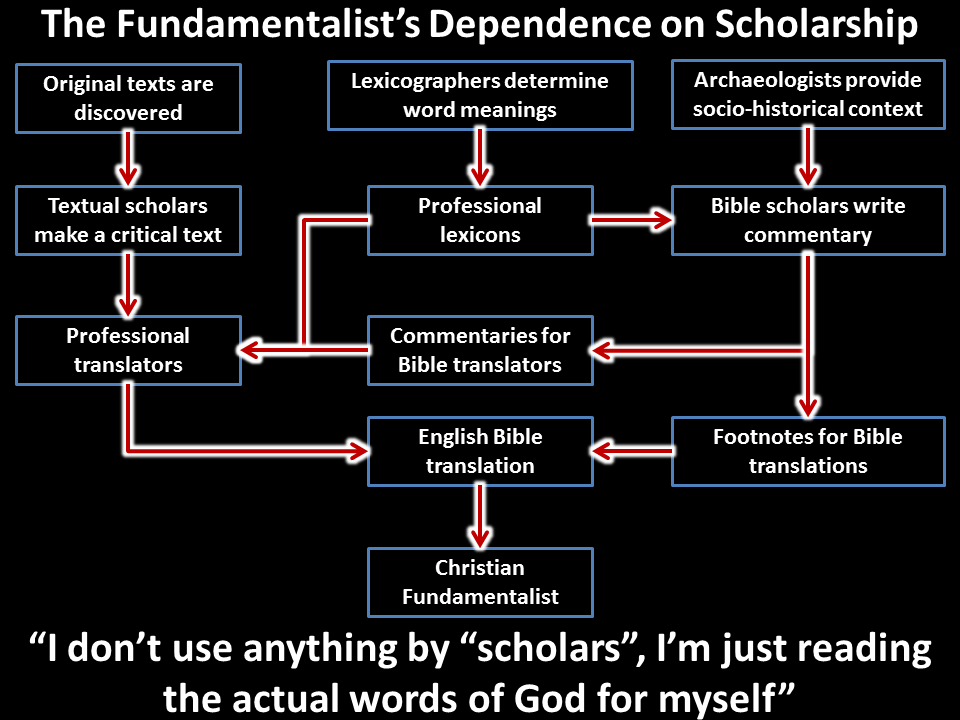
Reading biblical text within its historical, social and literary contexts places it where it was always intended to be, thus bestowing upon it the highest possible honor. Some, who are unacquainted with this as proper treatment of text, choose rather to label it “scriptural elitism” and thereby uncharitably disregard the valiant efforts of multitudes of scholars from varieties of disciplines, stretching years into the past, whose life mission has been to better understand this priceless treasure.

John Walton summarized it well, 

"God is not superficial, and we should expect that knowledge of him and his Word would be mined rather than simply absorbed. This means that all of us will be dependent on others with particular skills to help us succeed in the enterprise of interpretation. This is not elitism; it is the interdependence of the people of God as they work together in community to serve one another with the gifts they have." Walton, The Lost World of Genesis One; Ancient Cosmology and the Origins Debate (IVP Acedemic, 2009), 171.

I have posted this quotation in the past, but James McGrath was also spot on when he said,

"Does someone claim that they simply read the Bible and have no need for scholars, when they are reading the Bible in translation, or reading critical editions of the texts in the original languages, or using manuscripts copied by scribes, having learned Hebrew and Greek with the help of textbooks and lexicons? That person is a liar, plain and simple."

This is not to say that there haven't been or are not irresponsible conclusions or distortions (whether intentional or not is not for me to say). Brent Sandy perhaps has a balanced perspective,

"Evangelicals who support the concept of inerrancy have undoubtedly been guilty at times of claiming too much for the term and claiming that we know too much (e.g., about what historical accuracy demanded and about what authorship entailed). But critical scholarship is not innocent of similar unwarranted certainty and belief in 'assured results' as they apply the surgical knife to biblical books with such self-confidence." Walton and Sandy, The Lost World of Scripture; Ancient Literary Culture and Biblical Authority (IVP Academic, 2013), 276. 

Hold Fast to What is Good

“Only a virtuous people are capable of freedom. As nations become corrupt and vicious, they have more need of masters.” – Benjamin Franklin.

Throughout the years and during changing times, this country has endured. While many debate what the significant force behind it may have been, we do know that it has stood as a legacy of ingenuity and a testament to the productivity that can come from a society structured such as ours.

The people of this land are experiencing change in cultural, social, religious and economical trends to one extent or another. Whether it is a business owner, a senior citizen, a college graduate or the single mother trying to maintain a family while coping with inflation, all are being touched by an emerging new world that has quickly become threatening. Many find that the world in which they were raised, included attributes such as values, morality, courtesy, patriotism and more. They have also found that in many instances, these attributes have all but disappeared. Still, in other ways, the more mature citizens in our culture find technological marvels which in their childhood would have seemed a part of science fiction. The shifts in our small "sands of time" have uncovered a world that is new, yet very old.

Despite all the changes we are experiencing in technology, the economy, big business and myriads more that could be enumerated, one thing remains unchanged; it is still people that matter most. Whether it is accepted or exercised on a practical level or not, the truth of the matter persists. In a time when so much emphasis is placed on the political polls, parties and elected politicians, the largest factor, and that which really makes the difference, is our relationship with the people who are in our day-to-day lives. The revolution that elevated this country to its supreme stature would have never been accomplished without the unity of its countrymen. The strength exhibited, was in the ability to act harmoniously with each, stand together and in so doing demonstrate the importance of human relationships during perilous times.

The results of the past year and a half have revealed some of the best in people, but unfortunately in some it has revealed the worst this country has had to offer. Attitudes of not only intolerance, but flagrant hatred has run rampant in varying groups against those who are not "like" them.   

It disheartens me to no end seeing those who even profess citizenship to a superior kingdom verbally assault one another regarding an inferior one over which they have no control anyhow. Must we defend a political figure whom we have never met to the detriment of real human interaction? We live at a time where media, in its ever widening forms, has garnered an enormous influence over public opinion and action. As such, it is of crucial consequence that the community of God step forward as a voice of reason, restoration and remediation rather than retaliation. 

Regardless of your specific religious or spiritual convictions, there are universal laws that have been written on the hearts of mankind. They are laws which dictate certain guidelines in the ethical treatment of others, in spite of feelings toward them or their beliefs, religion, political persuasions, race or ethnicity. Regardless of public practice and proclamations of hate, loving our neighbor and treating them the way we desire to be treated is not out of style. Touching lives by reaching out to the hurting, or intervening in someone's distressed universe by bringing a little heaven into their hell should not be considered unfashionable!

In our current day of a seemingly advanced society, we find that we are more individualistic than ever. Communication has been taken to unprecedented levels and is available in more diverse ways than ever before in the history of mankind. Unfortunately, as a result, we do not have better relationships as one would hope. Instead, social severance in multiple forms rather than traditional person-to-person exchange has being sprung on humanity. Will the repercussions of a disjointed citizenry in current economic trends take us along the same route as our predecessors in our ability to band together for the justice and salvation of our families or instead result in our undoing?

It must be understood that reform does not start in Washington with political saviors, it starts on Main Street, in our homes. What are we teaching our children? Are we instilling  fear into them and a fundamental intolerance for those who may not see the world the same way we/they do? Who are we allowing to radically shape their ideals? What will happen if more difficult times once again set-in in this nation? Will we continue to allow the stake of diversity to be driven into and among our people? Diversity is only a downfall if we let it be; it can equally be a strength. Helping and supporting each other is vital, a truth with which our forefathers, at the inception of this country were well acquainted.

In an email sent to the faculty and student body, President Jeff Carter of Bethany Theological Seminary had a few words of wisdom and encouragement regarding this current political season which I thought were worth noting:

"Every election is historic. For months we have debated and discussed the candidates' views and abilities as well as shared our hopes for our future. It is clear through this election that there are a variety of hopes and expectations from a seemingly diverse electorate. Although we might hope and/or wonder what the future may hold as we enter this transition of power, we do know of our call and God’s presence . . . Romans 12 . . . is a fitting reminder as to how we might continue together in seeking our common good.


Let love be genuine; hate what is evil; hold fast to what is good; love one another with mutual affection; outdo one another in showing honor. Do not lag in zeal, be ardent in spirit, serve the Lord. Romans 12:9-11."   


We have seen devastation and disunity in many areas of this country as well as around the globe. Some of it is publicized, some goes all but unnoticed. No one knows for sure what lies ahead, but amidst the current adversity, and that which may once again present itself, would you rather have your neighbors and countrymen as enemies or allies, as friends or foes? There is much change occurring which will inevitably continue. We should then ask ourselves the question, where will our current course of attitude and influence lead us? How well do we know our neighbors (not necessarily those who live beside you)? How are our relationships?

There are many distractions in our culture that seek to steal our time, attention and devotion. For those who claim to be members of the household of the God of Israel, it is reaffirming and hopeful to remember that our citizenship is part of a different kingdom. Jesus is Lord, hence Caesar is not. While we may rarely endorse the actions of today's “Caesar,” God has not given his people the responsibility to dethrone him, revolt against him nor treat those who have given him their unwavering allegiance with disrespect or in inhumane ways. 

President Carter concluded his email with these words,  

"Everyone has a place at the table. May we be the unity we seek and may our witness speak of God’s grace, love, and compassion … for all and in all times."

There is hope. There is good everywhere if we choose to see it, and it’s worth persistently pursuing.

Son of God Apologetics: Deity, Divinity and Blessed Ambiguity.

The New Testament's use of "son of god" has been the source of confusion, confrontation and conflict in times past and present. With the ever narrowing fields of scholarship regarding these subjects, it has become evident that earlier (mostly) dogma driven views that captivated the Church were incorrect.

What is overtly disturbing however, are the Christian apologists and zealous pew occupying Christians who still maintain the false notion that "son of god" is somehow an ontological category. Never-mind the ambiguities of what god, deity or divinity may mean to them, somehow the title - with its root in the Hebraic worldview from which the NT writers hail - still finds a way to "clearly communicate" to some that Jesus, as the Son of God, just is the God of Israel. This is not the story of the Synoptics, nor is it the Jesus they describe. 

The writer of the book of Luke in his genealogy of Jesus stated at the end of chapter 3 that Adam was the "son of god." What does that mean? What is this piece that Christianity has been neglecting? What does it mean to be a "son of god"? Apparently unbeknownst to some Christians is the fact that the title "son of god" is not exclusive to Jesus. Adam was the first human "son of God," so what is special about Jesus' connection to this title?

There has been great progress in recent years on this subject, and scholars continue to investigate as more evidence comes to light. It is a wide, intriguing and important field of study, but suffice it to say, son of god is not tantamount nor synonymous to the later innovative title "God the Son."

Son of god does not point to a metaphysical or numerical identity with God, but rather a relational one. 

Far too many Christians are under the mistaken notion that the title son of god implies some strange metaphysical existence. This has large traces of Gnosticism present. This conclusion is unwarranted when deriving information from the Gospels. It severely distorts the context, reads external, anachronistic events into it and abolishes the meaning of the original authors/hearers by introducing categories alien to their worldview. Son of god was not a title reserved for Jesus alone. One need only read the rest of the Bible to know this is not the case. The real kicker is that this fact is not reliant on views of high or low Christology, liberal, conservative, Trinitarian scholars or not, but rather on its context. It was not firstly a theological title. 

"We must stress that in the first century the regular Jewish meaning of this title [Son of God] had nothing to do with an incipient trinitarianism; it referred to the king as Israel’s representative." N.T. Wright, Jesus and the Victory of God, 485-86.


"The psalms speak of the king as son of God, and say he is begotten, not adopted. This language is mythical and metaphorical rather than philosophical. It does not employ ontological categories. But it should not be dismissed as ‘mere’ metaphor. It was a powerful way of shaping perceptions about the special relationship between the king and his god." Collins, Son of God, 204.

"But when the One who set me apart from birth and called me by his grace was pleased to reveal his Son in me so that I might preach him among the Gentiles, I did not immediately thereafter consult with anyone . . . " Gal 1:15-16

"ἀποκαλύψαι τὸν υἱὸν αὐτοῦ ἐν ἐμοί, 'to reveal his Son in me.' The language of v 16a raises a number of difficult questions and has caused a great deal of speculation. The Christological title 'Son of God,' 'his [God’s] Son,' or simply 'the Son' appears in Paul’s writings fifteen times ('Son of God': Rom 1:4; 2 Cor 1:19; Gal 2:20; “his Son” or “the Son”: Rom 1:3, 9; 5:10; 8:3, 29, 32; 1 Cor 1:9; 15:28; Gal 1:16; 4:4, 6; 1 Thess 1:10), which warrants Werner Kramer’s comment: 'In comparison with the passages in which the titles Christ Jesus or Lord occur, this is an infinitesimally small figure' (Christ, Lord, Son of God, 183). Furthermore, in that all of these fifteen instances are in Paul’s earlier letters (i.e., the Hauptbriefe and 1 Thessalonians, but none in the Prison or Pastoral Epistles), it can be argued that “Son of God” as a Christological title was derived by Paul from his Jewish Christian heritage (cf. ibid., 185). During the first half of the twentieth century, of course, scholars influenced by G. H. Dalman and W. Bousset tended to separate “Son of God” from its Jewish roots and to see it as a Hellenistic epiphany accretion. Of late, however, the title is being increasingly related to Jewish messianology (cf. 4QFlor on 2 Sam 7:14; 4 Ezra 7:28–29; 13:32, 37, 52; 14:9) and seen as a feature of early Jewish Christian Christology (cf. my The Christology of Early Jewish Christianity, 93–99). In Galatians the title “Son of God” or “his Son” appears elsewhere at 2:20 and 4:4, 6, with each of these occurrences situated in a confessional or quasi-confessional portion. . . . So it may be claimed that “Son of God” is a title carried over from both Paul’s Jewish and his Christian past, and that he uses it here as a central Christological ascription because (1) it was ingrained in his thinking as a Jewish Christian, and (2) it was part of the language of his opponents, who were also Jewish Christians." R. N. Longenecker, vol. 41, Word Biblical Commentary : Galatians, Word Biblical Commentary,  (Dallas: Word, Incorporated, 2002), 30.


"'Son of God' is perhaps the single most familiar christological title. Indeed, it is so familiar that many people think it is the 'real' one, with the others perhaps being metaphorical. Tracing its development illuminate the meaning of the phrase. It has a history in the Hebrew Bible and the Jewish tradition. 'Son of God' could refer to Israel. In the story of the Exodus, Moses is told to say to Pharaoh: 'Thus says the Lord: Israel is my firstborn son. . . . Let my son go that he may worship you.' Hosea says in the name of God, “When Israel was a child, I loved him, and out of Egypt I called my son.' 'Son of God' could also refer to the king of Israel. Speaking in the name of God, Nathan the prophet said about the king, 'I will be a father to him, and he shall be a son to me.' In a psalm probably used in a coronation liturgy in ancient Israel, the divine voice addresses the king and says, 'You are my son; today I have begotten you.' In the book of Job, angels or perhaps members of the divine council are referred to as sons of God: 'One day the sons of God came to present themselves before the Lord, and Satan also was among them.' One further use of the metaphor in the Jewish tradition is also worth noting. Near the time of Jesus, other Jewish Spirit persons were sometimes called 'son of God.' What do Israel, the king, angels, and Jewish religious ecstatics have in common? All have a close relationship with God. That is, “Son of God” is a relational metaphor, pointing to an intimate relationship with God, like that of beloved child to parent.” N.T. Wright, The Meaning of Jesus, pg. 151.

Dr. Colin Brown, who was senior Professor of Systematic Theology at Fuller Theological seminary (also lexicographer of NIDNTT) wrote, 

“Indeed, one may well ask whether the term ‘Son of God’ is in and of itself a divine title at all. Certainly there are many instances in biblical language where it is definitely not a designation of deity. Adam is called "the son of God in Luke's genealogy of Jesus (Luke 3: 38). Hosea 11:1 (which is cited in Matt 2: 15) alludes to the nation of Israel as God's son. In Wisdom 2: 18 the righteous man is called God's son. Nathan's prophecy to David contains God's promise to David's successor: ‘I will be his father, and he shall be my son’ (2 Sam 714; cf. Psalm 89: 26-27). This passage also occurs in a collection of testimonies at Qumran (4QFlor IOf.), indicating that the messianic significance of this prophecy was a matter of continuing speculation in first century Judaism. In Psalm 2: 7 the anointed king is addressed at his installation: ‘You are my son, today I have begotten you’ (cited in Acts 13: 33; Heb. 1: 5; 5: 5; cf. 2 Pet 1: 17). This passage is the source of the identification of Jesus with God's Son by the Bat Qol (voice from heaven) after his baptism (Mark 1: 11; Matt 3:17; Luke 3: 22; cf. John 1: 34). The voice also identifies Jesus with the chosen servant in whom God delights (Isa. 42: 1; cf. also Matt 12: 18-21). In the light of these passages in their context, the title ‘Son of God’ is not in itself a designation of personal deity or an expression of metaphysical distinctions within the Godhead. Indeed, to be a ‘Son of God’ one has to be a being who is not God! It is a designation for a creature indicating a special relationship with God. In particular, it denotes God's representative, God's vice-regent. It is a designation of kingship, identifying the king as God's son… it seems to me that a complex structure has been erected upon the systematic misunderstanding of biblical language of sonship. What seems to have happened with a number of issues that we have been considering-various ways of understanding person- and Son-language, ‘eternal generation,’ kenosis, and indeed the social Trinitarian approach-is the evolution of a series interrelated protective lines of defence designed to safeguard central beliefs about God and Christ. In the course time these protective lines have come to be felt to be a necessary part of orthodoxy. Although justification was sought for them in biblical language, they moved progressively away from the testimony of Scripture.” Colin Brown, “Trinity and Incarnation: In Search of Contemporary Orthodoxy,” Ex Auditu, vol. 7 (1991), 88, 92.

Because I am in a small and conservative community, when discoursing on this issue (son of god), it often ends with accusations toward me as though I inhabit some "marooned islander" position. If the average Christian is convinced by apologists, pastors or other influential Church laity that scholarship is useless and liberal, seeking to subvert true Christianity, how can this topic even be engaged on those terms? Some Christians are convinced that the Bible was designed as a "living document" which has only to be read by them, under the illumination of the spirit and exposition of their pastor, to say everything it ever needs to say or was meant to say. What's the point of a discussion where logic, reason and authentic scholarship are forsaken in favor of tradition and dogma? 

This is the difficulty of Christians who take up the mantle of an apologist with little knowledge on a subject that has been studied by countless dedicated, qualified scholars who (have) document(ed) and discuss(ed) to gain a more complete understanding of what the intended phrase or passage meant/means. What's even worse is that many of these well-intending apologists have little desire to find out. These amateur apologists seek-out those - like ancient heresy hunters - who take a position different than what they identify as "orthodox" (although that almost always works itself out idiosyncratically) and attempt to bash them over the head with the hammer of orthodox hegemony.


Unfortunately, so many have been conditioned to think that the tradition they inhabit is the “right” and “true” perspective, the set of transcendent interpretations that can prove all others wrong, therefore there is no reason to ask questions or take other options into consideration.

Harnack on the Human Jesus of the Synoptics and the Apocalypse

"That book [Revelation] . . . with its glowing symbolism, and strong colouring of images and descriptions, expressly ascribes the divine attributes to the glorified Jesus. He is, like God, the first and the last, the Alpha and the Omega. He bears upon his forehead a new name, which is none other than the ineffable name of Jehovah. He is called the Word of God. 

But here let us not deceive ourselves. The author of the Apocalypse only means by this that Jesus, victorious over the world and sin, has gained all these titles. They have been conferred upon him from without, as a reward of his victory. He is not therefore the less a created being. 

It is from a certain moment, it is after his death upon the cross, that the divine perfections have been adjudged to him. The name of God, inscribed upon his forehead, will one day be written upon the foreheads of the elect.- His name, 'Word of God,' signifies that he is the revealer of the truth, the announcer of the divine judgments; and it is very far from bearing the metaphysical signification of the 'Logos,' or the 'Word' in the sense of Philo. . . . 

If we return to the three first Gospels, not asking as before what witness Jesus gave to himself, but in order to learn what his historians thought of him, we shall find there the feeling still very strong that Jesus positively belongs to humanity; and if of evangelical documents we only possessed the Gospel of Mark and the discourses of the Apostles in the Acts, the whole Christology of the New Testament would be reduced to this: that Jesus of Nazareth was' a prophet mighty in deeds and in words, made by God Christ and Lord.' 

There would even be no reason to question the favourite dogma of the old Ebionites, the orthodox of the primitive times of whom we shall have to speak again, according to whose opinion Jesus had himself no consciousness of his vocation until the period of his baptism in the Jordan, when the heavens were opened and the Holy Spirit descended upon him.

'A holy man, fully inspired by the divine spirit,' would therefore have been the prescribed Christological formula. With regard to the Gospels of Matthew and Luke, the two genealogies which these books respectively set forth plainly and expressly prove the strength of the primitive belief that Jesus was really man by his nature and birth."

Adolf Harnack, History of the Dogma of the Deity of Jesus Christ, (London: 1878), 31-33.

A New Old Orthodoxy

"When the Jew said something was ‘predestined,’ he thought of it as already ‘existing’ in a higher sphere of life. The world’s history is thus predestined because it is already, in a sense, preexisting and consequently fixed. This typically Jewish conception of predestination may be distinguished from the Greek idea of preexistence by the predominance of the thought of ‘preexistence’ in the Divine purpose."

E.C. Dewick, Primitive Christian Eschatology, The Hulsean Prize Essay for 1908 (Cambridge University Press, 1912), 253f.

God is not a Hebrew, but has chosen to communicate to the world via the Jewish people (e.g. prophets and his son). Merely because something or other is Jewish does not mean it is inherently better or closer in proximity to God's heart. They were the conduit through whom God chose to tell his saving story. But to understand the story as it was originally intended, simply reading the Jewish message that was placed into their world and cultural context with any paradigm has often severely distorted that message. When the writers used words and definition, it cannot be supposed that what they meant means the same thing in a twenty-first century context. Language changes, cultures shift and what Paul really meant can get glossed by later explanations that would not have been indigenous to his historical context and theological edifice. With the rise of historical analysis, the new perspectives on Paul were inevitable and much needed. 

Being or thinking like a Greek (westerner) is not wrong. But to take the Greek worldview, definition or ways of thinking and impose it on what radically different Jewish writers were communicating is to do violence to the original message. For example, we cannot read Paul and assume that he was a Trinitarian. To go into the text with that anachronistic presumption and interpret his words through a fourth and fifth century filter is to miss what he actually was saying. We don't have to assume that Paul's idea of kenosis matches that of many modern interpreter's opinions regarding the Carmen Christi.

The Second Temple Jewish view of preexistence is virtually absent in our world of Christian congregants. When a post-modern interpreter thinks of preexistence, it is generally not with the opinion that God's foreknown purpose was thought to have preexisted the reality. Greeks (westerners) tend toward thinking in terms of abstract metaphysics and ontological categories. If Jesus preexisted (whatever that actually means), he must therefore of necessity have existed in some other form (i.e. logos theology) before entering the womb of Mary. 

When biblical titles like Son of God are redefined by using later definition, it is not difficult to see how the shift in this thinking occurred. With neo-Platonism governing the overall approach to biblical hermeneutics, and the spark of creativity in the air, the Patristics - and eventually the councils - replaced the NT (based on OT use) Son of God with a philosophically contrived God the Son. Thus, a new "orthodoxy" was born. It threatened - under the pain of excommunication and eternal damnation - that its definitions and dogmas must be unquestioningly accepted for salvation (Athanasian Creed). Jesus was subsequently torn out of his Hebraic world and placed into another. Geza Vermes put it well in The Authentic Gospel of Jesus, 

“Compared to the dynamic religion of Jesus, fully evolved Christianity seems to belong to another world.”

The use of Jewish foreknowledge and pre-ordination was ripped from its own context and sculpted around a twisted philosophical template of John's Gospel. 

"This man [Jesus], delivered over by the predetermined plan and foreknowledge of God" Acts 2:23 (c.f. 1 Peter 1:2).

 God already had it predetermined; the plan was there, but did not make its appearance upon the stage of humanity until it literally came into existence. It did, or was said to exist in a different way before its revelation.

The New Schaff-Herzog Encyclopedia of Religious Knowledge, “Revelation” says it well,

"God avails Himself of human thought and speech to make Himself known and His speech intelligible." 

He does not reveal himself in illogical or intangible ways. However, it must be qualified that just because traditional Christianity has based much of its belief on tradition and has muddied the waters, does not mean it was difficult and challenging to the original hearers. The NT and OT are thoroughly Jewish collections of writing. Its writers were Jewish, and most of its audience was Jewish (obviously there are intended Gentile recipients within the Pauline corpus). Post-modern readership has approached their interpretive reading with a Greek (western) perspective, this cannot be helped. It has been handed down from the church and early post-biblical creeds which neglected the context and cultural significance of utmost importance, that Jesus was a Jew who thought and taught in Rabbinical Jewish ways with Jewish interpretations, hermeneutics and categories. It is a person of ignorance who claims that they can close their eyes and ears to this reality. Our savior was a Jew and came into existence by birth, not, as Irenaeus has it: 

"This Christ passed through Mary just as water flows through a tube." 

This is something radically different from Matthew and Luke’s description that Jesus was brought into existence inside Mary, by the power of God. Greg Deuble in his book, They Never Told Me This in Church noted that 

"Protestants who deplore tradition-bound Roman Catholics because they revere Church tradition above the Scriptures fail to see that in some areas they are just as bound to tradition, i.e. to long held interpretations of Scriptures."

J. R. D. Kirk I believe summarized it well, 

“We sometimes see divinity where the text doesn’t require it because that is the theology we bring with us to the text.”

Intolerance

Here is a quote from Mahatma Gandhi. In a simple and profound way, he pinpoints yet another underlying attitude prevalent throughout some forms of Christendom today: 

"Intolerance betrays want of faith in one's cause." 

Unfortunately, the downward trend is anything goes, but it never should become a point of hatred or ostracism. Of all people, Christians should be the ones who can deal with situations and handle those who do not believe quite like them. So what has happened? Have Christians lost faith in their own cause and leader, having traded it for a bunch of worthless doctrines and traditions? It's repugnant, that's what it is.

Why the Rapture isn't Biblical

Here is a great piece on the biblical absence of the modern rapture doctrine enthralling so many today by Kurt Willems.

"Christ will return to resurrect, to purge, to heal, and to establish the eternal kingdom of God on this earth. Heaven and earth will unite like a bride and husband – for all eternity. That’s it. The Bible teaches that when Christ comes back, it will be Good News!"

Hope

"Plato has taught us to be suspicious of claims of hope. In the Greek world, hope is merely the projection of desired ends in order that I may survive the current trauma. Hope is not real. It is merely psychologically necessary, a convenient crutch to support my battered psyche until I can return to a more rational state of mind. So when the psalmist declares that I can hope in God’s word, my good Greek training whispers, 'Well, if you need to believe this, go ahead, but you know that things don’t turn out that way in the end, do they? You don’t really think God’s goodness will show up, do you? After all, how could the world be in such a mess if what God says is really true?' Ah, the wonders of paradigmatic assumptions. If I listen to all that good training, I will stay in the dark, brooding over the lie of fate." 

Inquiry for Truth

"There are only two kinds of people in the end: those who say to God, 'Thy will be done,' and those to whom God says, in the end, 'Thy will be done.'"  
In one of his classic works, The Great Divorce, C.S. Lewis wrote of two men engaged in a theological discussion where this statement was made:

"Once you were a child. Once you knew what inquiry was for.
There was a time when you asked questions because you wanted answers, and were glad when you had found them. Become that child again: even now. . . . Thirst was made for water; inquiry for truth. What you now call the free play of inquiry has neither more nor less to do with the ends for which intelligence was given you than masturbation has to do with marriage."1

I don't adhere to much of Lewis's theology, but his point is well made and the story well told. When love of being right eclipses a love for truth, great tragedy can occur resulting in cognitive corruption. It's not wrong to be right, but right as its own end seems wrong. Because, ultimately it's not about us. We are stewards, even of truth and intelligence.

1. C.S. Lewis, The Complete C.S. Lewis Signature Classics, The Great Divorce (HarperOne, 2002), 487.

"In the Right"

"It is ecclesiology (membership in God’s people) as the advance sign of soteriology (being saved on the last day). It is 'justification' in the present, anticipating the verdict of the future. God will declare on the last day that certain people are 'in the right,' by raising them from the dead; and that verdict has been brought forward into the present, visibly and community-formingly."

N.T. Wright, Justification: God's Plan & Paul's Vision, 146-7

Compassion

Feeling compassion for those who despise us is not natural, but embracing that which is not our nature is to welcome something much greater than ourselves and participate in a work that only God can do. 

~ S. Edwin Rufener

Covenantal Soteriology

“It should be noted most emphatically that, although ‘resurrection’ is naturally something that individuals can hope for, for themselves or for those they love, the belief...is always focused on a general resurrection at the end of the present age and the start of the age to come. This will be a raising to life in which all Israel...will share. Seen from one angle, it will constitute Israel’s salvation: after the long years of oppression and desolation, she will be rescued at last. From another angle, it will constitute Israel’s vindication (or ‘justification’): having claimed throughout her history to be the people of the creator god, the resurrection will at last make the claim good. Creational and covenantal monotheism, and the eschatology to which they give birth, thus form a context within which what is sometimes called ‘Jewish soteriology’, the beliefs that Jews held about salvation, may be situated accurately and fruitfully...The word ‘salvation’ would denote, to a first-century Jew, the hope...seen particularly in terms of Israel’s rescue, by her god, from pagan oppression. This would be the gift of Israel’s god to his whole people, all at once. Individual Jews would find their own ‘salvation’ through their membership within Israel, that is, within the covenant; covenant membership in the present was the guarantee (more or less) of ‘salvation’ in the future.”

N.T. Wright, The New Testament and the People of God: Christian Origins and the Question of God, (Fortress Press, 1992), 334.

Salvation Through Redemption

"God’s work as Creator (whether recognized or not) actually and always precedes God’s work as Redeemer. Moreover, God’s redemptive work does not put an end to God’s creative work; God’s work as Creator continues through and beyond such historical redemptive actions. The language of ‘salvation’ has reference to both the effects of redemptive actions as well as to the effects of distinguishable acts of continuing creation (e.g., healing; gifts of food and water in the wilderness). Redemption does not do away with the life-giving effects of the Creator but stands in the service of them. The objective of God’s work in redemption is to free people to be what they were created to be, the effect of which is named salvation."

Terence E. Fretheim, God and World in the Old Testament: A Relational Theology of Creation (Abingdon Press, 2005), 10.

It’s Okay to Change Your Mind

I was doing my daily blog reading when I came to Dr. James McGrath's post of a few statements from John Pavlovitz. It is worth your read. He has another that is also worth the time. For those readers who struggle from the degenerative disease of TLDR, here are some statements that give a brief synopsis:


"The first time I questioned my theology, I mean really questioned it I was flat-out terrified. Not terrified of God, per se (because I figured God being God an all, was more than big enough to handle my assorted queries), but the people of God.


My orthodoxy was my membership card in the Club, affording me the perks and privileges that came along with it. As long as my theology didn’t waver greatly from the party line, I remained securely cradled in the bosom of the Body. Stray too far from the narrow path though, and things could get really ugly, really quickly.

It’s okay to question things you used to be sure of, to come to different theological conclusions than those you had previously, or to find yourself in small or large ways challenging orthodoxy. These things are not sins.

Doubts and questions, and changes of heart and mind on issues of faith (even fundamental ones) are not character defects or moral flaws. On the contrary, often they are the bravest and most God-honoring places to reside because they are the most authentic. The bottom line is, that’s really the only thing you’re responsible for.

Life should alter us. It should renovate our souls and adjust our lenses. Time and experience, and the things we read and see and discover should change us or we’re probably more committed to the appearance of consistency than to real growth. I don’t have the understanding of myself and of God and the world that I had twenty years ago, I am not too proud to suspect the same won’t be true two decades from today.

God isn’t as insecure or easily angered as those we share space with or worship beside. God is pleased with the depth of our personal search and the integrity of our road, and understands our conclusions better than anyone.

Imagine if we created church communities where theological deviation and spiritual doubt weren’t red flags or prayer concerns or deal breakers; where everyone could speak the truest true without fear of being pushed to the margins or excluded outright. How different might our journeys be? How much richer might our communities become?"

Are Christians Like Their Christ?

Christians who claim to be followers of Jesus are frequently heard belting phrases like 

"I want to be like Jesus more than anything else." 

Unfortunately, the track record for Christendom as a whole speaks for itself and is found to be far from exemplifying this. While many Christians pontificate their genuineness and faith, the real declaration being communicated is seen and heard when others are treated with contempt, spite and ostracism due to ethnicity, religion, doctrine, politics or sexuality etc.  

Those who bear the title "Christian" on their lapels, yet flagrantly act in this manner toward fellow humanity reveal themselves to be liars beyond the pale. It is they who drag the name of "Christ" through the mud and cause the mention of "Christian" to be abhorred among the nations. Perhaps Gandhi nailed it perfectly when remarking, 

"I like your Christ, I do not like your Christians. Your Christians are so unlike your Christ."