Pages

Showing posts with label review. Show all posts

Review of Aviya Kushner's "The Grammar of God"

"A Hebrew Speaker's Response to the Bible in English." xxxii.

It is important to note that most of the reading I do is in biblical academia, so my judgment of this book is not based on the same criterion. The reason I mention it is because I read some other reviews of this book in which they were quite unfair, attempting to judge it as a work of biblical or linguistic scholarship. That is not what this book is, nor does the author claim this (see Introduction xxxii); reading the book you will find that to not be the point.

This book was recommended to me and now I am so glad it was; what a fantastic work! I appreciated her insights and background of having been raised in a Jewish home where speaking and reading Hebrew was at the center of the family life.

Again, while it is not a scholarly work, The Grammar of God does contain many trails for the chasing, if the reader possesses the notion. This book will thrill both the grammarian and lover of the Bible, as it is written beautifully and is full of heart. She investigates the histories of English translational difficulties and tells the story of her own personal journey with the realization that "some of the most politically charged issues of our time are rooted in biblical translation." xxiii

Here is one of my favorite quotes from the book:
"It [the Bible] is a story that is part of every man and woman who has ever felt the need to claw against destiny, to insist on a different future than what God appears to be offering. And sometimes, in the Bible, what man wants so passionately is unacceptable to God. What man wants is so destructive that is is a threat to the earth, to the creatures that live on it, to other humans." 114.

Also, the book is available in multiple formats and editions, including audiobook.

Hans Küng on John's Christology and the Shema

In a little reading of Hans Küng's Judaism; Between Yesterday and Tomorrow, I came across these statements:

“In this Gospel [John] ... there cannot yet be any question of a ‘metahistorical drama of Christ’, the objection often put forward by the Jewish side. Precisely in this late, fourth Gospel, we still have statements like: ‘And this is eternal life, that they may know the only true God, and Jesus Christ whom you have sent.’ Or, ‘I am ascending to my Father and your Father, to my God and your God. Here there is a clear distinction between God and Jesus Christ.

No, this Gospel too does not contain any speculative metaphysical Christology – torn from its Jewish roots – but rather a christology of sending and revelation associated with the world of Jewish Christianity. However, its statement about pre-existence, understood in an unmythological way, takes on heightened significance: ‘John does not investigate the metaphysical nature and being of the pre-existent Christ; he is not concerned about the insight that before the incarnation there were two pre-existent divine persons who were bound together in the one divine nature. This way of conceiving of things is alien to John. So too is the conception of a 'begetting within the Godhead.' 'I and the Father are one.' This statement has nothing to do with any dogmatic-speculative statements about the relationship of the natures within the Godhead.' So what was John's positive concern? What stands in the foreground is the confession that the man Jesus of Nazareth is the Logos of God in person. And he is the Logos as a mortal man; but he is the Logos only for those who are prepared to believe, trusting God's word in his word, God's actions in his praxis, God's history in his career, and God's compassion in his cross’ …


If the Jewish tradition has always held unshakeably to a basic truth of Jewish faith, then it is the ‘Shema Israel’, Hear, O Israel, Yahweh is our God, Yahweh alone! … This confession of the unity and uniqueness of God meant the strict repudiation not only of any dualism but also of any trinitarianism.”

Hans Küng, Judaism; Between Yesterday and Tomorrow (Continuum, 1991), 382-3.

Resources for Educational Purposes

I have benefited greatly in the past from the generosity of various professors and institutions of higher education, who have made resources freely available to those who may otherwise never have the opportunity.

With the rise of the internet has come a tool of incredible power to share and learn, but with it comes the danger of widely disseminating falsehood as well. There are endless circular quotations and content that is taken as legitimate but is often not the case. Fake news, propaganda, falsified information and amateurs purporting to be experts can find unsuspecting audiences, unaware of what they are consuming. As individuals, it is our responsibility to be prudent with the information we take as "truth" and "fact." This is where reputation can play a large factor; find it in a book.

One particular tool that has been useful is iTunes University. It is like podcasts or video-casts provided by Colleges, Universities and Seminaries. There is an incredible amount of classes able to be taken on your own and at no expense. Many even contain the handouts and syllabi to provide the full experience. I have utilized this resource on many occasions including (but not limited to) classes from Yale, AMBS and Fuller Theological Seminary. The disadvantage is that it is limited to Apple users, but it has been worth it to me to have an Apple device for this reason alone.

Another option is "The Great Courses." Some of the most well-known teachers from respected institutions have lectures covering any range of topics and areas of study. These can be downloaded, or (my personal favorite) found in your local library system. If you have not been a regular patron of your local library, you are missing out on an incredible resource with dedicated people possessing an extraordinary knowledge for aiding you in your quest. As Matt Damon's character Will said in Good Will Hunting,

"You wasted $150,000 on an education you coulda got for $1.50 in late fees at the public library."
  
There are other options as well, such as reputable professors making their classes available on a site like YouTube. One in particular I will note is Craig Keener. He has magnanimously made various of his lecture series available to all, such as Romans and Matthew. Dr. John Walton has similar lectures: Job.


There are lectures given in a series, such as those the Lanier Theological Library in Houston has done at regular intervals. They host various scholars giving talks on a variety of topics. Their videos are archived on Vimeo

For someone who may be interested in learning a foreign language, I highly recommend Simon and Schustler's Pimsleur (and Little Pim for Children). Again, these are resources that will be readily available at most local libraries. 

A Free Gift: Romans

You are probably supposing that the title of the post relates to Paul's theological motif in Romans. Well, it does, but not in the way you might expect. Here's the deal, every month, Faithlife Corp. (who has brought us great tools such as Logos Bible Software) generously gives away a free resource (no strings attached, really), such as a digital book or commentary. 

This month (October, 2016) is a phenomenal prize, Craig Keener's Romans commentary. If you aren't familiar with this Asbury distinguished scholar and are a NT biblical studies and research person, you have been missing out. His list of works are extensive. I have used his written and media content and greatly benefited. He is well researched and articulate. Best of all, this is free. Who doesn't like a free gift? Click, and it shall be given.

Life, Bible, Demons and Spiritual Warfare Links

Richard Beck has been posting a series on Idolatry, Oppression and the Development of Demons. He has just posted part six. To read from the beginning (recommended), here is one, two, three, four and five

He has made some great observations regarding the way scriptural evidence sends us, rather than as tradition has often made us assume. The posts are short and informative, especially if it is an area you haven't thought about much. 


Also, Kurt Willems (from the Paulcast) interviewed Greg Boyd on the subject of "Spiritual Warfare." Greg talks about how he dealt academically with the evidence presented, especially when unexpectedly coming face to face with a real spiritual force.


Kurt also blogs at Patheos.

Buried Deep Blog on Gnosticism

Here is a great introduction to Gnosticism. My friend Kegan Chandler, over at his blog Buried Deep, has a golden pen, so to speak. It would be worth your time to check-out some of his recent posts. Also, tomorrow (August 24, 2016) is the launch of his new book "The God of Jesus in Light of Christian Dogma: The Recovery of New Testament Theology."


"First, what do we mean by “Gnosticism”? Today the term describes a fluid category of spiritual traditions developing in the mid to late first century CE which emphasized the acquisition of gnosis, or secret knowledge of the divine, in order to achieve salvation. While the movement was not exclusive to Christianity, it is best known by its manifestation in various Christian groups deemed “heretical” by the great proto-orthodox polemicists of the second and third centuries. . . . Gnosis-inclined “proto-orthodox” Christians, like Clement of Alexandria (d. 215 CE) and Origen (d. 254 CE), also employed a hermeneutic which assumed a spiritual meaning behind the text reflective of real happenings in a real spiritual world. This affinity may provide a clue to a deeper relationship between the “Gnostic” and the emerging “catholic” Christianity of the third and fourth centuries than many have supposed"

Book Review: The One: In Defense of God

I am honored to say that I am a friend of J. Dan Gill. In the past few months, my family and I enjoyed the fantastic southern hospitality of Dan and his wonderful wife Sharron. Together, with their wide spectrum of combined talents, they run the 21st Century Reformation web site. 

Dan magnanimously provided me with a copy of his new book "The One: In Defense of God," and so I offer this short review.

This apologetic work is a skillfully woven case not only for theism, but something he refers to as monotarianism (p. 98), the existence of one God as one person. He begins his defense in the introduction as though his audience has little to no understanding of who God is or even possesses doubt regarding his existence. Quite naturally then, he begins with atheism and agnosticism, systematically working his way into examining the ways various people groups throughout the ages have thought about the divine and worshipped the “gods.” He investigates and calls into question the traditional ways Christendom has been conditioned to think about God throughout the past two millennia. Not surprisingly, the testimonies of such voices are often found confusing, contradictory and unnecessarily complicated.

The foundation of Hebrew Scriptures and the witness of the New Testament take precedent for Dan over the years of bishop and emperor governed councils and subsequent theological tradition: 

“Multi-personal orthodoxy ultimately triumphed not because it was a good idea or because it was biblical – it was neither. Rather, it prevailed because of persecution. With the coming of Emperor Constantine the Great and his embracing of Christianity, Christians were allowed to exist freely in the Roman world. However, that freedom applied only to people who adhered to the version of Christianity approved by Constantine and his successors” p. 255.

Dan constructs his arguments layer by layer in a clear, direct and understandable way that any layman would be able to fully appreciate. He calls relevant scholarship to the figurative witness stand for the sake of providing testimony, often revealing dubious characters, sinister plots and heinous acts.

Dan writes with a warm, friendly and gentle tone. Great heart and genuineness bleed through the pages as he discusses a plethora of issues that have captivated some Christians and addled others. He provides sufficient detail without becoming too technical or academic for the average reader. Technical details on topics that require greater explanation are put in chapter end-notes.


As I worked my way through the book, I found a number of short, quotable gems: 

“If it were not for the abuses of some religious people, there would be far fewer agnostics and atheists” p. 14. 

At the conclusion of this case, I resoundingly concurred with the verdict. The statements made in his closing remarks offer an appropriate challenge on which Christians should ruminate:  

“Will we forever allow ourselves to be mesmerized by proof-texting, faulty syllogisms and non-scriptural examples . . . will we cling to the notion that we are invincible? We need to quit believing our own Christian propaganda that Christianity could never be wrong in the matter of defining God” p. 263.

Podcast Episode - Is God Timeless?

I'll admit, I have spent little time formally investigating this subject, but it is nonetheless fascinating to me. In this episode of the Trinities podcast Dr. Dale Tuggy interviews Dr. R.T. Mullins regarding the topic of his new book, The End of the Timeless God.

"In this episode, Dr. Mullins surveys current philosophies of time and change, explains his understanding of time, analyzes the meaning of traditional claims that God is “timeless,” gives an objection or two to divine timelessness, and discusses previous theologians who’ve taken the minority view that God is temporal."

Have a listen, perhaps there are things about God and his relationship to matter, space and time that we don't yet know (said with a bit of cheek).

The Paulcast

I love the Hebrew Scriptures. I love the New Testament. When someone is dedicated to reading the NT within the framework of its indigenous paradigm, something beautiful and insightful happens.

Kurt Willems, in addition to his blog, has recently begun a podcast on Paul, which he has cleverly titled The Paulcast.

I am three episodes in and really enjoying it. Kurt keeps it light and interesting. I am looking forward to listening to some of the big name NT scholars he has lined up in the next few episodes.

So, for those who - like me - are fascinated in in Second Temple era Judaism, are convinced Paul should be read in this historical context and have time on their hands when a lighter, historically driven discussion (rather than theologically driven) sounds appealing, you may want to have a listen or two. 

One Great Tri-Personal Book - Part XI - Conclusion

Smith addressed numerous phrases often used in an attempt to buttress Jesus as having been an incarnated deity, such as “the word [logos] became flesh” and “come into the world” p. 39, 136, 137-9, 168-9.

He also analyzed the Synoptic emphasis on begetting, “the moment he came into existence” p. 139. This language is frequently accompanied by the reader’s presupposition, as if the gospel writers intended only Jesus’ human nature came into existence, thus communicating Jesus is somehow more than human. He goes on to say, 

“the Synoptics call Jesus an anthrōpos a total of eleven times (three times in Matthew 3; two times in Mark; six times in Luke). What may be surprising to some is the increased persistence regarding Jesus’ humanity within the Fourth Gospel, which calls him an anthrōpos fifteen times – more than Matthew, Mark, and Luke combined!” p. 139.

Irons was adamant that the 

“historic, orthodox interpretation of the birth narratives…is superior to Smith’s psilanthropic interpretation because it is consistent with the New Testament’s preexistence-incarnation teaching.”

Irons made the claim that 

“by focusing on the virgin birth, they teach that Jesus is the divine Son of God who took true human nature into personal union with himself by being born of the virgin” p. 154. 

Apart from being entirely outside the scope of Synoptic data and relevance, this is also wholly an eisegetical and anachronistic perspective. The Gospel writers make no such claim.

While Irons foundationally objected to Smith’s “methodology” on the grounds of a perceived reliance on Jewish literature, Irons exemplified somewhat of a double-standard, being completely dependent on later views forced upon the Jesus narratives, all the while claiming his paradigm to be derivative from the biblical text. 

Smith covered a great deal of Christological ground in short order, as to the New Testament’s identity of Jesus. He examined the title “Son of God” within biblical context and use, rather than a Nicene and ontological one: 

“It should come as no surprise that Jesus frequently spoke about his identity. Within the Gospels, Jesus refers to himself most often as the Son of Man, the messianic human agent of judgment from Daniel 7:13…No less than forty times does Jesus address God as ‘My Father.’ As a good Jewish monotheist who without hesitation affirmed Judaism’s Shema (Mark 12:28-34), Jesus identified the Father as ‘My God’ ten times (Matt 27:46; Mark 15:34; John 20:17; Rev 3:2, 20). Since the Father was Jesus’ God, he regularly claimed his unreserved subordination to Him by saying things like ‘the Father is greater than all,’ ‘the Father is greater than I,’ and so forth (John 10:29; 14:28; 20:17” p. 141-142.

The statements made by the Gospel narratives concerning Jesus’ identity were not taken as stated by Smith’s interlocutor Irons, but were coupled with an interpretation of Phil 2 and divine self-emptying (meaning an ontologically divine self) p.148. This interpretation finds its way into Irons’s perspective of what the Gospel writers intended, i.e. only the human aspect of the divine Son of God.
There are of course multitudinous details that could continue to be examined regarding this discussion, but it’s high time to close the cover (I don’t like to keep too many Irons in the fire). In my opinion, while arguing with class and clarity, both Irons and Dixon failed to provide any conclusive evidence to substantiate their views (whether historically Orthodox or not), and I failed to be convinced.

Out of all three essays and subsequent interaction, Smith stuck to the core of biblical evidence, and I found his premises to be derived from solid historical and cultural contexts without imposing anachronistic arguments or extraneous issues.

Throughout the discourse, while a mutual consensus of Jesus’ identity between the three interlocutors was not reached, nor were there hailed “victors,” the goal of a gentlemanly, coherent and scholarly dialogue accessible for non-academics most certainly was.

I want to commend Lee Irons, Danny Dixon and Dustin Smith for their contributions resulting in a valuable work that will no doubt become an asset for people in years to come, as there are those seeking to educate themselves on basic arguments from multiple sides of this ancient conversation. Upon completing the last segment of the dialogue, the reader is left with a framework and comprehensive bibliography to further examine any of the issues discussed.

It is my hope – as I am sure is also true of the authors – that many individuals as a result, will do just that. Don’t be afraid, dig in.

 - My people are destroyed for lack of knowledge. (Hos 4:6; Isa 5:13)

How I Do Research: James D.G. Dunn

I find interviews with authors and scholars that probe their writing and research methods inspiring. This post from Cruxsolablog with James Dunn is no exception.

Prof. James D.G. Dunn (Emeritus Lightfoot Professor of Divinity, University of Durham) is undoubtedly my favorite New Testament theologian – brilliant, gracious, creative, and a wonderful friend and mentor to his students. It is an understatement to say that he is prolific – I am especially fond of his commentaries on Romans (WBC), Colossians (NIGTC), and Galatians (BNTC), but he has written many stimulating monographs including Christology in the MakingUnity and Diversity in the New Testament, Theology of Paul the Apostle, and the acclaimed three volumes in the “Christianity in the Making” series, the third volume having just been released, Neither Jew nor Gentile. I was deeply honored to have him answer questions about his way of doing research.
How do you approach research as a whole? Do you have a big-picture strategy? Do your research all at once, and then write? Do you do some sketching and reflecting on paper and then dig into research? Do you go back and forth?
My practice over the past 40 years or so has been to identify an issue or subject I want to write on, but to confine my reading to a few major works (to ensure I am alert to the main issues) and to work directly on the text(s) to draft out what seems to me to be the main concerns and arguments. Only then, with a paper in first draft, do I go into intense study of as much of the main secondary literature as I can lay my hands on. This may explain why in most of my writings most of the argument with other scholars comes in the endnotes.

  1. What kind of notes do you take (ideas, quotes, etc.)? How do you organize them?
Since my preliminary draft will have identified most of the issues to be discussed, when I do the more extensive secondary reading the notes I take are of direct relevance to the issues identified.

  1. What kind of tools do you use for researching and collecting information? (software? Do you store notes in Endnote? Dropbox? Evernote? Filing cabinet?)
This question comes too late for me. I developed my own style well before Dropbox, etc. was available. And in what I have been doing since these tools became available it wasn’t really necessary to change my practice.

  1. What have you learned about doing research, collecting notes, and the process of writing throughout your career – put another way, if you could get into a time machine and go back twenty years (or ten years), what advice would you want to give to your younger self about the process of research and how you take notes and read scholarship?
I would press the value of the practice I have followed, since it allows the texts to throw up the questions and enables me to order the results of my reading in accord with the text and the issues/questions raised thereby. It would seem to me to be important that the texts being analyzed or discussed always have primacy and the secondary literature be treated as secondary.

One Great Tri-Personal Book - Part X

Much of Smith’s argument focused on addressing literal versus notional preexistence. Using Old and New Testaments as well as a wide range of ancient Jewish literature, Smith demonstrably produced convincing evidence for notional preexistence.

In his response, Irons objects to “Smith’s methodology,” stating that he could not 

“follow Smith in elevating this early Jewish literature to such heights that it is capable of defining the qualifications for the Messiah” p. 149. 

I believe this to be an inaccurate assessment of Smith’s presentation, there was no indication that Smith derived his Christology or claimed to do so from anywhere but the Scriptures. His citation of Jewish literature was patently for the purpose of illuminating perspectives of the Second Temple era, examining the various methods, metaphors and allegorical ways of speaking concerning the religious dynamics of utmost value in the worship and service to their covenant God, Yahweh.

Smith points out that the subjects of (but not limited to) the patriarchs, the Torah and (name of) Messiah etc. were among the most important elements in their worldview. 

“Things which are fixed within God’s plans are regularly spoken of as having already taken place, despite the fact that they clearly have not done so in the literal sense (see Gen 15:18; 28:4; 35:12; 2 Kgs 19:25; Matt 6:1; Rom 8:30; 1 Cor 2:7; 2 Cor 5:1)” p. 102-105.

Despite the hyperbolic presence of “heavenly messenger” (e.g. 1 Enoch, p. 149) language, the notion that these texts must necessarily spell out messianic expectation to have been a human being is absurd. The foundation and bedrock of messianic hope was first detailed in Deut 18, where God had promised he would raise-up a prophet like Moses from among the community of Israel, not that he would send an existing angelic messenger or incarnate himself. This individual was not expected to be anything other than human; it didn’t need to be re-defined. In these other texts however, embellishment not redefinition, is often exhibited. Smith never suggested biblical definition should be abandoned for or surveyed as equal to extra-biblical texts.

In the final reply to his challengers, Smith expressed his astonishment concerning the disregard of various Jewish texts: 

“I am disappointed that my employment of Jewish texts in an attempt to recreate plausible historical contexts was so effortlessly dismissed. Any text, biblical or extra-biblical, needs to be placed into its proper context…I find it rather amazing that Irons waves the sola scriptura flag in defense of his position, seeing how the consensus of Church historians is that the Trinity was a slowly developing doctrine of the course of the first five centuries. Scholars who have attempted to acutely define the specifics regarding how ‘a preexisting being can become human’ are regularly puzzled, forcing them to retort to unpersuasive lingo concerning a ‘mystery [which] can only be described in terms of a paradox’” p. 176.

One Great Tri-Personal Book - Part IX

In the third section of The Son of God:Three Views of the Identity of Jesus, Dustin Smith takes the podium and gives a solid apology for his position. He provides the reader with a brief sketch of his story which was instrumental in shaping his current perspective. He also began by summarizing the conclusions he has drawn as being 

“the result of pursuing the question concerning the identity of Jesus” 

and a 

“personal quest,” 

to which I can intimately relate. p.128
   
Smith’s argument consisted of examining 

“the expectations of the Messiah from the Hebrew Bible” and “how those texts were interpreted in the Second Temple period…the birth of the Messiah…key data from relevant texts…the life and teaching of Jesus, particularly how both Jesus viewed himself and how other viewed him…the importance of the suffering and death of the Messiah…Jesus’ resurrection and exaltation” and “texts which describe the return of Jesus to consummate the kingdom of God upon the earth” p. 128.

At the outset of Irons’s response to Smith’s essay, he began by attempting to place a determinative label on what was presented, “a view called psilanthropism.” Irons defined this for the reader in the footnotes: 

“from the Greek words psilis (mere) + anthrõpos (man)” p. 146. 

My reasoning for citing this is due to its nature as an archetypal remark often encountered when a “high Christology” is being defended against lower Christological inquiries or persuasions. As I briefly sketched earlier in this series, Irons’s definition of “divine” had to do with ontology; he was tenacious on that point. What becomes a great muddle when describing the “humanity” of Jesus is, regardless whether from the orthodox perspective and the doctrine of two-natures or from a “psilanthropic” one, the questions naturally needing to be answered are, “what does it mean to be human,” and “was Jesus properly in this classification?” Perhaps then, the archaic notion of what is meant by “mere man” can begin to be addressed.

Is this supposed to be a declaration of ontology, that Jesus was more than flesh and blood unlike the rest of humanity, and his cellular composition was on another level or in alternative class? Or, does this mean that Jesus was flesh and blood in his humanity just like all other members of the human race (as orthodoxy itself describes) but was not a mere man in his nature, essential character as well as his relationship to and with God?

If the latter is correct, then in my reading of his discourse, Smith’s opinion regarding Jesus’ identity falls well into this category; Jesus was no “mere” or ordinary man in this way. The discussion is too often textually extraneous, where anything short of divine and full equality with God - in an ontological sense – provides one side of a false dichotomy opposed to a degrading sense of Jesus presented as a “mere man” on the other. Was Moses a “mere” man? Were Adam, David, Abraham, Joshua, Elijah, John B. “mere” men? Smith follows up this dialogue with the following: 

“Irons seems to have misunderstood my position by his repeated claim that I supposedly paint Jesus as being ‘a mere man.’ I wish to respond by stating that this designation is an unfair representation of both my Christology and of my initial essay.”


Smith went on to list many characteristics and descriptions which set Jesus in a position of exalted status. p 167-8 This argument often contains a combination of conflicting terminology, therefore when discussing the historical Jesus one must be cognizant that it is not an ontological discussion. Jesus’ role as the ideal human who is greater than any other to ever exist, having become the second Adam, restoring the image, the one who reveals the Father, the king of Israel through whom God is bringing about recreation, having attained first-born status and subsequent inheritance by right, among many others places him wholly outside of mere man. These are all biblical themes woven into the fabric of the Jesus story.

Trinities Post - The Son of God Review

I was flattered to have Dr. Dale Tuggy from Trinities.org dedicate a post to my review of The Son of God

Be sure to head on over and check it out. While you're there, snoop around a bit, he has some amazing content.

One Great Tri-Personal Book - Part VIII

Throughout his segment of the book, Dixon made some great observations and thoughtful analysis. I was not however, persuaded by his overall thesis, that Jesus is a divine being (although not “divine” as defined by Irons), who literally existed before his birth as the preincarnate logos. At the commencement of his short and thorough Arian oeuvre, Dixon presented the fundamental premise of his presentation:

“divine as he [Jesus] may have been (John 1:1) he is not eternal in the sense of having had no beginning, nor is he Almighty God – mighty and exalted as Jesus the Christ may be, any more so than God’s other children will eventually be (John 1:12; John 3:1-2)” p. 65.

Dixon was somewhat vague in his explanation of Jesus’ origin:

“I believe the one who became Jesus came to have existence with God as a sentient individual at some unrevealed time before becoming a human individual, born as miraculously as was Adam the original human son of God (Luke 3:38) or his helper who corresponded to him (Gen 1:26-27; 2:18-25).”

Dixon does accept the miraculous events that brought about the birth of Jesus, however he does not see this as being this "sentient individual's" origin. While he did not specify, this naturally communicates that Jesus was the human aspect of a preincarnate divine “self” known as the logos. This logos (sometimes mistakenly identified as Jesus) was the instrument of God in the creation of cosmos in Dixon’s way of reckoning.

With no disrespect toward Mr. Dixon, his intention to produce evidence for Jesus as a preexisting divine figure, who instead of being “out of” Mary (Smith rightly and crucially points out p. 98) as the gospels describe, is rather imagined as having traveled “through” her. This, in my opinion is not convincing. On page 45, Smith - replying to Irons - addressed this very thing,

“Irenaeus seems to be exaggerating when he writes, ‘This Christ passed through Mary just as water flows through a tube,’ something radically different from Matthew’s and Luke’s insistence that Jesus was brought into being inside his mother Mary.”

The Bible’s clear language of “begetting” and what that entails has been sacrificed for another definition.

Dixon then proceeded through a series of investigations into Jewish writings and motifs. I found his citations to be a compelling and reasonable synopsis of the messianic milieu, although not a convincing proof for Arianism. His developed investigation was true to his stated objectives:

“1. The one and only ‘God’ ought to be understood as Jews of Second Temple monotheism understood him to be. 2. The exclusiveness of Father-God Yahweh/Jehovah is not comprised by exalted, worshiped, and Yahweh-functioning human or angelic figures who are also presented in the Second Temple-period writings as gods. 3. Jesus’ position and treatment is a result of his exaltation, which parallels secondary figures in Judaism. 4. Jesus’ life is derived from the Father” p. 66.

I have no objections to his claims, but these do not presuppose a preexistent divine figure. Dixon covered many key issues often misunderstood by well-meaning Christians:

“The Bible affirms that there is only one true God (Deut 6:4; John 17:3; 1 Tim 2:5), and while it would be easy for a believer to say that because there is only one God all other gods are false, this would be an oversimplification from the standpoint of the biblical data.” 

Dixon then quotes Carl Mosser,

“Moderns are often unaware that theos had a much broader semantic range than is allowed for G/god in contemporary Western European languages” p. 67.

Quoting from James McGrath, he also rightly concludes that agents who represent an authority are an important piece of evidence to not be ignored:

“Agency was an important part of everyday life in the ancient world. Individuals such as prophets and angels mentioned in the Jewish Scriptures were thought of as ‘agents’ of God. And the key idea regarding agency in the ancient world appears to be summarized in the phrase from rabbinic literature so often quoted in these contexts: ‘The one sent is like the one who sent him.’ The result is that the agent can not only carry out divine functions but also be depicted in divine language, sit on God’s throne or alongside God, and even bear the divine name” p. 67, from McGrath, Only True God, 14.

Dixon made another great comment,

“The ability of a Jewish author to speak of one who is an exalted divine agent as 'your God' demonstrates just how far agency was understood to go – even to the point of permitting the transfer of God’s titles to God’s specially appointed agents.” 

Here, Dixon again departs from the definition of “divine” as used by Irons. Dixon is not promoting an ontological identity with Yahweh as Irons did, but rather a subordinate position to him, stating that God

“is ontologically superior to and apart from him” p. 33.

Dixon spent a fair amount of time investigating the Melchizedek character, and other than strengthening his development of agency and actions said to be performed by Melchizedek, I am not entirely sure what his intention was or how it aided in determining whether or not Jesus was a preexistent divine being alongside God.

It also seemed to me in numerous places as though the concept of notional or ideal preexistence presented succinctly by Smith was not even taken into consideration by Irons or Dixon, but rather brushed aside as implausible. Dixon especially, who quoted from a wide variety of Jewish literature from the Second Temple period would surely have known that what Smith presented was a common element of thought. Instead, a literal preexistence and conscious existing with the Father in some form or another was preferred by Irons and Dixon amid the difficulties this reading poses on multiple hermeneutical levels. For example, on page 113 Dixon - responding to Smith – wrote,

“Enoch, Jacob and others preexisted their human existence according to Second Temple Jewish literature. This is problematic for a point of view that says no one could have imagined such.”

Perhaps I am missing the weight of the argument, but what reason is there to conclude that Second Temple use of preexistence concerning exalted figures and patriarchs are not within terms of ideal preexistence and hyperbolic narratives? Am I to conclude from these pieces of literature that Jews envisioned the Torah to be errant when it told of the births of Jacob from his mother, that Jacob only came into flesh at that time? To conclude that literal preexistence was normative based on these texts is a seemingly tenuous thread on which to hang one's argument.

One Great Tri-Personal Book - Part VII

On page 61 in response to Smith’s arguments, Irons - explaining the delicate balance between the Son’s divine and human natures - spoke of the self-imposed limitations the Son took upon himself when he came into union with human nature. Irons respectfully chided Smith for a rather “superficial understanding” of the “historic doctrine of the two natures of Christ” 60. 

Irons here again postulates the existence of a two-natures primacy: 

“The Council of Chalcedon, based on the teaching of Scripture, helped define for the church the language and the theological grammar that ought to be used in speaking of the two natures of Jesus…although the Bible sometimes uses paradoxical language…’The Son does not know the day or the hour of his coming’ means ‘The Son, according to his human nature, does not know the day or the hour of his coming.’ ‘The Son died’ means ‘The Son died according to his human nature.’  The divine nature of the Son is omniscient and immortal. But because of the incarnation, the Son has taken a true human nature into personal union with himself, so that the Son can experience human things like not knowing everything, being tested and tempted, hungering and thirsting, dying, being raised from the dead, and so on” 61.

There are multiple difficulties embedded within these statements, so I will comment on each one separately:

The text
There is nothing within the texts cited to insinuate that the reading offered by Irons the genuine intent of the author. It is a mistake to anachronistically read “Son” as the later, ontological second person of the Trinity, as “defined” at Chalcedon. The synoptics refer to the historical Jesus of Nazareth, and mean what they say. To suggest that the texts infer only the human half of the “Son” is presumptuous, calling into question the reliability of context and language.

The Son, himself
Irons used the phrase, 

“the Son has taken a true human nature into personal union with himself.” 

His use and presupposition of the “Son” is problematic because the synoptic use refers not to the divine nature and/or preincarnate Son, but the historical human Jesus. Irons seemed to reflect that in his understanding of the two natures, there was not a balanced union of human to divinity present within the “Son,” but rather a divine “self” who put on a human robe. Irons used “himself” to refer to the divine, preincarnate “Son” who took “a true human nature.” This again, borders on Docetism, where the “Son” only seemed to be human, was merely a human apparition or manifestation of a divine reality. Another implication of this is that the preincarnate “Son” did indeed change if in fact he became a split person of two natures, due to him having an eternal existence when he was not incarnated.

Omniscience
If a being is omniscient, then there isn't anything that being does not know. Irons’s reasoning for the Son taking up a human nature was 

“so that the Son can experience human things like not knowing everything, being tested and tempted, hungering and thirsting, dying, being raised from the dead, and so on.” 

This is a contradiction, not a paradox. If a being is omniscient, then experience in order to “gain knowledge” of something is completely unnecessary, due to it already being known in an "all knowing" mind. If the Son did not “know” without experience, the Son was not omniscient. Such explanations are wholly outside the scope of biblical data. Can God make a rock so big he can’t lift?

Dying.
Irons’s use of the Son was at certain points that of the two-nature identification, and not only the human nature. He said,

“When the Gospels tell us that Jesus died by crucifixion, they are not saying that the divine nature died – which is impossible – but that his human nature died, or, more accurately that Jesus the Son of God died according to his human nature.”

It aroused my curiosity further when Irons posited that the Son came into personal union with

“true human nature…so that the Son can experience human things like…dying, being raised from the dead…” 

If the preincarnate Son, the Logos, the divine nature could not die (“which is impossible” according to Irons), how then does the “Son” experience dying if when incarnating into “true human nature” he laid aside all divinity and divine knowledge? This raises questions concerning God’s (the Son) cognitive access into the human consciousness of the human Jesus, creating implications for God being incarnate in everyone. Is Irons suggesting a two-minds premise? Hick, citing Thomas Morris’s “two-minds” Christology theory states,

“there was what can be called an asymmetric accessing relation between the two minds. Think, for example, of two computer programs or informational systems, one containing but not contained by the other. The divine mind had full and direct access to the earthly human experience resulting from the incarnation, but the earthly consciousness did not have such a full and direct access to the content of the overarching omniscience proper to the Logos, but only such access, on occasion, as the divine mind allowed it to have.”

To which Hick then comments, 

“I conclude that the two-minds Christology fails to give an intelligible meaning to the idea of divine incarnation and is in the end no better than the two-substances Christology which it seeks to replace.” Hick, Metaphor, 50, 60.

The point of the matter is that the Scripture never discusses or assumes this is the reality of Jesus of Nazareth. 

One Great Tri-Personal Book - Part VI

On page 32 Dixon challenged Irons regarding the son’s aseity, and in passing, references John 5:26, questioning how the son could have aseity if that life was granted. Responding to Dixon on page 57, Irons got a bit linguistically creative and asserted that “grant” has another definition from its 

“ordinary meaning, that is when it is predicated of creatures, normally implies a temporal sequence in which a creature comes into possession of something it did not previously possess. But that ordinary meaning does not fit here, otherwise the verse would be self-contradictory. Therefore, it is best to see the Father’s ‘grant’ of life to the Son as an eternal or timeless grant – admittedly not an ordinary use of the verb ‘grant,’ but then again, this is no ordinary context.” 

I would be intrigued to see this dictionary of word definitions with extraordinary meanings. This is another example where Irons seems to use a circular argument. It is seen by Irons as a place where an “ordinary meaning” does not fit, but in this case he believes it communicates the ontological qualities of the Son of God’s aseity. How is one to draw-out “eternal or timeless granting” from didōmi? I submit this is not what the text nor the word “granted” allows.

Although it is an age-old way of speaking of the son’s relationship to the Father, an ontological Son of God who has two natures has nonetheless still failed to meet the basic tenets of human speech and comprehension. When the ancient writers put their quill to parchment or orally disseminated the stories pertaining to Jesus of Nazareth, did they use intelligible language meant to communicate an idea for the express purpose of being understood by their audience, or did they use secret gnosis language not intended to be fully appreciated until the later fathers explained?

What is the point of "sonship" if one does not truly come from the other but eternally existed alongside? Why say “son” at all if it is not what is being communicated? Why use “beget” if not within the scope of human terminology and cognition?

The argument containing later “divine Son” nomenclature that Irons recapitulates fails to persuade:
“The Son always was included within the divine identity or essence, eternally, by the Father’s eternal generation of the Son. The exaltation of Christ does not change, create, or add to it. It merely makes it evident to us so that we can now see what was true of him all along. The reason the exaltation of Christ is needed is because the Son emptied himself by becoming man, thus temporarily and partially hiding aspects of his divine identity” 50.

Within this rational, I am therefore obligated to abandon all rules of grammar and logic and accept on faith that the true definition of “son” is actually an ontological category, denoting identity with Yahweh? I am to accept that what the human Jesus did, resulting in his exaltation didn’t matter, because it only revealed what was already there? This fails to meet any qualification for true humanity. Hick precisely points out, 

“Merely to assert that two different natures coexisted in Jesus ‘without confusion, without change, without division, without separation’ is to utter a form of words which as yet has no specified meaning. The formula sets before us a ‘mystery’ rather than a ‘clear and distinct idea’. Further, this is not a divine mystery but one that was created by a group of human beings meeting at Chalcedon in present-day Turkey in the mid-fifth century. Many attempts were made in the great period of Christological debates, both before and after Chalcedon, to give intelligible meaning to the idea of a God-man. However, they all failed to meet the basic Chalcedonian desiderata, namely to affirm both Jesus’ deity and his humanity, and accordingly they had to be rejected as heresies…This fallacy, however, within such appeals to mystery as a substitute for conceptual clarity is that the kenotic Christology is not a revealed truth but…a theory. It is a humanly devised hypothesis; and we cannot save a defective hypothesis by dubbing it a divine mystery.”  Hick, Metaphor, 48, 71.

On page 53, in response to Dixon and Smith’s challenges, Irons offered the following lines again, 

"Jesus’ claim to be son of God," 
“making himself equal with God” and 
“the divine son of God as he claims”

 as though he had successfully proven Son of God is ontological and denotes the later “God the Son.” It's not ontology that is being called into question by Jesus’ detractors, but authority.

On page 54, when appealing again to the three-stage Christology and the “self-emptying” of the “Son, subsequently taking the form of a bondservant, Irons wrote, 

“he voluntary chose not to exercise all of his divine attributes and prerogatives, making himself appear as a mere human, although his divine glory did shine through at times even during his humiliation and prior to his exaltation.” 54

Perhaps I am misunderstanding his intentions with these lines, but they have a tone of Docetism and make me wonder whether he ascribes to the Chalcedonian creed at all. Jesus did not merely “appear” human, he was an actual, full flesh and blood human with the same characteristics as us.
Regarding the two natures, am I to conclude that the divine nature (or center of consciousness) of the Son is the God aspect, but the human nature is not mere human but is also in some sense God? His human nature only looked human, but was somehow not? I understand the orthodox position on the matter to be that the second member of the Triune God was in two natures, divine and human, God and man (vague and confusing though it is). The hypostatic union was the full divine Son in union with full flesh and blood human, Jesus of Nazareth: 

“Perfect in Godhead and perfect in manhood, truly God and truly man…made in all things like us, sin only excepted…must be confessed in two natures, unconfusedly, immutably, indivisibly, distinctly, inseparably [united]…the special property of each nature being preserved and being united in One Person and subsistence…” Definition of Faith of the Council of Chalcedon, NPNF second series, vol. 14, 264-265.


On page 56, responding to Dixon’s claim of the Logos being an agent of creation but not God himself, Irons used again his creature/creator argument, and attempted to clarify his meaning in Paul’s words, “all things” (1 Cor 15:27), how it cannot include God, but rather those things of the created order. I found it humorous when Irons made the following statement,

“it must include all created things. If it included all things that exist, then it would include God the Father himself, which would mean that God created himself – an obvious absurdity.”

When I read this, I had to think that “creating himself” seems no less absurd than what I must conclude when reading of Jesus’ calling the Father “his God.” Perhaps this issue can be resolved by appealing to the “human nature” argument, the catch-all paradox. God being his own God, God creating himself; it sure is a toss-up. 

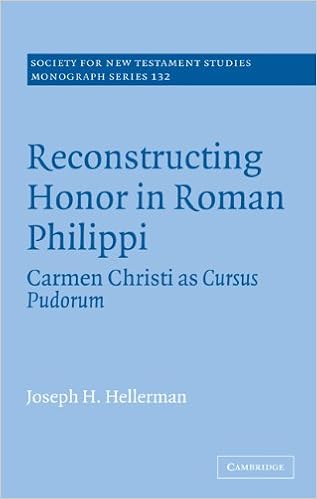
Reconstructing Honor in Roman Philippi

Here is a quotation from a worthwhile book I just finished from the Society for New Testament Studies Monograph Series 132, Reconstructing Honor in Roman Philippi: Carmen Christi as Cursus Pudorum by Joseph Hellerman. As much as it pains me to say, I will not (as of now) be writing a review of this book, due to having too many Irons in the fire already. I gained many great insights from this book, but also had a few caveats.

"Instead of rejecting in principle the social realities of honor and shame, therefore, Paul and those who shared his sentiments sought to reconstruct the cultural values and social codes of the Roman world by substituting, for those attitudes and kinds of behavior deemed honorable by the dominant culture, a radically alternative set of attitudes and kinds of behavior to be honored in the Christian ekklesia. That God himself had profoundly honored these very attitudes and behavior in the life of his servant Jesus assures Paul's readers that the alternative vision for social relations which he offers them is, in the final analysis, far superior to - and much more enduring than - the public pomp and status-conscious value system of the Roman world." 165

One Great Tri-Personal Book - Part V

On page 10, Irons briefs his interlocutors and readers with reasoning as to how Jesus’ deity is found in expressions of “revealing the Father” and exalted terminology such as “image of the invisible God,” which in his opinion is why 

“the church fathers took up this theme and made it one of their key arguments for the deity of Christ.” 

I heartily concur that it is indeed Jesus, the son, who most fully and adequately reveals the Father, but Jesus was not the first to be (in) “the image of God.” Adam (humanity) was created in the image of the invisible God and this in no way necessitated an argument for Adam’s deity. An attempt to prove a divine nature or ontological oneness with the Father based on him being the “true revealer” was (in my opinion) rather weak.

On page 12, Irons – interpreting John 17 – spoke of the conscious state of Jesus reflecting on his past glory with the Father.

“There is only one center of consciousness, one ‘I’ of the Son, as he speaks of his relationship with the Father as man and as he looks back upon his preincarnate life with the Father ‘before the foundation of the world.’ It strains credulity to interpret these straightforward vignettes of the pretemporal, interpersonal relationship between the Father and the Son as mere hyperbole of a personified divine attribute.”

First, his reference to “before the foundation of the world” is a line found in Revelation (as well as other places), and is telling because this phrase speaks to notional or ideal preexistence and foreknowledge not literal eternal existence with the Father (cf. Acts 2:23; 1 Pet. 1:19-20; Rev 13:8; 17:8).

My question is, if I am to believe that as the human, yet incarnate son, who - in kenotic form - set aside his divinity (which orthodoxically included omnipotence, omniscience and omnipresence), how then was he unable to access divine knowledge of the Father’s plans vis à vis the timing of the future, but able to access divine son knowledge about the eternal glory he shared with the father before assuming mortal flesh? In other words, if the son laid it all aside (kenosis), that knowledge should have been off limits, rendering him incapable to reminisce of the eternal state alongside his Father prior to his birth/incarnation. This seems to me an irreconcilable double-standard which does not square with either the Biblical account or Chalcedon.

The “two tests of ontological deity” proposed by Irons to prove Jesus’ identity were:

(1) He used “all things were created through him” (based on John’s prologue, statements in Paul’s letters and Hebrews) and argued that “all things” need refer to the corporeal universe. Utilizing the creator/creature distinction, he surmised that Jesus cannot possibly be on the creature side of the juxtaposition, but mentioned nothing of "in heaven and on earth," “rulers and thrones,” as speaking to authority, rather than material creation. 13-14.

(2) Aseity. I was a bit confused in his presentation of this, as he used passages that - in context - suggest that the authors were speaking of Jesus in his humanity rather than divinity, otherwise I am left to read the texts in a nebulous of weaving curiosity as to which of Jesus’ two natures were being referenced.
For instance, he wrote, 

“The New Testament predicates aseity, and therefore ontological deity, of Jesus. The Father has granted the Son to have ‘life in himself’ (John 5:26) and therefore he possesses the uniquely divine attribute of aseity” 15. 

This is somewhat of a non sequitur, for on the same page Irons defined a se as: 

“a Latin phrase which means that one has one’s being ‘from oneself’ and not from another. Only God has aseity.” 

Therefore, if Jesus – whether as divine or human son - had to be “granted” aseity, it is by definition not aseity! There was a time when the son was not a se. The Father alone is a se, so it does not follow that because the Father granted the son “life in himself,” this is somehow synonymous to aseity.

He wrote, 

“Jesus is unchanging.” 

What did he mean by this, the divine or human? When “Jesus” is referenced, is this his humanity (which was born) or the preexistent logos? Jesus - the man - grew, learned (obedience) and upon his resurrection and subsequent glorification was changed. In my opinion, Irons did not prove Jesus’ ontological deity, and further arguments contingent upon this unproven premise were nullified because they were begging the question.

In his comments on the Johannine Prologue, Irons made the claim that the 

"logos existed as a divine being distinct from God the Father." 

While many read it this way, it is a bit presumptuous to build a Christological stronghold around its “personhood.” It rather says the logos was “with” God. It is the logos (word) in the prologue that finds expression and fulfillment (becoming flesh, manifested) in Jesus of Nazareth, who was born to Mary, not “the logos born and assuming flesh as a pre-existent entity.” The logos was always with God, in this way of speaking, but does not mean Jesus of Nazareth was. You can read my brief sketch of John’s logos here. 11

He argued against two-stage Christology in favor of a “three-stage career” of the son which includes:

“(1) the preincarnate state of the Son, with God the Father before and at creation, (2) the first phase of his incarnate state, that is, his earthly ministry, and (3) the second phase of his incarnate state, that is, his exaltation at God’s right hand.”

In his perspective, a two-stage Christology (eliminating preexistence) would mean a human received divine honors, and the deification of a “mere man” would be implausible or 

“conceptually and theologically impossible within the context of an early Christian movement composed of Jewish believers raised in and committed to the strict monotheism inherited from Judaism. Therefore, the exaltation of Christ must be interpreted along different lines.”  

He had previously clarified that his use of “divine” was not like that observed by the culture (citing the example of Romulus’ apotheosis). Irons believes that an exalted human is an infringement on strict Jewish monotheism, but yet the identity of a being and subsequent claim of two-natures in a hypostatic union that belongs within a tri-personal entity who has always been the God of Israel is not? This argument is another where its coherence eludes me. If it is not Jesus’ humanity being exalted, what then is the point? Why would a divine son who already possessed the “fullness of the Godhead,” ontological oneness, or as the NIV puts it, “in very nature God” need exaltation (Phil. 2:6)? Irons seemed to have forgotten the orthodox position of the two natures for a moment, which posits that Jesus, an incarnate, fully human being, set aside all deity. If Chalcedon is to be accepted as foundational to the hermeneutic, divine honors would be bestowed on a human in Phil. 2 anyway, because Jesus never ceased to be fully human. At this point, one would not be referencing the preexistent logos, but the man, the historical Jesus. The honors and exaltation are bestowed not pre-incarnation, but after, as the result of his obedience. Both Dixon and Smith had good responses to this segment. 16

Irons wrote, 

"no mere creature could be given that divine authority as Lord of all creation” 17.

I align with the statements of Smith in response: 

“His statement is problematic for a number of reasons. First…a sinless, miraculously begotten Son of God who will one day rule as the king of the kingdom could never be called a ‘mere creature.’ This again sets up the straw man. Secondly, I am surprised that Irons finds no parallel to human figures being given universal domination. Was not Adam told, ‘rule over the fish of the sea and over the birds of the heavens and over the cattle and over all the earth and over every creeping thing that creeps on the earth’ (Gen. 1:26-27)?” 42

On page 21, the argument Irons provided as to Jesus' role in God’s redemptive action in no way necessitates his identity as fully and ontologically divine. He spoke of mediation and brandished the term "incarnate son." His statements regarding the “objective accomplishment” and “subjective response to redemption” requiring ontological divinity were completely unfounded.

I also found his bandwagon fallacy a bit surprising: 

“Millions of ordinary Christians throughout history have confessed that Jesus is the Christ, the Son of God, exalted at God’s right hand as sovereign Lord over all creation, and have put their faith and trust in him as their divine Savior and have worshipped him as such.” 

Regardless of what millions have done or believed does not provide a basis for arguing ontological identity with Yahweh, divine sonship or anything for that matter. The same logic could be applied to four-thousand years of Israelite belief in the one true God, who Jesus confessed as his God, with no belief in a Trinity. What about those millions of ordinary Hebrews through whom God chose to reveal himself to the world? Were they all completely mistaken about their God for all those years? In all fairness, he did not rest his argument on his above statement, but placed it following his exposition as to why Jesus must be a divine savior. 21-22


After the first round of responses and challenges by Dixon and Smith to his core argument that the son is eternal and thus a second ontologically divine person (eternally generated alongside the Father and Spirit), Irons still did not provide any biblical basis for this claim, but rather reframed and continued to beg the question he envisioned as adequately having been established. 49

One Great Tri-Personal Book - Part IV

As briefly noted in the last post, Dr. Irons’s Christology is almost exclusively founded on the creature-creator distinction and harnessing the prologue as speaking of literal preexistence regarding the son as the logos. Some Pauline passages dealing with the creation that has taken place through the son are also used in an interpretation of literal creation. His persistent claim that Jesus’ is ontologically identical with Yahweh has also been well worn.

On pages 7-8, his stress on Jesus calling God "Father," thus proving something regarding divinity is certainly a moot point in my opinion. Uniqueness does not mandate divine or metaphysical ontology. Granted, there is no disputing that Jesus had a unique relationship with God and that God was literally shown to be Jesus’ Father in the human sense, but this does not prove divinity on these grounds (Luke’s genealogy for instance speaks of Adam as “son”). None of these texts he cites, speak of eternal generation. Rather, the conclusions drawn by Jesus’ adversaries in John are relied upon for drawing conclusions of what “blasphemy” entails. It is taken as a proof text since Jesus claimed God as his Father, that – due to the accusation of his peers - he is making himself equal with God. This is poor logic for multiple reasons, but we need not even step outside the book of John to realize that if this is what was being communicated, there is a substantial contradiction, even to the prophets. If we read three chapters later, we find the “Jews” - with whom Jesus is disputing - calling God their Father as well,

“We were not born of fornication; we have one Father: God” John 8:41.

Further, when appearing to Mary after his resurrection Jesus tells her, 

“I have not yet ascended to the Father; but go to My brethren and say to them, ‘I ascend to My Father and your Father, and My God and your God.’”

This does not make one equal with God. The prophets had described, 

“For I am a father to Israel, And Ephraim is My firstborn.” Jer. 31:9;

“You are our Father…You, O LORD [Yahweh], are our Father” Isa. 63:16; 

“But now, O LORD [Yahweh], You are our Father,” Isa. 64:8; 

“Just as a father...So the LORD” Ps. 103:13.

Perhaps even of greater clarity is the statement from the Prophet Malachi (2:10), 

“Have we not all one [echad] Father? Has not one [echad] God created us?” 

One God = one Father. Whether the intention here is to equate “father” with “God” or rather that the progenitor of Israel (“one father”) corresponds to Abraham, and “one creator” to God, matters not for the use of echad, as it pertains to both. Even Paul when writing to the Romans and Galatians states,

“you have received a spirit of adoption as sons by which we cry out, ‘Abba! Father!’” (Rom. 8:15, Gal. 4:6).

What fails to make sense with this argument is the claim that it somehow works into Trinitarian dogma. It actually works against it. If identity with Yahweh is what is being communicated, it makes for something closer to Modalism. The Father is numerous times identified as Yahweh. How is this to work with Jesus as a separate person, identical or ontologically the same as Yahweh, but yet distinct from the Father? Can the Father grant authority to someone who is equal in essence and rank? How does this make any sense? If the Father and Son share the same ousia (essence), in what way then, are we to understand Jesus’ claim that he does only that which his Father tells him and permits him to do?

Usually the objection resounds something like this, 

“this only means that He has been given power and authority in his human nature, not divine nature.”

Herein lies the difficulty; to postulate this explanation one must presuppose the doctrine of the two natures, a dogma of which the text says absolutely nothing about. In other words, it’s a circular argument; one must read the text according to this doctrine to claim it supports the doctrine.

Irons makes a statement later in the book commenting on Smith’s explanations and posits that the “obvious meaning” of texts are self-evident when they are not “being twisted to fit a preconceived dogma” using “exegetical gymnastics” p. 148. Here, I would point out - using Irons’s own logic - that Jesus is like anyone else who was given authority by another. He was dependent on that authority and subservient to it.

Of course Irons does not disregard Smith's claims of Jesus as the human Messiah. Jesus rather, is only half of the complete person that makes up the “Son.” To reiterate, the problem is Irons’s reliance on later developed dogma. While he cites early sources as seeming evidence of the Church's unity on the matter (dispelling the psilanthropic error, p. 146) he does so against greater evidence that there was not one universal or unanimous position held by the "Church" as a whole. Thus, such a position is anachronistic and Eusebian flavored. It seems to me that this is another case in which it may be proper to ask, "why isn't the emperor wearing any clothes"?