Pages

Showing posts with label Israel. Show all posts

Review of Aviya Kushner's "The Grammar of God"

"A Hebrew Speaker's Response to the Bible in English." xxxii.

It is important to note that most of the reading I do is in biblical academia, so my judgment of this book is not based on the same criterion. The reason I mention it is because I read some other reviews of this book in which they were quite unfair, attempting to judge it as a work of biblical or linguistic scholarship. That is not what this book is, nor does the author claim this (see Introduction xxxii); reading the book you will find that to not be the point.

This book was recommended to me and now I am so glad it was; what a fantastic work! I appreciated her insights and background of having been raised in a Jewish home where speaking and reading Hebrew was at the center of the family life.

Again, while it is not a scholarly work, The Grammar of God does contain many trails for the chasing, if the reader possesses the notion. This book will thrill both the grammarian and lover of the Bible, as it is written beautifully and is full of heart. She investigates the histories of English translational difficulties and tells the story of her own personal journey with the realization that "some of the most politically charged issues of our time are rooted in biblical translation." xxiii

Here is one of my favorite quotes from the book:
"It [the Bible] is a story that is part of every man and woman who has ever felt the need to claw against destiny, to insist on a different future than what God appears to be offering. And sometimes, in the Bible, what man wants so passionately is unacceptable to God. What man wants is so destructive that is is a threat to the earth, to the creatures that live on it, to other humans." 114.

Also, the book is available in multiple formats and editions, including audiobook.

Learn War No More - Micah 3:1-4:5

If only God were worshipped, there would not be dissensions and wars. For men would know that they are the sons of one God.” – Lactantius.[1]


“No one will make them afraid.” More beautiful words have rarely been uttered. There will be worship instead of war and wickedness, bounty rather than bribery and bloodshed, peace in place of perversion.
There is nothing pleasant surrounding the prospect of judgment or impending doom. But at this time, the proclamation of justice against civil authorities and spiritual leaders of the nation[2] would have been welcome news. Micah posits to deliver the words of Yahweh, making accusations against the rich who have acted oppressively by coveting, seizing fields, houses and inheritance (2:2); tearing the skin off (3:2); eating the flesh and breaking the bones (3:3) of the people. This is “the sin of abusing one’s fellow man.”[3] Unfortunately, it was not the only time when the leadership of Israel was convicted of this charge.[4]
Yahweh in this oracle is portrayed in an “old tradition of the theophany of the divine warrior,”[5] having been roused to action due to the injustice, cruelty, and abominations done by a select group.[6] Finally, because of God’s action, peace and salvation would come to the troubled remnant of Israel.
Commentators have suggested these visions and others similar (Isa 2; 60) reflect the culmination of the ages, or eschaton where all wars will cease. David Leiter observed that such outlining is often perceived as having “little or no practical implications for our current age. . . . The vision indeed had contemporary implications for Israel and if taken seriously can also have implications for our world today.”[7] Yet, there are social critiques within this oracle that are able to be applied to various situations in the present, as well as hope for peace in the future.
In consideration of the warrior imagery, Scott Holland noted that we are more comfortable with a God who fits our own ideology and are sometimes willing to substitute divine “otherness” for our own system of ethics. “We tend to make God in our image and thus in the process make ourselves like God.”[8] If a religious group becomes violent about their religion, it is possibly because their violent perspective has created a god to meet that desire. I conclude – from a meta-narrative perspective – that ultimate redemption and reconciliation is the final objective.  However, the way God goes about that is not always clear. [9]
Ultimately, we must leave vengeance up to God, “precisely because God has the prerogative to give and take life that we do not have.”[10]  These words of Scott Holland have stuck with me since I first read them: “Could it be that because Yahweh is a warrior, we can be a people of peace?”[11] Willard Swartley, also citing this statement, eloquently explained that attributing violence to God is an inaccurate and wrong accusation from a Scriptural perspective. It undermines God’s moral character and redemptive intentions as well as confuses the perversion of human violence with God’s divine prerogative to establish justice. It can also depend on how "violence" is defined. If it entails a violation of a norm, Swartley would argue that for Christians the terms should not apply to God, who is the transcendent source of norms. Nevertheless, judgment characterizes the sovereign and holy God, who punishes humanity for their sins expressly to end human violence.[12]
Micah’s promise of restoration and deliverance is one of hope, and relevant to all those who long for peace and justice to be the order of the day.[13] Embedded within the purpose of prophetic oracles is the call for repentance. If repentance occurs, right relationship with God is restored, divine judgment can be averted and peace will be the result.[14]    


[1] The Divine Institutes, 5.8.66 (ANF 7.143).
[2] C. F. Keil and F. Delitzsch, Commentary on the Old Testament, 10 vols. (Peabody, Mass.: Hendrickson Publishers, 2011), 10:305
[3] Ralph L. Smith, Word Biblical Commentary: Micah-Malachi, vol. 32 (Dallas: Word, Incorporated, 2002), 5.
[4] E.g. Isa 3:12-15; 56:11-12; Ezek 13; 22:24-31; 34; Jer 10:21; 12:10-11; 23:1-5; 50:6-7; Zech 10:2-3.
[5] John J. Collins, Introduction to the Hebrew Bible: Second Edition (Minneapolis, MN.: Fortress Press, 2014), 340.
[6] 2:1–2, 8–9; 3:2–3, 9–11; 7:2–6.
[7] David A. Leiter, Neglected Voices: Peace in the Old Testament (Scottsdale, PA.: Herald Press, 2007), 72.
[8] Scott Holland “The Gospel of Peace and the Violence of God,” Seeking Cultures of Peace: A Peace Church Conversation, ed. Fernando Enns, Scott Holland, and Ann Riggs (Telford, PA.: Cascadia Publishing House, 2004), 141.
[9] N.T. Wright, Surprised by Hope (London: SPCK, 2007), 206.
[10] Holland 2004, 141.
[11] Ibid., 144.
[12] Willard M. Swartley, Covenant of Peace: The Missing Peace in New Testament Theology and Ethics (Grand Rapids, MI: Wm. B. Eerdmans Publishing Co., 2006), 395.
[13] Elelwani B. Farisani, “Micah” The Africana Bible: Reading Israel’s Scriptures From Africa and the African Diaspora, ed. Hugh R. Page, Jr. (Minneapolis, MN.: Fortress Press, 2010), 192.
[14] Leiter 2007, 93-4.

The Bloody City – A Reflection of Ezekiel 22

As I sit at my desk reading, writing and listening to the enchanting melodies of master guitarist Phil Keaggy,[1] I am transported into the ancient world of a Zadokite[2] priest. Ezekiel lived in Jerusalem and was active (594 – 571 B.C.E.)[3] before the first group of exiles were taken to Babylonia by Nebuchadnezzar in 597 B.C.E.[4] He was at the heart of Judean society and a proponent of Zionist covenantal theology, which was a tradition emphasizing them as Yahweh’s choice people, Jerusalem as the capital of a perpetual Davidic dynasty, and Zion (Jerusalem) –with the Solomonic Temple – as the divine habitation.[5] The exile considerably challenged this belief, as it called into question God’s promised protection of the holy city.[6]
Following the destruction of Jerusalem, the tone of Ezekiel’s proclamations changed. This is reflected in the book’s division into three distinct sections: chapters 1-24 are primarily oracles against Jerusalem and Judah and contain material preceding the Babylonian invasion.[7] Chapters 25-32 are directed against foreign entities, and the third – chapters 33-48 – contains oracles regarding Israel’s future salvation and restoration. Chapter 22 is also divided into three units: vv 1-16, 17-22 and 23-31.[8] The textual and historical tradition of Ezekiel has a long, complicated history of criticism and is far too extensive to address here.[9]
“The bloody city” rings loud and clear at the onset of these oracles in chapter 22. This is a phrase used to describe Nineveh in Nahum 3:1. The divine decision was been made to punish God’s chosen, but guilty city.[10] The list of wrongs is detailed throughout this chapter: v 6 rulers are shedding blood; vv 7, 25, 29 aliens suffer extortion, fathers and mothers are treated contemptuously, orphans and widows are wronged; vv 10-11 women are violated in horrific ways, adultery, fornication and incest are taking place; v 12 bribes are made for killing; v 26 priests have done violence; v 27 officials portrayed as wolves; v 28 prophets are declaring lies as though from Yahweh; v 29 the poor and needy are oppressed.[11]
It is also important to note that God warns people to adjust their course and honors repentance. Even in verse 30, with its military metaphor,[12] there is the hyperbolic sense of God looking for one for whom the city could be spared.[13] Regardless, the people’s actions have brought these consequences on themselves.[14]
Surveying this spectacle, I cannot help but shudder at the eerie familiarity it has to our own day. Jesus made pronouncements similar to that of Ezekiel when dealing with the corruption of his own time. Israel in our time still finds itself as the center of attention for unethical behavior. As a Christian who has some Jewish ancestry, I can appreciate that these issues are sensitive for many. Yet, there are still questions. When will God deal with corruption? Does God still protect Israel? Does Israel still oppress its own people and countrymen?
In a class lecture,[15] John Goldingay made this statement,
“God still protects the Jewish people. In our time we have to make a distinction between the state of Israel, which is a state like any other and the Jewish people, most of whom live outside the state of Israel. And declaring that God is committed to the Jewish people does not mean that you reckon that God is committed to the state of Israel, particularly over against the Palestinians. But it’s hard, I think, for Christians to make those distinctions.”
This is crucial because today there are Christian and messianic Zionist movements who have not been able to make a distinction. Some are of the mind that Israel – the state – can do no wrong. “We must bless Israel,” goes the mantra. This is not about Israel but rather an ideology that desires to nationalize God to fit political agendas.
Regardless of one’s eschatology and opinions of political policy, categorizing the State of Israel as though it is the legitimate recipient of God’s favor before all others is a gross mistake with detrimental ethical repercussions.
“For believing that God accompanies one’s army is always comforting, and a people can perhaps be braver the more inclined they are to view God as able and willing to come out in their defense.”[16]
The history of humanity, including Christianity, is strewn with a trail of blood where imperialistic aspirations have been religiously justified as though it were God’s own desires.[17]
“It is always easier to assume that God is with us more than he is with our enemies. In war, how can God be on the side of the foe? Whether it was the time of the Assyrian Empire, the Babylonian Empire, or the Persian Empire (etc) those Israelites who heard or read the story . . . were all people who chafed under subjugation by a foreign power. Their natural tendency would be to presume that God was with them and not with their oppressors.”[18]


[1] “Study helps for the book of Ezekiel should include a musical instrument—a guitar or recorder. Ezekiel is noted as a musician, one who has a beautiful voice and plays well on an instrument (33:32).” Millard Lind, Ezekiel, Believers Church Bible Commentary (Scottdale, Pa.: Herald Press, 1996), 13.
[2] John J. Collins, Introduction to the Hebrew Bible: Second Edition (Minneapolis, MN.: Fortress Press, 2014), 371.
[3] Walther Eichrodt, Ezekiel: A Commentary (Philadelphia, PA.: The Westminster Press, 1970), 1.
[4] Ezek 33:21; 40:1.
[5] Katheryn Pfisterer Darr, “The Book of Ezekiel,” New Interpreter’s Bible, A Commentary in Twelve Volumes, vol. VI,  Leander E. Keck, et al., eds. (Nashville, TN.: Abington Press, 1994), VI:1082-3.
[6] Michael Coogan, The New Oxford Annotated Bible: New Revised Standard Version, 4th ed. (New York, NY.: Oxford University Press, 2010), 1160.
[7] L. S. Tiemeyer, “Ezekiel, Book of,” Dictionary of the Old Testament Prophets: A Compendium of Contemporary Biblical Scholarship (Downers Grove, IL.: IVP Academic, 2012), 219.
[8] Leslie C. Allen, Word Biblical Commentary: Ezekiel 20-48, vol. 29 (Dallas: Word, Incorporated, 1990), xx.
[9] G. W. Bromiley, “Ezekiel,” The International Standard Bible Encyclopedia, 4 vols. (Grand Rapids, MI.: Wm. B. Eerdmans Publishing Co., 1988; 2002), 2:250-52; David Noel Freedman, “Ezekiel, Book of,” The Anchor Bible Dictionary, 4 vols. (New York, NY.: Doubleday, 1996, c1992), 2:714-16.
[10] Eichrodt 1970, 308.
[11] This is my compilation, cf. Lind’s list, “Ezekiel has his own list of Ten Commandments”: (Lind 1996, 187).
[12] Darr 1994, 1315.
[13] Cf. Gen 18:20-33; Jer 5:1-5, although seemingly contradictory to Ezek 14:12-20.
[14] Cf. 9:10; 11:21; 16:43. Jesus, when dealing with the corruption of his own time made references similar to that of Ezekiel: Matt 23:37-39; Luk 13:33-35; 23:28-30. Upon contemplation of this, I recalled the poem by William Blake, “Prologue, Intended for a Dramatic Piece of King Edward the Fourth.”
[15] John Goldingay, class lecture, Chronicles and Esther Part 2 (27:49),” OT500: The Writings as an Introduction to the Old Testament, Fuller Theological Seminary, Fall 2010.
[16] Patricia M. McDonald, God and Violence: Biblical Resources for living in a small world (Scottdale, PA.: Herald Press, 2004), 77.
[17] David A. Leiter, Neglected Voices: Peace in the Old Testament (Scottsdale, PA.: Herald Press, 2007), 10.
[18] Douglas Stuart, Word Biblical Commentary: Hosea-Jonah, vol. 31 (Grand Rapids, MI: Zondervan, 2014), 502.

Dr. John Goldingay on Israel and Palestine

This is a brilliant statement of crucial importance:

“Does God still protect Israel? Well, God still protects the Jewish people. In our time we have to make a distinction between the state of Israel, which is a state like any other and the Jewish people, most of whom live outside the state of Israel. And declaring that God is committed to the Jewish people does not mean that you reckon that God is committed to the state of Israel, particularly over against the Palestinians. But it’s hard, I think, for Christians to make those distinctions.” 

Dr. John Goldingay

Daniel - Part V

The Continuing Four-Kingdom Theme:


Apparently, the Jews did not abandon the four kingdom theme, but interpreted Rome as the fourth and final empire. Within these later Jewish sources it was intended as an anti-Roman polemic. Where five empire lists exist (Polybius), it is most likely a conflation of the prior-existing schema that began with Assyria. Rabbinic and other interpreters obviously relied on Daniel for their interpretations (e.g. 4 Esdras (Ezra) 12:11-12; 2 Bar. 39:3-7), and Jesus speaks of elements within Daniel as still as yet to take place (Matt 24:15; Mk 13:14).

As Rome became viewed as the fourth empire, Babylonia had to remain as the first due to Daniel explicitly saying so; Greece became the third, which left either Media or Persia being cut or combined into one kingdom in the dream. Since the time of at least Josephus, the interpretation has been most popular as follows:

Babylonia (head, gold), a combined Medo-Persian empire (arms/chest, silver), which Josephus intimated by stating,

“the two hands and arms signify this, that your government shall be dissolved by two kings” Ant. 10.10.4.

The third empire has been thought to be Greece (belly/thigh, bronze) and finally, the fourth kingdom most popularly interpreted as Rome (legs/feet, iron and iron/clay mixture). While Josephus does not explicitly say he believes the fourth kingdom to be Rome, it appears as though he did. Flusser comments,

“He could not openly speak about the common interpretation of the four empires in Daniel because of its anti-Roman character, but when he interprets Nebuchadnezzer’s dream in Daniel ii (Ant. X, 209-210) his intention was clear to all readers who were prepared to understand him” JOC, 327.

Commenting on chapter eight Josephus also records,

“Indeed it so came to pass, that our nation suffered these things under Antiochus Epiphanies, according to Daniel’s vision, and what he wrote many years before they came to pass. In the very same manner Daniel also wrote concerning the Roman government, and that our country should be made desolate by them” Ant. 10.11.6.

Iian Provan in his commentary on Daniel states:

“There is, moreover, an inherent weakness in the ‘Greek hypothesis’ – that the book of Daniel nowhere explicitly says that there was a Median Empire. It only says that Babylon was ruled for a while by a king of Median extraction, who is said to have applied the laws of the Medes and the Persians (6:8) and may well have been the same person as Cyrus the Persian (if the end of 6:28 is translated ‘the reign of Darius, that is, the reign of Cyrus the Persian’). Media and Persia are two parts of the same empire in Daniel – the two horns on the single ram of ch. 8 [v.20]. The fourth empire on this view is not named in the book, but thought of as coming after Greece (i.e. Rome).”

While Provan does not specifically view Rome as being the fourth kingdom following Greece as third, he does view the fourth simply as

“an empire to come, at some point after the Greek empire has passed away, during which the events of the end times occur” Dunn, Provan, “Daniel,” Eerdman’s Commentary on the Bible, 667.

Finally, it is interesting to note that nowhere is the kingdom that replaces the fourth (whether identified as Greece, Rome or some other unknown confederacy) called the “fifth.” Due to its description of 

1) originating without human hands; 
2) encompassing the whole earth; 
3) being without end, replacement or destruction, it is clearly not just another kingdom, but rather the eschaton of sorts; another kind of kingdom. Some view this kingdom as the reversion of the Jews to their rightful locale or the rule of God, interpreted through the rise of Christianity.

Whatever identification we assign to the four kingdoms and their exact time of existence and supplanting, it is evident that the point of it all is summed up in the rule of God, and his establishment of a superior kingdom. This is a kingdom dominated by peace (Isa. 2) and a time of rejuvenation of the nations (Isa. 19:22-25). Attempts to predict the time of the end with calculation and application of Danielic text to modern events has proven to be inaccurate while doing a great disservice to the intention of the book. It is a form of chronological snobbery to consider Daniel – or any other biblical text for that matter – irrelevant to the contemporary social context in which it was written. 

Pete Enns, in a recent blog post, made some worthwhile observations when he said (albeit in the context of Genesis, but nevertheless still applies):

“All biblical writers were limited by their culture and time in how they viewed the physical world around them. This is hardly a novel notion of inspiration, and premodern theologians from Augustine to Calvin were quite adamant about the point. No responsible doctrine of inspiration can deny that the biblical authors were thoroughly encultured, ancient people, who spoke as ancient people. Inspiration does not cancel out their “historical particularity,” no matter how inconvenient. . . . We do indeed ‘know more’ than the biblical writers about some things. That alone isn’t an alarming theological problem in principle. But that principle has become a problem because it now touches on an issue that some feel is of paramount theological importance. . . . Should the principle be abandoned when it becomes theologically uncomfortable? . . . Acknowledging that we know more than biblical writers about certain things is not to disrespect Scripture. We are merely recognizing that the good and wise God had far less difficulty with ancient categories of thinking than some of us do.”

Daniel must be read within its own cultural context. Did Daniel have a message for its contemporaries, or was it only a book that was meant to be understood much later? It is unfair to place on this collection of writing a system of interpretation that would have been quite foreign to it. While I continue to investigate and attempt to understand the content, I won’t willfully ignore the vast amount of scholarship that has been done on this canonical collection.

There is much regarding Daniel, its timing, interpretations etc. which we may never be completely sure of, but what we can assuredly conclude is that Daniel stresses the action of the God of Israel and his intimate involvement within the affairs of humanity. Nothing, even the most horrific acts, eludes his attention.

Here are some thoughts from Goldingay which are worthy of repeating:

“There is no hint of timing in Daniel’s revelation. Whether it is actually comes from the Babylonian period, the Persian period, or the Greek period, it implies that history can be divinely foreknown, but not that it is divinely foreordained. The chapter does not speak of final events fixed since time’s beginning, of the whole world under evil’s power, of a dualism of this world and the righteous world to come, of judgment in the form of an immutable fate, or of a division of world history into periods determined by God. . . . It assumes that human beings make real decisions that do shape history, yet that human decision-making does not necessarily have the last word. It affirms the sovereignty of God in history, working sometimes via the process of human decision-making, sometimes despite it. The end of history promised here is not history coming to its goal. . . . Nor, however, is it history being broken off. . . . Nor are the four empires succeeded by a further, fifth empire, but by something wholly other. Daniel promises a new future, one which is not merely an extension of the present. . . . It is of supernatural origin. But it is located on earth, not in heaven. Daniel envisages no dissolution of the cosmos or creation of a different world. His understanding of this kingdom is more like the prophetic idea of the Day of Yahweh than that of some later apocalypses. The problems of politics and history can only be resolved by a supernatural intervention that inaugurates a new kingdom, but this involves changing the lordship of this world, not abandoning this world. The new kingdom fills the earth. History is not destroyed; other sovereignties are. . . . The qualities of this new rule are not described except by saying that it is God’s and that it lasts, both of which qualities contrast with those of its predecessors” Goldingay, WBC, Daniel, 59f.

In his book Seriously Dangerous Religion, Provan gives some good thoughts regarding Daniel. Daniel goes out of its way to inform the reader that this world -

“is governed by ‘beasts’ – the beastly empires described in Daniel 2 and 7. It is a world, therefore, that has been turned upside down. The world created by God is one in which human beings should govern the animals (Genesis 1:26-30), but in Daniel, the ‘animals’ govern the human beings. Here the idolatry of the self has been transposed into the idolatry of the state, and upon human beings who refuse such idolatry suffering falls, whether in fiery furnaces or in lions’ dens or in some other way. This is what happens when the emperor, in particular, comes to think that he is a god (Daniel 3)” Provan, Seriously Dangerous Religion: What the Old Testament Really Says and Why it Matters, 168.

I will conclude this chapter with this reminder as to the greater picture of God’s plan:

“The belief in the destruction of Babylonian, Median, Persian, and Greek rule is a powerful pronouncement to the listener that God will bring these reigns of terror to an end. All forms of inhumanity are destined to end, and it is this destiny that the faithful are invited to know and act upon by means of an insight in to the future of God’s plan” D.L. Smith-Christopher, NIBD, VII:55.

Check out DustinMartyr blog on Daniel 9, one, two and three.

Daniel - Part IV


Before the King: 


Daniel begins his interpretation of this dream in v 36. There is no need to speculate regarding the golden head, as Daniel informs the king that it is he. Josephus has it, 

“the head of gold represents you and the Babylonian kings who were before you” Ant. 10.10.4.

The four parts of the statue are similar to the four beasts of chapter seven and are four empires, although Goldingay does not think chapter two and seven correspond to the same motif. Other commentators such as Keil and Delitzsch view chapters seven, eight and nine to be further descriptive of that represented as a “whole” in chapter two (Keil and Delitzsch, 9:557). Regardless, both are linked together through some commonalities: in Nebuchadnezzar’s dream they are all part of one unified image and in Daniel’s vision of chapter seven, they are all beasts. Also, a shared component is the external phenomenon – not from among them – that ultimately triumphs by annihilation, i.e. stone cut without human hands (chapter two) and the intervention of the “son of man” and “ancient of days” (chapter seven). 

But within chapter two, what conclusion should be drawn of these kingdoms as to their identities? It probably comes as no surprise to know that through the years the interpretations regarding the “who’s who” of these “empires” has varied, depending on the period of time and who was doing the interpreting.

Even before the Greek conquest, the idea of three empires succeeding one another – Assyria, Media and Persia – is documented. Both Herodotus (I, 95, 130), writing in the fifth century B.C., and Ctesias, writing in the fourth century B.C., affirm this. Flusser notes,

“Thus, the idea of three empires: Assyria, Media and Persia is probably a Median historical conception before the conquest of the East by Alexander” JOC, 323. 

Even Assyria to Media is mentioned in Tobit (14).

Flusser adds that when the idea of four empires is compared with the Zoroastrian conception of four periods within human history, it became an eschatological and political ideology with anti-Greek tendencies, as Rome would be in a later period and interpretation. It’s not too hard to imagine how a contemporary rule would react to literature that speaks of its utter overthrow and destruction. Such speech is anti-imperial and thus rarely explicit in its detail, as well as interpretation.

The fourth book of the Sibylline Oracles contains the four-empires. It is related as Assyria, Medes, Persians, Macedonians (Greece). In the document, an apparent secondary change (Flusser, JOC, 319) took place where Rome was introduced following Greece. “World domination” is applied (in the SibOr text) to the Assyrians (v. 50), Persians (v. 65) and the Romans (v. 103). Rome did not belong in this source, as it is outside of the ten generation history on which it is based, meaning that it was a later redaction of the text.

It is generally accepted today by scholars, that the four empires of Daniel were intended as Babylonia, Media, Persia and Greece (Flusser, Judaism and the Origins of Christianity, 324). Isaiah and Jeremiah have texts that seem to point in this direction as well:

“The LORD has aroused the spirit of the kings of the Medes, Because His purpose is against Babylon to destroy it; For it is the vengeance of the LORD, vengeance for His temple” Jer. 51:11, cf. 28 NAU

and 

“Behold, I am going to stir up the Medes against them, Who will not value silver or take pleasure in gold. . . . Babylon, the beauty of kingdoms, the glory of the Chaldeans' pride, Will be as when God overthrew Sodom and Gomorrah” Isa 13:17, 19 NAU.

In addition to these texts, there are those that speak of Persia, with Cyrus at the Babylonian helm (2 Chron. 36:22-23; the entire book of Ezra; Isa. 43, 44, 45). There are also texts which mention a “Darius” as king during Jerusalem’s post-exile restoration (Hag 1:1, 15; 2:10; Zech 1:1, 7; 7:1).

Historian W. Durant, with a detailed historical recounting of the ANE empires, says this of Cyrus:

“When Cyrus and his disciplined Persians stood at the gates, the anti-clericals of Babylon connived to open the city to him, and welcomed his enlightened domination. For two centuries Persia ruled Babylonia as part of the greatest empire that history had yet known” Our Oriental Heritage, 263.

Durant also summarizes the downfall of the Medes:

“When Cyrus, the brilliant young ruler of the Median dependency of Anshan, in Persia, rebelled against the effeminate despot of Ecbatana, the Medes themselves welcomed Cyrus' victory, and accepted him, almost without protest, as their king. By one engagement Media ceased to be the master of Persia, Persia became the master of Media, and prepared to become master of the whole Near Eastern world” Ibid, 352.  

While I am not entirely convinced one way or another (mostly due to not having adequately considered the parallels in chapter seven), important questions to consider are, “why would content have been included or excluded in a book such as this, what purpose would it serve? What would the readership have taken it to mean, and why?

Flusser offers an explanation of how and why the interpretive shift from Greece to Rome as the fourth kingdom took place:

“The book of Daniel reached its present form between 168 and 165 B.C.E. at the beginning of the Maccabean revolt against Antiochus Epiphanes. The scheme of four empires with Greece at the end was not obsolete from the political point of view of the Jews in Palestine persecuted by the Greek King [Flusser here notes Dan. 11:30 containing a hint of Rome’s intervention against Antiochus’ plans to conquer Egypt]; but it would no longer fit the political reality in Asia Minor after 191 B.C. E. because there it was already clear that the Romans succeed Macedonia. . . . As to the book of Daniel itself, there is a common opinion that its author used older material from various periods” JOC, 324.

It is the historical events of Babylonia, Media and Persia and their relation to certain parts of Daniel where I have some difficulties. For instance, Daniel five states that Belshazzar saw writing on the wall, which communicated that his kingdom was being turned over to the “Medes and Persians” (5:28). That night, says the text, Darius the Mede received the kingdom (30-31). However, Belshazzar was the son of Nabonidus, not Nebuchadnezzar. And it was Nabonidus, not his son, who was the last king of Babylon, regardless of being a coregent or not. Carol Newsom points out that there are 

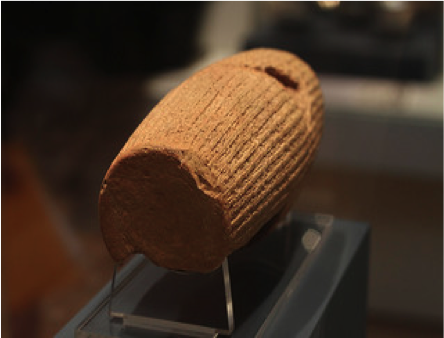
“five ancient sources that refer to the events of the fall of Babylon in 539 B.C.E.: (1) The Babylonian Chronicle . . . (2) the Cyrus Cylinder . . . (3-4) the accounts of the Greek historians Herodotus (1.190-91) and Xenophon . . .(5) the account of Berossus, a Hellenistic-era Babylonian historian ” Newsom, Daniel, 163.  

According to the Nabonidus Chronicle in the Ancient Near Eastern Texts (ANET, 306-307; 315-316), Cyrus was the one who invaded Babylon (as Chronicles, Ezra and Isaiah indicate), and did so without opposition.  John Collins notes that the inclusion of a “Mede” is a redaction for “Cyrus the Persian” for the sake of the four-kingdom motif (Collins, Daniel, 242).

The problem I have with interpreting Media as the silver, second kingdom in the dream of the image is that she was coexistent with Babylon, although indisputably inferior. Under the leadership of Nabopolassar, the Babylonians – united with the Medes under Cyaxares along with the Scythians from the Caucasus – succeeded in destroying Assyria in 612 B.C. Durant puts it, 

“at one blow Assyria disappeared from history” Oriental Heritage, 283f.

So then, how does Media fit this description, “In your place another regime will arise inferior to yours”?

Babylon did not fall to Media, but to Persia, who also had taken over Media. I see no reason from the historical evidence to combine Media and Persia as though they were one kingdom, as they most definitely were not. Combining the two kingdoms does not solve the issue regardless. While the metal does decline in value, it is not ultimately what the dream is about. Focusing on the metal seemingly misses the point. 

Collins, while interpreting the four the way most scholars do today, does mention, 

“The inclusion of Media in the succession of world empires appears odd because Media never ruled over the Jews. It was, however, included in a reckoning that became traditional in Greek and Roman historiography” Collins, Daniel, 166.

Daniel - Part III


The setting:


In chapter one of Daniel, the story of Jerusalem falling under the power of the Babylonian superpower and her ferocious king Nebuchadnezzar is told. A lot could be said here culturally, how kings in the Ancient Near East (ANE) handled conquered territories etc. For instance, Daniel and his friends mentioned are not just random peasant children, but in all probability sons of nobility, or to use an anachronism, part of the aristocracy. We know this not only from ANE practice of conquering and creating vassal relationships, but Josephus (Ant. 10.10) informs us of this as well.

In Daniel two, a new scene begins where the king had a troubling dream. I won’t recount the story, but basically, the king refused to tell his dream for the sake of not wanting to be deceived regarding its interpretation. The diviners and specialists of these matters protested the impossibility of his request, although David Flusser notes from Herodotus, Croesus King of Lydia testing the Greek Oracle, makes the request of Nebuchadnezzar “reasonable” or “not so illogical as the book of Daniel pretends” (Flusser, JSTP, ii:2; JOC, 325).

The Hebrew hero Daniel asked for time and the king (obviously) consented and through the pleading of Daniel to the God of Israel (Yahweh), the secret was made-known in a vision.

The Interpretation:


The interpretation of this dream has been one of constant debate. It is important in a text like this to pay attention to the structure. The reason being, the context is partially reliant upon another portion of the text of Daniel (anachronistically titled “another chapter”). Far too extensive to cover in this post is the chiastic structure with chapters two and seven serving as bookends (see Goldingay, WBC, Daniel, 158; IVP Dictionary of the OT Prophets, 110). Beginning in 2:4, the language changes from Hebrew to Aramaic and reverts back to Hebrew after the conclusion of chapter seven.  

Within this dream – in chapter two – the king saw an image, a large (great) statue. Its parts were divided into head (gold), breast and arms (silver), belly and thigh (bronze) and finally legs (iron) and feet (mixed iron and clay). Goldingay comments that gold and silver are representative of “majestic and precious” in political and religious contexts while bronze and iron are “strong and hard.” He also states that “the four metals together sum up the variety of valuable natural resources” and “there is no implication of deterioration as we move from head to trunk to hips to legs; nor are these four metals 'the metals of idolatry.'”

Since the discovery (1948) and publication of the Dead Sea Scrolls, fragmentary details have aided the study of not only Daniel but have contributed invaluably to furthering many other biblical studies as well. Such is the case with a fragment known as the Prayer of Nabonidus (4QPrNab, 4Q242). Nabonidus was the last king of Babylon and the father of Belshazzar. It is thought by some scholars that this fragment is part of an earlier form of the Daniel story, where it retains Nabonidus, who later became identified as Nebuchadnezzar for various reasons. One proposition is due to it being Nebuchadnezzar who conquered Jerusalem and destroyed the temple.

With the other Daniel-related traditions belonging to Jewish literature (Prayer of Azariah, Song of the Three Jews, Susanna, Bel and the Dragon) it is not difficult to understand how these stories circulated, even independent of each other. PrNab is illuminating to Daniel in several ways, but pertaining to this chapter (two) it contains the materials found in the image of the dream:

“Words of the pr[ay]er which Nabonidus, king of [the] la[nd of Baby]lon, the [great] king, prayed [when he was afflicted] by a malignant inflammation, by decree of the G[od Most Hi]gh, in Teiman. [I, Nabonidus,] was afflicted [by a malignant inflammation] for seven years, and was banished far [from men, until I prayed to the God Most High] and an exorcist forgave my sin. He was a Je[w] fr[om the exiles, who said to me:] Make a proclamation in writing, so that glory, exal[tation and hono]ur be given to the name of [the] G[od Most High ». And I wrote as follows: « When] I was afflicted by a ma[lignant] inflammation […] in Teiman, [by decree of the God Most High,] [I] prayed for seven years [to all] the gods of silver and gold, [of bronze and iron,] of wood, of stone and of clay, because [I thoug]ht that t[hey were] gods.” F.G. Martı́nez, The Dead Sea Scrolls: Study Edition, 1:487.

Is it possible that this story took on more than one form through the years? Is it possible that as time went on, the shifting sands of external political forces and internal religious factions that dramatically affected Israel had an emphasis on the way the story was told and redacted in specific periods of time?

Like I stated at the outset of this series, my point is not to draw radically different and dogmatic conclusions merely for the sake of doing so, but rather to consider alternative points of view, comparing historical events well-known to scholars, but often obscured from the average Christian. My hope is that this inquiry is not seen as an affront on supernaturalism, prophecy or the preservation of words God intended for his people. My objective is to better comprehend how this collection of texts was intended to be understood and thus (hopefully) come to a fuller grasp on what God wanted his people to know concerning the troublesome times they (we) continue to face.  

Be sure to check out DustinMartyr on Daniel 2, 7 and 8.

Daniel - Part II

Ancient and Modern Perspectives:


The interesting thing about Daniel is the attitude toward it. The Old Testament (as Christians know it) is for Jewish folk called Tanakh, which is an acronym taking the T from torah, N from navi (im) (prophet(s)), K for ketuvim (written things, writings) and adding some vowel sounds. It is somewhat telling that Daniel is not grouped in with the prophets but rather the writings

“Daniel is classified with the Major Prophets in the LXX and was regarded as a prophet already in antiquity (Matt 24:15; Ant 10.11.7 [266]). Yet in the Hebrew Bible the book of Daniel is found in the Writings, in the fourth place from the end (before Ezra, Nehemiah and Chronicles). The position in the Hebrew Bible reflects the late date of Daniel (after the collection of Prophets had been standardized) but may also reflect an awareness that Daniel does not belong with the Prophets in genre” (Anchor Bible Dictionary, ii:31).

Why? David Flusser takes up the challenge in an attempt to answer the question as to why Daniel – the only full-fledged apocalyptic book (Anchor, ii:31) – was incorporated into the canon. He writes, 

“Ultimately this came about because of the first part of the book, chapters one through six, which contain legends about Daniel as a man, seer and healer from the end of the Babylonian era and the beginning of the Persian. . . . As for the tales in the first part of the book, they were dear to the hearts of the Jews of the day because they contain the two earliest accounts of Jewish martyrs” (Flusser, Judaism of the Second Temple Period, The Jewish Sages and Their Literature, ii:5).

The majority of scholars date the book to the second century B.C.:

“The book of Daniel can be dated with relative precision between the second campaign of Antiochus Epiphanes against Egypt in 167 BCE and his death in 164” (J. Collins, SBL, Semeia 14, 30). 

It is also typically considered vaticinium ex eventu, although this is not the case for all. John Walton, for instance, states that this 

“appears to face considerable problems. The four-year time span (168-164 B.C.) is far too short for a book of that time to be written, copied, circulated and adopted as truth and then preserved as canon.”

He continues on,

“the presuppositional rejection of supernaturalism is largely responsible for the rejection of a sixth-century date for the book.”

He also goes on to say that

“the linguistic evidence (in regard to the both the Hebrew and Aramaic of Daniel) points toward a earlier time than the second century, as does the appearance of Daniel in the Septuagint (usually dated as early as the third century B.C.) and the Dead Sea Scrolls (from the first and second centuries B.C.)” Walton, Survey of the OT, Zondervan, 2nd ed., 454.

Jesus did refer and quote Daniel as a prophet, but in reality it’s not as clean-cut and easy as it may first appear. For example, scholars know that Enoch 1 is depicted in the content of at very least a couple NT writers and an influence on others (like Paul). Does this mean that those individuals believed the book of Enoch to be literally penned by the historical individual or was rather eponymous?

The role of a prophet was not merely or always predictive. They were messengers from the God of Israel to deliver words of hope, reassurance and more than not, repentance. If we are to be good expositors of any text – including Daniel – we need to ask the questions of why and how this message functions within the social and ethical context of the Hebraic community.

Skip Moen in a recent blog post on exegesis put it this way:

“Exegesis is a linguistic-theological project. It begins with what the author of the text meant in the cultural framework of his world. It must begin there since there is no other way to understand the words that he wrote. This may lead to theological assertions (or it may not) but the theology is secondary. Theology is abstraction from the text, just as the speeches of Romeo and Juliet are not directly applicable to our generation. Doctrines that regulate what the text must mean hinder exegesis. They are the stuff of paradigms and typically prevent us from seeing anything in the text except what the paradigm says is in the text. The biggest obstacle to learning God’s word is thinking that we already know what He says. We must practice spiritual suspended animation, putting what we think we know on the shelf, if we are going to re-think what the text teaches. Hopefully we will find that what we thought we knew is still the case. But not always. Sometime our most cherished beliefs are the very things that prevent us from hearing what the original author said.”

Christianity has little conception of the reality that in the Hebraic world of literature, authority rather than autograph was of greater significance. In other words, in an oral as opposed to a textually dominant culture, attempting to link the origin of a book itself to a specific individual is not as important as the tradition and authority on whom it is based. John Walton remarks, 

“We should remember, however, that this canonical final form does not override the authority figures or the traditions that preceded it. . . . Authority is not dependent on an original autograph or on an author writing a book. Recognition of authority is identifiable in the beliefs of a community of faith (of whom we are heirs) that God’s communications through authoritative figures and traditions have been captured and preserved through a long process of transmission and composition in the literature that has come to be accepted as canonical” Walton, Lost World of Scripture, 68.

Daniel - Part I

I am interrupting the series on salvation history for a number of posts on the visions within the book of Daniel. I will get back to the salvation series in the not-too-distant future. Over at his blog DustinMartyr, Dustin Smith is tackling the same subject. He posted his second article already, but here is his part one and two.

Traditional use and abuse


I’ll be frank, I am no prophecy savant. Allow me to be even more candid; prophecy interpretation (and the failure thereof to do so correctly) has inadvertently promoted heinous acts and has resulted in duping copious amounts of people throughout the centuries, often times with devastating results. This has left a horrible taste in my mouth and a hesitation to draw dogmatic conclusions when past expositors have been guilty of distorting the text and perpetuating error for personal prosperity. All of those having used prophecy in this way have been one-hundred percent wrong, one-hundred percent of the time.

As with any genre of literature, it is important that proper hermeneutical principles of context, culture and adequate historical analysis guide the reader. As illustrated above, it is patently obvious that the general attitude and application/interpretation of prophetic texts has been a dismal failure. The book of Daniel is no exception.

I concur with Josephus when he said,

“if anyone be so very desirous of knowing truth, as not to wave such points of curiosity, and cannot curb his inclination for understanding the uncertainties of the future, and whether they will happen or not, let him be diligent in reading the Book of Daniel, which he will find among the sacred writings” (Ant. 10:10.4).

Regardless of the date one accepts as genuine for Daniel, the simple fact remains: interpretations tend toward becoming functions of the group reading the specific text.

In scholarship:


There has been a good deal of debate within scholastic circles centering on this book, pertaining to its origin, authorship and authenticity. It has been a challenge to step-back and reevaluate the flood of information available on the matter, and who/what is to be trusted. I have attempted to analyze and examine it from a logical, practical and as unbiased position as possible. Here are some of the conundrums which I have faced and facts which can hardly be ignored:

1. Scholarship is necessary. Without it there is no archaeological evidence wherewith to establish proper cultural context, no lexicography, no critical texts or textual analysis, no commentaries and the last step, no English translation. If you doubt this, most what is said here will be meaningless.

2. Not everything scholars say and think is true. Scholarship is old. Really old. The best of the best have been wrong, just ask John Hagee. Scholars are and can be wrong, but the methodologies, tools and accessibility to copious amounts of ancient texts at the disposal of today’s historian have never been greater.

3. Prophecy is part of faith in the God of Israel. This cannot be overlooked. If we trust in the God of Israel, there is a certain amount of faith (which cannot always be proven by analytics) required. The problem for historians is there is no way to substantiate the claim. Historians cannot authenticate prophecy or prove the veracity of miracles, which is partially why the date is troublesome. For instance, how can Daniel two and seven include information about Rome or Greece if there isn’t even a Pompey yet? This does not in and of itself disprove miracles or prophetic forecasts from having taken place. I am merely relating why it is troublesome for historians in general.

4. The book possesses difficulties. Not only does Daniel present difficulties for scholars within its own content, but contains historical inaccuracies against the vast amount of evidence from the period in which it claims to have been written and the period in which most scholars have concluded it was written. That is to say that the book is actually one piece of literature by one individual from one period of time, which it almost certainly was not. An example is Belshazzar in Daniel being presented as Nebuchadnezzar’s son rather than Nabonidus’s son, not to mention certain acts of Nabonidus attributed to Nebuchadnezzar.

5. General scholarly consensus views Daniel as a prophecy written after the fact (Latin vaticinium ex eventu). Meaning, Daniel was a reverse history, and not necessarily always a very good one.

6. Jesus called Daniel a Prophet. This has been, and continues to be one of my greatest challenges to the way I view Daniel. Jesus appealed to events predicted in Daniel and identified himself as the “son of man,” which is depicted in the seventh chapter. If we are to take Jesus and the Gospels seriously, what are the implications of modern scholarship’s dating, view of origin and composition? Are we to then assume Jesus was claiming to be Gabriel and/or endorsed Canaanite mythology?

These are a few questions that need to be taken into serious consideration. It’s not just a matter of flippantly dismissing any difficulty that either scholarship or traditionalism presents and throwing it under the bus of canonicity for the sake of convenience rather than face a perceived hardship. It also needs to be remembered that no matter the position some may take, it does not make them a heretic or a Jesus denier/hater.

Book Review: The One: In Defense of God

I am honored to say that I am a friend of J. Dan Gill. In the past few months, my family and I enjoyed the fantastic southern hospitality of Dan and his wonderful wife Sharron. Together, with their wide spectrum of combined talents, they run the 21st Century Reformation web site. 

Dan magnanimously provided me with a copy of his new book "The One: In Defense of God," and so I offer this short review.

This apologetic work is a skillfully woven case not only for theism, but something he refers to as monotarianism (p. 98), the existence of one God as one person. He begins his defense in the introduction as though his audience has little to no understanding of who God is or even possesses doubt regarding his existence. Quite naturally then, he begins with atheism and agnosticism, systematically working his way into examining the ways various people groups throughout the ages have thought about the divine and worshipped the “gods.” He investigates and calls into question the traditional ways Christendom has been conditioned to think about God throughout the past two millennia. Not surprisingly, the testimonies of such voices are often found confusing, contradictory and unnecessarily complicated.

The foundation of Hebrew Scriptures and the witness of the New Testament take precedent for Dan over the years of bishop and emperor governed councils and subsequent theological tradition: 

“Multi-personal orthodoxy ultimately triumphed not because it was a good idea or because it was biblical – it was neither. Rather, it prevailed because of persecution. With the coming of Emperor Constantine the Great and his embracing of Christianity, Christians were allowed to exist freely in the Roman world. However, that freedom applied only to people who adhered to the version of Christianity approved by Constantine and his successors” p. 255.

Dan constructs his arguments layer by layer in a clear, direct and understandable way that any layman would be able to fully appreciate. He calls relevant scholarship to the figurative witness stand for the sake of providing testimony, often revealing dubious characters, sinister plots and heinous acts.

Dan writes with a warm, friendly and gentle tone. Great heart and genuineness bleed through the pages as he discusses a plethora of issues that have captivated some Christians and addled others. He provides sufficient detail without becoming too technical or academic for the average reader. Technical details on topics that require greater explanation are put in chapter end-notes.


As I worked my way through the book, I found a number of short, quotable gems: 

“If it were not for the abuses of some religious people, there would be far fewer agnostics and atheists” p. 14. 

At the conclusion of this case, I resoundingly concurred with the verdict. The statements made in his closing remarks offer an appropriate challenge on which Christians should ruminate:  

“Will we forever allow ourselves to be mesmerized by proof-texting, faulty syllogisms and non-scriptural examples . . . will we cling to the notion that we are invincible? We need to quit believing our own Christian propaganda that Christianity could never be wrong in the matter of defining God” p. 263.

Israel Song Experience

A song of my experiences in Israel. I played and sang this at Ray Vanderlaan's seminar in Mt Hope, March 2016. Thsi is my arrangement and re-wording of Fernando Ortega's "Angel Fire."

Typology From Context

Jesus told many parables, but possibly the most frequent subject he addressed was servant-hood/stewardship. In the parables - few of which are original to him - he spoke of good stewards commended because of wisdom, good stewardship and bad stewards cast away because of poor stewardship. He also spoke of an unjust steward who was commended for being shrewd.

When hearing of a good and shrewd steward/servant, on which famous character would a first century listener possibly reflect? It is important to remember when reading the NT that agency is a predominant theme throughout the OT, where examples abound of servants who demonstrated dominance and also possessed the ability to "put all things into subjection," or under their "lord’s feet."

Typology is important for biblical interpretation, but so is context. When reading narratives in the OT, what can be deduced regarding the precedent they set, if any? How did the NT writers weave these well-known narratives and motifs into the telling of what they saw as a greater story with fulfilling characteristics? If one's objective was to communicate that the climax of Israel's history was at hand, and history had led up to the current point, what better way than to highlight the stories that made them who they were?

“The fact that stories are a fundamental characteristic of worldviews can be further illustrated in relation to the Jewish worldview and its various mutations. These can never be reduced to sets of maxims. Even at its most proverbial and epigrammatic, Jewish writing retains the underlying substructure of the Jewish story about the covenant god, the world, and Israel. For most Jews, certainly in the first century, the story-form was the natural and indeed inevitable way in which their worldview would find expression, whether in telling the stories of YHWH’s mighty deeds in the past on behalf of his people, of creating new stories which would function to stir the faithful up in the present to continue in patience and obedience, or in looking forward to the mighty deed that was still to come which would crown all the others and bring Israel true and lasting liberation once and for all.” 1


Jacob lived an interesting life to say the least. After he had fled from home, he found himself working for his mother’s brother Laban, in Paddan-aram. He worked a total of 14 years - due to deceit - in exchange for two of Laban’s daughters.

Rachel was the one whom Jacob loved (Gen 29:18), and it displeased Rachel greatly that she was unable - at first - to give Jacob children. She pleaded with Jacob to which he responded

“can I take the place of God, who has denied you the fruit of the womb?”

One of the next events was Jacob being divinely instructed in a dream to return to his native land. It was the threat of his brother Esau trying to kill him (27:42) that caused him to flee. Is it possible that this situation was no longer a threat? In the same chapter, Rebecca says to Jacob,

“Stay with him (Laban) a while, until your brother's fury subsides.” 

This sounds similar to the instructions given to Joseph after having fled from Herod to Egypt, and then instructed to return,

“those who wanted to kill the child are dead” (Matt 2:20).

Not unlike the description of God “remembering” Noah and then acting accordingly by causing his ruach (wind, spirit) to pass over and save the vessel bound travelers, the athropotheism

“God then remembered Rachel” 

demonstrates that God was directly intervening to produce results. The result was Rachel conceiving and bearing a son who became a deliver of not only the tribes of Israel, but also the entire land of Egypt, and surrounding nations.

God opening Rachel’s womb was a miraculous event, resulting in a miraculous birth. God can do whatever he desires to suit his own purposes. Whenever attempts are made to box him in, we exclude ourselves from the miraculous.
___________________________

1. N. T. Wright, The New Testament and the People of God: Christian Origins and the Question of God (Fortress Press, 1992), 39.

True Blue Jew

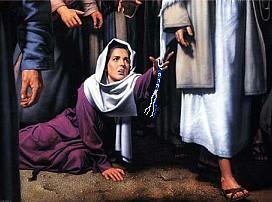
In Matthew 9, Mark 5 and Luke 8 there is somewhat of an odd story involving a woman who after having suffered for twelve years comes into miraculous contact with Jesus for healing. This story takes place while Jesus is assisting Jarius’ twelve year old daughter. Is this double-mention of twelve coincidence, a number used to relate context to the tribes of Israel? Is it also by chance that the author uses δώδεκα (dodeka, twelve) twelve times in Luke, but not once in Acts? Both stories also have the victims as “daughter.”

Matthew and Mark have the woman saying to herself,

“If I just touch His garments, I will get well [lit. I will be saved, Hagner, WBC]."

Luke however does not mention this, instead it is stated that she had a twelve year issue of blood and

“came up behind Him and touched the fringe of His cloak, and immediately her hemorrhage stopped.”

In Luke, the reader is not given the woman’s thoughts as to why she took such action,

“she devises a plan of secretly touching his garment. Her reasoning and simple faith find articulation in v 21. It will suffice to touch the garment of this very special person. This strategy may well have been dictated by her ritual uncleanness and her sense of the holiness of Jesus as a divinely empowered healer. το κρασπέδου το ματίου ατο, ‘the fringe of his garment,’ probably refers not simply to the edge of Jesus’ garment but to the tassels (Hebrew צִיצִת, îit’) required by Num 15:38–41 and Deut 22:12 for the four corners of one’s outer garment (cf. 23:5). Jesus is thus faithful to the Torah in his dress. The idea of being healed through even the garments worn by a holy person was not so unusual in that culture (cf. 14:36; Mark 6:56; Acts 19:12)."1

This is a tough situation for the woman, more than the text lets on for most of the readers in our culture. This woman was perpetually unclean, meaning she was an outcast, completely cut-off from everyone; no human contact. It is obvious that she approaches Jesus in this stealthy manner because she believes that he would not come close due to her impurity, she would be rendering him unclean. Keener remarks,

“this woman’s sickness was reckoned as if she had a menstrual period all month long; it made her continually unclean under the law (Lev 15:19–33)—a social and religious problem in addition to the physical one. If she touched anyone or anyone’s clothes, she rendered that person ceremonially unclean for the rest of the day (cf. Lev 15:26–27, [m. oharot 5:8]). Because she rendered unclean anyone she touched, she should not have even been in this heavy crowd. Many teachers avoided touching women altogether, lest they become accidentally contaminated. Thus she could not touch or be touched, she had probably never married or was now divorced, and she was marginal to Jewish society.”2

Matthew and Luke have a word Mark does not in the telling of this particular story; fringe (kraspedon). In a recent blog post, Gerald McDermott explores this briefly, but in my opinion leaves the best part out.

The word kraspedon is used few times in the NT, but there is a lesser mentioned portion of text in Matthew 14 and Mark 6, when Jesus was in Gennesaret, and the same word is employed:

“when the men of that place recognized Him, they sent word into all that surrounding district and brought to Him all who were sick; and they implored Him that they might just touch the fringe of His cloak; and as many as touched it were cured” Mat 14:35-36.

Why were people drawn to Jesus’ fringe or hem?

“The LORD also spoke to Moses, saying, ’Speak to the sons of Israel, and tell them that they shall make for themselves tassels on the corners of their garments throughout their generations, and that they shall put on the tassel of each corner a cord of blue. It shall be a tassel for you to look at and remember all the commandments of the LORD, so as to do them and not follow after your own heart and your own eyes…” Num 15:37-38.

The covenant people of God were commanded to sew tassels (tsitsith) on the “corners” of their garments. The word corner in Hebrew is kanaph and can also be translated as wing or extremity as in the passage where Yahweh - extending protection and covering over Israel - says,

“I spread the corner of my garment over you and covered your nakedness” Eze 16:8 ESV.

It is used of wing in the sense of protection, as a mother bird spreads her wings over her chicks and the wings of the Seraphim which covered the Ark, their face, “feet” (euphemism for something else) and were used for flying.

In the Septuagint, the word corner (kanaph) is translated kraspedon; the same word Matthew and Luke use in these narratives (cf. Mat 23:5). Why then does Jesus credit the woman with an exercise of faith for touching his tassel?

Possibly because of a messianic prophecy in Malachi that stated,

“But to you that fear my name shall the Sun of righteousness arise, and healing shall be in his wings [Heb. kanaph, where the tassels or tsitsith were sewn]…” Mal 4:2 LXE.

Jesus as the Jew of Jews or the true blue Jew (blue cord in tassel joke there cf. Nu 15:38) of course would be wearing tassels. If he was not, he was a disobedient Jew. When I was in Israel, the historian R. Vanderlaan - who was teaching - made the comment in regard to this narrative,

“every piece of art we have shows Jesus breaking God’s law, and we want Jews to take seriously that he is the messiah.” 

Prof. Anthony Buzzard appropriately asks,

“Have we forgotten that our Savior was a Jew?” Jesus Was Not a Trinitarian, 9.

McDermott, as well as Keil and Delitzsch mention the Pharisaic superfluous attitude in commands such as Nu. 15:38,

“The size of these tassels is not prescribed. The Pharisees liked to make them large, to exhibit openly their punctilious fulfillment of the law.” Kiel and Delitzsch, 1:721.

Mark describes the woman as having

“endured much at the hands of many physicians, and had spent all that she had and was not helped at all, but rather had grown worse.” 

Ironically, Luke the doctor left that part out. The woman’s faith is exemplified - according to Matthew and Luke (12 x 12) - by pointing to her action upon the belief that by “touching” (hapto, “lay hold of”) the symbol of God’s protection for his people and the messianic characteristic of healing, she would be a recipient of that promise. Instead of Jesus becoming unclean from her, she became clean and was “saved” because of him (8:48). Jesus said of the little girl,

“Do not be afraid any longer; only believe, and she will be made well [lit. saved]" (v. 50).

This theme of Jesus as the truest Jew bringing salvation is the larger picture Luke wants to give his audience.


1. Donald A. Hagner, vol. 33A, Word Biblical Commentary : Matthew 1-13, Word Biblical Commentary, 248 (Dallas: Word, Incorporated, 2002).

2. Craig S. Keener and InterVarsity Press, The IVP Bible Background Commentary : New Testament, Mt 9:20 (Downers Grove, Ill.: InterVarsity Press, 1993).