Pages

Showing posts with label Practical Biblical Application. Show all posts

A Continuing Look at Hebrews

A Bit About the Creator

In this post, I am continuing on from a previous one where I began discussing the prologue of the book of Hebrews. 
In Acts 4, Peter and John were presenting their case. They were speaking about this “Jesus” and what they had “seen and heard.” In 4.24 “they lifted their voices to God with one accord and said, ‘O Lord, it is You who made the Heaven and the earth and the sea, and all that is in them.”
The creation of the world was unquestioningly accredited to Israel’s ancestral deity, Yahweh, as their Scriptures attested: Exod 20, Deut 4.32; Psalm 146; 148.1–6; Isa 42.5; 44.24; 45.11–12; Neh 9, Job 38.1–41; Matt 19.4. In this story, they quote “David” (who they call their father) from Psalm 2, who they credit as being the servant of Yahweh (the context of Psalm 2 shows Yahweh and the anointed, messiah): “Who by the Holy Spirit, through the mouth of our father David Your [the same God, Yahweh they attribute with the creation of the world] servant [someone different, who did not create the world], said, 'why did the gentiles rage, and the peoples devise futile things? 'The kings of the earth took their stand, and the rulers were gathered together against the LORD [Yahweh, the creator] and against his [Yahweh, creator] Christ [not Yahweh or creator]’” Acts 4.25-26.
They continue praying to God, the Father (Jesus himself taught them to pray in this manner, Matt 6.9) as verse 24 presents and the contexts of Exodus, Nehemiah, and Psalms bear out, “For truly in this city there were gathered together against Your [God, Yahweh, the creator] holy servant Jesus [someone different, not God, Yahweh the creator], whom You [Yahweh] anointed, both Herod and Pontius Pilate, along with the Gentiles and the peoples of Israel” Acts 4.27.
Jesus is clearly portrayed (Matt 27.46; Mark 15.34 from Psalm 22; John 20.17; Rev 3.12;) as having called Yahweh his Father and God. If I am processing this correctly, the disciples pray to God, called the Father (who is Yahweh in the Hebrew Bible– Deut 32.6; Jer 31.9, Isa 63.16, 64.8, Mal 2.10) and to whom they credit the creation of the world. They call David his servant, and then Jesus, as the one anointed by Yahweh.
A similar episode is found in Acts 17 where Paul spoke to the Stoic Philosophers in Athens. Paul declared to them that “the God who made the world [kosmos] and all things in it” (vs. 24) desires all to repent, because this God “has fixed a day in which he [the God] will judge the world in righteousness through a man [someone other than the God] whom he [the God] has appointed” and provided “proof to all men by raising him [someone other than the God] from the dead” (vs. 31). 
Paul did not say that the one raised was the creator of all (as John 1 and Hebrews 1 are often interpreted to say), or that Jesus was this “God.” Quite the opposite, he said that this man has been appointed to judge in righteousness and was raised from the dead by this “God,” as a testimony of that choice.
If Jesus was being communicated as the second member of the Trinity, then why wasn’t he given proper credit for the creation of the world (according to traditional John 1; Col 1; Heb 1 interpretation) in this text? It was the God, called Father who was instead credited with the material creative role. They were not praying to Jesus and certainly not to the spirit as a separate entity. What should a proper Trinitarian response be to these apparently confused disciples?
 Back to Hebrews 1, here is another thought that grabbed my attention. As a member of the human race, I am prone to reflect upon my own mortality. When reaching the phrase regarding those “who are about to inherit salvation” (v. 14), it reminded me of the larger NT theme of God’s restorative eschatology. It drew my attention back to how the writer began the chapter, “in these last days.” In the use of the word eschaton, the writer refers to the time but emphasizes the means by which God is communicating. Perhaps the author believes that these “last days” may continue for any length of time. The point is that God has now spoken through a son, in a way similar to what had been done through the prophets.

The whole point I saw being communicated was that as Christians, we have hope. This chapter seems set to that tune. The old saying goes, “hope is hearing the music of the future, and faith is dancing to it today.” The world is a mess and things are bad, but through this son, God has revealed more of the cosmic plan of remediation and justice than had been revealed before. 
The author of Hebrews continues to develop these themes throughout the book, and as we immerse ourselves in the message, it places our hope on the one for whom we wait. While today and tomorrow may not signify the end, that is not ultimately what matters. What matters is that he has been seated at the right hand of God and at the proper moment, the tide will turn and justice will be the order of the day. I like N. T. Wright’s exclamation in his book Surprised by Scripture, “Jesus is coming – plant a tree.”

Acts' Story: Sent from Jerusalem

Acts 8.4-9.43.
The time came and the witnesses to all that had happened in Jerusalem made their way into other regions of the ancient world. New challenges arose, but also many joys unfolded. In this story, we find a mirror to our own world: who are the unsung heroes behind the scenes of our lives? Are we proclaimers of our Lord or rather of ourselves?

Here is the podcast, and on iTunes.

Here is the PowerPoint

Acts' Story: Strife in Jerusalem

In Jerusalem, God’s power through Jesus’ spirit, and the actions of the apostles has taken center stage. In the next part of the story, other characters are faced with obstacles and challenges as the Church grows and continues to spread the word about what God has done for his people through Jesus.

Here is the podcast and here on iTunes.

Here is the video.

Acts' Story: Power in Jerusalem

The story of emergent Christianity continues with the early followers still frequenting the Temple. In this next chapter of the story, Peter and John go up to the temple for the time of prayer. Here, miraculous power is observed through the connection to the name of Jesus. How is it that this power drove the message onward?

Here is the link to the podcast, for those who would prefer it. Also in iTunes.

Here is the video:

Here is the PowerPoint:

Acts' Story: Anointed in Jerusalem

Much of Luke’s purpose is recognized through the story he tells. He demonstrates how Israel’s earlier history was being realized in new ways. He told his story with Israel’s legacy as a backdrop, and stuck to a pattern of using Hebrew Bible themes for the sake of showing the continuity of salvation history.
The people for whom he wrote would have readily understood the themes from which he formed his story, as these were quite familiar.

In the same way that story can powerfully motivate us today, so it did for them. But it was not just any story; it was the legacy of an entire people. By retelling, howbeit in new forms and different ways, the truths of the past were carried into their present to bring to light how God was at work. Without the spirit there would be no story to tell, there would be no assembly and no way to follow.

Here is the PowerPoint:

Acts' Story: Beginning From Jerusalem

I will continue posting my series on the "Gospel as Peace" in the next few weeks. This post, however, is to share something a bit different with you. I have been afforded the privilege to fill-in at a local congregation for a few months. Throughout my time there, we will be examining the book of Acts.

The Acts of the Apostles is without question the most exciting and dramatic book in the New Testament, and possibly in the entire Bible. The story of the beginnings, of what became known as Christianity, is narrated with great vigor and vividness, leaving its reader wide-eyed in amazement. Even today, this book has the ability to ignite passion and stir emotion from those within the faith community.

We will begin this adventure examining what we can know about who, where, when, why, and how, and then, as best as we can, listen with their ears, read through their eyes to see what God is saying to us in our time. It all began in Jerusalem…
Note: The last few minutes of my final text, comments, conclusions, application were cut-off due to a technical glitche.

Here is the PowerPoint:

Reclaiming the Apocalypse: Some Thoughts on Revelation 19:11-21

Fear is powerful. It can elicit awe, foster motivation, induce panic, create division and frequently cause disruption. Fear is chaotic and disrupts inner shalom. It can be created in various ways, one of which is ignorance. Often, that which is not understood and cannot be controlled is a source of fear.
In response to the disturbing content within the Apocalypse, there are Christians today that express a response of fear when reading or discussing Revelation. Experiences range from neglecting Revelation for reading, study, and preaching, as well as questioning its authentic inclusion in the NT canon. I am not necessarily taking a position one way or another, just pointing out the variety of feelings toward this book.
Juxtaposed to a response of fear, theories have been proposed to explain the imagery in the apocalyptic text. Often, these propositions ignore the genre and view the Apocalypse as speaking only to the future. Up to the present time, every attempt to force the text into a modern framework for predicting or elucidating current and expected events has failed completely.
“Those to whom John originally wrote Revelation may have known how to interpret apocalyptic texts. Most present-day people do not, so the possibility of unqualified readers going astray is even greater than with other parts of the New Testament. Let readers beware.”[1] 
These approaches have wreaked fear into the hearts and minds of those on whom the paradigm has been forced. Unfortunately, this “fleecing good-minded folks”[2] has become all too common and is partially responsible for the disdain many have of Revelation.
When examining the text with consistent hermeneutical methods and in light of its historical and literary context, a clearer vision emerges. Richard Bauckham said it well:
“Revelation itself allows no neutral perception: either one shares Rome’s own ideology, the view of the Empire promoted by Roman propaganda, or one sees it from the perspective of heaven, which unmasks the pretensions of Rome. Revelation portrays the Roman Empire as a system of violent oppression, founded on conquest, maintained by violence and oppression. It is a system both of political tyranny and of economic exploitation.” [3] 
Focusing on the aspects of war and violence as though it were the point of the vision seems to miss the allusions being represented.[4]
An import element to note in this passage is the image of a slaughter. Although universal in language, “flesh of all, both free and slave, both small and great” (19:18 NRS),[5] these are not worshippers of God but those who have refused and rebelled. Here, God is crushing a political system for refusing to acknowledge heaven’s kingship. This system has usurped the divine prerogative for personal greed and oppressed the weak.[6] 
The paradoxical conquering motif is prevalent throughout the Apocalypse. While often accused of being a violent depiction of slaughter and carnage only, Jesus in the Apocalypse – it can be consistently argued – is dripping with his own blood, rather than that of his enemies. The Greek word for “slaughtered,” is always used in the Apocalypse in relation to the violent acts of empire.[7] The only weapon this text describes in Jesus’ arsenal as a conquering Messiah is the sword of his mouth,[8] not in his hand.[9] To suggest this text is denoting acts of violence counteracts the intentional apocalyptic imagery that the book evokes; Jesus, as the slain Messiah, has conquered through self-sacrifice.
The irony regarding the Apocalypse of John is that this message, intended as a declaration of hope to early followers, has turned into fearful dread for some modern readers. The response to Revelation – and this text – should be that of shalom, not terror. God’s people can be a people of peace precisely because the Lamb has conquered through self-sacrifice.
Divine judgment is never for justifying human oriented acts of violence or physical aggression. Interpretations used to justify unethical behavior toward humanity and environment merit reconsideration on these grounds alone. Readers are encouraged to “persist in rendering faithful witness, in imitation of Jesus and his ‘patient endurance’ (1:5, 9).”[10]    


[1] Patricia M. McDonald, God and Violence: Biblical Resources for living in a small world (Scottdale, PA.: Herald Press, 2004), 248.
[2] Willard M. Swartley, Covenant of Peace: The Missing Peace in New Testament Theology and Ethics (Grand Rapids, MI: Wm. B. Eerdmans Publishing Co., 2006), 324.
[3] Richard Bauckham, New Testament Theology Series: The Theology of the Book of Revelation (New York, NY.: Cambridge University Press, 1993), 35.
[4] The Isaianic root of Jesse, the servant of Yahweh (Isa 11:4; 49:2 cf. Rev 19:11) with a mouth like a rod and sharp sword is he who will fairly treat the poor and oppressed. Even faithfulness and righteousness are around his waist.
[5] Cf. 19:19; cf. 6:15; 13:16.
[6] This is also reminiscent of Psalm 2, where the “kings of the earth” (2:2) set themselves against Yahweh and his anointed in rebellion. “Probably also from the psalm is John's use of the phrase 'the kings of the earth' as his standard term for the political powers opposed to God which Christ will subdue (1:5; 6:15; 17:2, 18; 18:3, 9; 19:19; 21:24; cf. 16:14).” Bauckham, 1993, 69.
[7] Wes Howard-Brook and Anthony Gwyther, Unveiling Empire: Reading Revelation Then and Now (Bible & Liberation) (Maryknoll, NY.: Orbis Books, 2005), 140.
[8] Cf. 1:16; 2:12, 16; 19:15, 21.
[9] See Michael J Goreman, Reading Revelation Responsibly: Uncivil Worship and Witness : Following the Lamb into the New Creation (Eugene, OR.: Wipf and Stock Publishers, 2010), 153-155.
[10] McDonald 2004, 275.

Let’s Be On Our Way – John 14:25-31

“For it is not right that a worshipper of God should be injured by another worshipper of God.”
–Lactantius[1]
            Historically, it is no secret that diverse Christianities have had difficulties dwelling together peacefully. Strife among God’s people can be traced almost anywhere, anytime to anything imaginable under heaven.
C. S. Lewis famously remarked that the quickest way to a desired destination – if a wrong turn has been taken – is to get back to the right road. The individual making an about-turn first, though seemingly counter-productive, is the most progressive.[2]
Doctrinal dissension has arguably proven to be divisive and destructive throughout the history of the Church.[3] This text is a prime example of such a battleground. It is a theological lithosphere of christological, pneumatological and ultimately Trinitarian layers which shifted[4] early and shook Christianity to its core for centuries.[5] Not only is there what some see as a proto-Trinitarian formation,[6] there is also an unavoidable subordinationist Christology present.[7]
As it happened, to argue that Jesus was equal in divine majesty to God the Father required “considerable literary ingenuity”[8] to explain these texts. The result was a widened rift between the subordinationists and those in favor of the Nicene Creed. Gregory of Nyssa described, 
“If in this city you ask anyone for change, he will discuss with you whether the Son is begotten or unbegotten. If you ask about the quality of bread, you will receive the answer that, ‘the Father is greater, the Son is less.’ If you suggest that a bath is desirable, you will be told that ‘there was nothing before the Son was created.’”[9]
Having personally been involved in unavoidable, chaotic feuds merely for being open-minded theologically, I am more convinced than ever that relating to our brothers and sisters in Christ with peaceful and humane dialogue is the only way forward. One’s conviction on any given text is never grounds to degrade or deride a perceived theological opponent or, in consideration of Church history, use violence. “Loving one another,”[10] as so frequently and plainly taught within the Johannine corpus, should never be annexed for that which is speculative, and the subject of constant debate.
Regardless of one’s Christology, Jesus – as God’s executive agent and revealer[11] – has given a supreme example of perfect peace.[12]  Though conflict came to him, 
“Christ did not become what men were; he became what they were meant to be, and what they too, through accepting him, actually became.”[13]
Before actually leaving, Jesus prayed: “[that] they may be one, as we are one” (John 17:22 NRS). Believers in Jesus have the hope that he will indeed return, 
“He is the promise, but the Father is the fulfillment. What Jesus says here about his own death applies also to the death of individual Christians.”[14] 
Until that time, we have the responsibility of emulating his example to love each other, even if our theological, doctrinal or political views don’t always mesh. By grasping onto the theme of the Prince of Peace we can bring the shalom[15] of the age to come into our present, one selfless action at a time. Let’s make an about-turn and get-on. “Let us go from here.” Let’s keep conversing, but be of the same mind and in the same love through humility while we do.[16]


[1] A Treatise on the Anger of God, 13.99 (ANF 7.271).
[2] C. S. Lewis, “Mere Christianity,” The Complete C. S. Lewis Signature Classics (New York, NY.: Harper One, 1952, 2002) 33.
[3] Swartley seems to imply that some are not as prone toward provocations of this nature: “Even among Mennonites, historically considered sectarian, one finds both high christology adhered to be some and a considerably lower christology adhered to by others.” Willard M. Swartley, Covenant of Peace: The Missing Peace in New Testament Theology and Ethics (Grand Rapids, MI: Wm. B. Eerdmans Publishing Co., 2006), 296 (fn. 48).
[4] Hans Küng, Christianity : Essence, History, and Future (New York, NY.: Continuum Publishing Co, 1996), 170-71.
[5] See Professor of Conflict Resolution Richard Rubenstein’s excellent book, When Jesus Became God: The Epic Fight over Christ’s Divinity in the Last Days of Rome (Orlando, FL.: Harcourt Brace and Company, 1999), 7-8.
[6] George R. Beasley-Murray, Word Biblical Commentary: John, vol. 36 (Dallas, TX.: Word, Incorporated, 2002), 261; Craig S. Keener, The Gospel of John: A Commentary, vol. 2 (Grand Rapids, MI.: Baker Academic, 2003), 2:976.
[7] C. K. Barrett, “The Father is Great Than I,” Essays on John (London, SPCK, 1982), 19-36; Karl-Josef Kuschel, Born Before All Time? : The Dispute Over Christ’s Origin, trans. John Bowden (New York, NY.: The Crossroad Publishing Company, 1992), 388.
[8] Charles Freeman, A.D. 381: Heretics, Pagans, of the Monotheistic State (New York, NY.: Overlook Press, 2009), 60.
[9] Joseph H. Lynch, Early Christianity: A Brief History (New York, NY.: Oxford University Press, 2010), 166.
[10] John 13:34-35; 15:12, 17; 17:26; 21:15-17. Even the Johannine Epistles carry this theme: cf. 1 Joh 3:10-11, 14, 16, 18, 23; 4:7-8, 11-12, 16-21; 5:2; 2 Jo 1:5.
[11] Barrett 1982, 23.
[12] F. F. Bruce points out, “the world can only wish peace; Jesus gives it.” F. F. Bruce, The Gospel of John: Introduction, Exposition and Notes (Grand Rapids, MI.: Wm. B. Eerdman’s Publishing Co., 1983), 307 (Fn. 14).
[13] John A.T. Robinson, The Priority of John, ed. J. F. Coakley (Oak Park, IL.: Meyer-Stone Books, 1985), 378.
[14] Ernst  Haenchen, Robert W. Funk, and Ulrich Busse, John 2: A Commentary on the Gospel of John, Chapters 7-21 (Philadelphia, PA.: Fortress Press, 1984), 128. See (Keener 2003, 982).
[15]  “Peace was believed to be a feature of righteous royal rule and of the messianic age.” Marianne Meye Thompson, John: A Commentary (Louisville, KY.: Westminster John Knox Press, 2015), 316
[16] Phil 2:1-3.

The Bloody City – A Reflection of Ezekiel 22

As I sit at my desk reading, writing and listening to the enchanting melodies of master guitarist Phil Keaggy,[1] I am transported into the ancient world of a Zadokite[2] priest. Ezekiel lived in Jerusalem and was active (594 – 571 B.C.E.)[3] before the first group of exiles were taken to Babylonia by Nebuchadnezzar in 597 B.C.E.[4] He was at the heart of Judean society and a proponent of Zionist covenantal theology, which was a tradition emphasizing them as Yahweh’s choice people, Jerusalem as the capital of a perpetual Davidic dynasty, and Zion (Jerusalem) –with the Solomonic Temple – as the divine habitation.[5] The exile considerably challenged this belief, as it called into question God’s promised protection of the holy city.[6]
Following the destruction of Jerusalem, the tone of Ezekiel’s proclamations changed. This is reflected in the book’s division into three distinct sections: chapters 1-24 are primarily oracles against Jerusalem and Judah and contain material preceding the Babylonian invasion.[7] Chapters 25-32 are directed against foreign entities, and the third – chapters 33-48 – contains oracles regarding Israel’s future salvation and restoration. Chapter 22 is also divided into three units: vv 1-16, 17-22 and 23-31.[8] The textual and historical tradition of Ezekiel has a long, complicated history of criticism and is far too extensive to address here.[9]
“The bloody city” rings loud and clear at the onset of these oracles in chapter 22. This is a phrase used to describe Nineveh in Nahum 3:1. The divine decision was been made to punish God’s chosen, but guilty city.[10] The list of wrongs is detailed throughout this chapter: v 6 rulers are shedding blood; vv 7, 25, 29 aliens suffer extortion, fathers and mothers are treated contemptuously, orphans and widows are wronged; vv 10-11 women are violated in horrific ways, adultery, fornication and incest are taking place; v 12 bribes are made for killing; v 26 priests have done violence; v 27 officials portrayed as wolves; v 28 prophets are declaring lies as though from Yahweh; v 29 the poor and needy are oppressed.[11]
It is also important to note that God warns people to adjust their course and honors repentance. Even in verse 30, with its military metaphor,[12] there is the hyperbolic sense of God looking for one for whom the city could be spared.[13] Regardless, the people’s actions have brought these consequences on themselves.[14]
Surveying this spectacle, I cannot help but shudder at the eerie familiarity it has to our own day. Jesus made pronouncements similar to that of Ezekiel when dealing with the corruption of his own time. Israel in our time still finds itself as the center of attention for unethical behavior. As a Christian who has some Jewish ancestry, I can appreciate that these issues are sensitive for many. Yet, there are still questions. When will God deal with corruption? Does God still protect Israel? Does Israel still oppress its own people and countrymen?
In a class lecture,[15] John Goldingay made this statement,
“God still protects the Jewish people. In our time we have to make a distinction between the state of Israel, which is a state like any other and the Jewish people, most of whom live outside the state of Israel. And declaring that God is committed to the Jewish people does not mean that you reckon that God is committed to the state of Israel, particularly over against the Palestinians. But it’s hard, I think, for Christians to make those distinctions.”
This is crucial because today there are Christian and messianic Zionist movements who have not been able to make a distinction. Some are of the mind that Israel – the state – can do no wrong. “We must bless Israel,” goes the mantra. This is not about Israel but rather an ideology that desires to nationalize God to fit political agendas.
Regardless of one’s eschatology and opinions of political policy, categorizing the State of Israel as though it is the legitimate recipient of God’s favor before all others is a gross mistake with detrimental ethical repercussions.
“For believing that God accompanies one’s army is always comforting, and a people can perhaps be braver the more inclined they are to view God as able and willing to come out in their defense.”[16]
The history of humanity, including Christianity, is strewn with a trail of blood where imperialistic aspirations have been religiously justified as though it were God’s own desires.[17]
“It is always easier to assume that God is with us more than he is with our enemies. In war, how can God be on the side of the foe? Whether it was the time of the Assyrian Empire, the Babylonian Empire, or the Persian Empire (etc) those Israelites who heard or read the story . . . were all people who chafed under subjugation by a foreign power. Their natural tendency would be to presume that God was with them and not with their oppressors.”[18]


[1] “Study helps for the book of Ezekiel should include a musical instrument—a guitar or recorder. Ezekiel is noted as a musician, one who has a beautiful voice and plays well on an instrument (33:32).” Millard Lind, Ezekiel, Believers Church Bible Commentary (Scottdale, Pa.: Herald Press, 1996), 13.
[2] John J. Collins, Introduction to the Hebrew Bible: Second Edition (Minneapolis, MN.: Fortress Press, 2014), 371.
[3] Walther Eichrodt, Ezekiel: A Commentary (Philadelphia, PA.: The Westminster Press, 1970), 1.
[4] Ezek 33:21; 40:1.
[5] Katheryn Pfisterer Darr, “The Book of Ezekiel,” New Interpreter’s Bible, A Commentary in Twelve Volumes, vol. VI,  Leander E. Keck, et al., eds. (Nashville, TN.: Abington Press, 1994), VI:1082-3.
[6] Michael Coogan, The New Oxford Annotated Bible: New Revised Standard Version, 4th ed. (New York, NY.: Oxford University Press, 2010), 1160.
[7] L. S. Tiemeyer, “Ezekiel, Book of,” Dictionary of the Old Testament Prophets: A Compendium of Contemporary Biblical Scholarship (Downers Grove, IL.: IVP Academic, 2012), 219.
[8] Leslie C. Allen, Word Biblical Commentary: Ezekiel 20-48, vol. 29 (Dallas: Word, Incorporated, 1990), xx.
[9] G. W. Bromiley, “Ezekiel,” The International Standard Bible Encyclopedia, 4 vols. (Grand Rapids, MI.: Wm. B. Eerdmans Publishing Co., 1988; 2002), 2:250-52; David Noel Freedman, “Ezekiel, Book of,” The Anchor Bible Dictionary, 4 vols. (New York, NY.: Doubleday, 1996, c1992), 2:714-16.
[10] Eichrodt 1970, 308.
[11] This is my compilation, cf. Lind’s list, “Ezekiel has his own list of Ten Commandments”: (Lind 1996, 187).
[12] Darr 1994, 1315.
[13] Cf. Gen 18:20-33; Jer 5:1-5, although seemingly contradictory to Ezek 14:12-20.
[14] Cf. 9:10; 11:21; 16:43. Jesus, when dealing with the corruption of his own time made references similar to that of Ezekiel: Matt 23:37-39; Luk 13:33-35; 23:28-30. Upon contemplation of this, I recalled the poem by William Blake, “Prologue, Intended for a Dramatic Piece of King Edward the Fourth.”
[15] John Goldingay, class lecture, Chronicles and Esther Part 2 (27:49),” OT500: The Writings as an Introduction to the Old Testament, Fuller Theological Seminary, Fall 2010.
[16] Patricia M. McDonald, God and Violence: Biblical Resources for living in a small world (Scottdale, PA.: Herald Press, 2004), 77.
[17] David A. Leiter, Neglected Voices: Peace in the Old Testament (Scottsdale, PA.: Herald Press, 2007), 10.
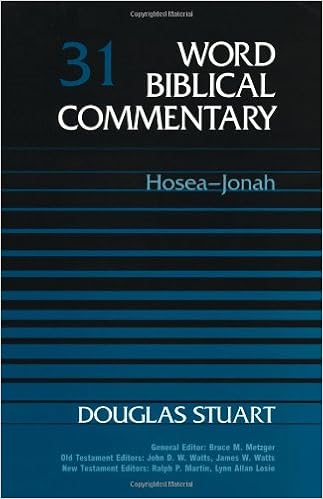
[18] Douglas Stuart, Word Biblical Commentary: Hosea-Jonah, vol. 31 (Grand Rapids, MI: Zondervan, 2014), 502.

With Us or Them?

I am currently working on a project that is related to the book of Jonah. Here is some commentary on Jonah's attitude in chapter 4 that struck me as being particularly relevant to our day:

"It is always easier to assume that God is with us more than he is with our enemies. In war, how can God be on the side of the foe? Whether it was the time of the Assyrian Empire, the Babylonian Empire, or the Persian Empire (etc) those Israelites who heard or read the story of Jonah were all people who chafed under subjugation by a foreign power. Their natural tendency would be to presume that God was with them and not with their oppressors. But they could not confine God to serving their own interest! Jonah’s resentment at having his fears come true strikes at the complacency of the audience." 


Douglas Stuart, Word Biblical Commentary: Hosea-Jonah, vol. 31 (Grand Rapids, MI: Zondervan, 2014), 502.

Before too long, I will be posting a more detailed look at this idea of nationalism and political hegemony as it relates to God being with "us," and against "them."

For All Nations - A Reflection of Mark 11:12-25

I sincerely apologize again for my negligence in posting new material on the blog. I have finished my school semester so I will try to post more frequently, as time allows.

           Mark has the theme of “son of God”[1] as its bookends.[2] This work was written at a time when the emperor claimed divine status with this title. Here, Jesus was declared the son of God, and there could hardly have been a more “counter-political message”[3][4] for the Markan audience. However, he was characterized by acts of mercy, kindness, and intervention on behalf of the oppressed rather than cruelty, brutality and selfish ambition.
            When considering the content of Mark and the ways it differs from the later traditions found in Matthew and Luke, there are numerous elements that stand out. Matthew and Luke[5] quote from Jeremiah 7 but only Mark has the more complete reference to Isaiah 56:7, “for all the nations.”[6] While there are multiple possibilities present in this text,[7] there are two particular themes of interest for this post.
First, it does not appear in Mark that Jesus is against the temple or ritual in and of itself.[8] There is the suggestion that commercialization and corruption of the priesthood,[9] at the people’s expense, is the focus of his protest. This is seen in the contrast between “house of prayer for all nations” and “den of robbers.”[10] Sources indicate that many Jews in this period were overtly perturbed with the way the leadership was abusing their authority[11] and failing to guide the God-ordained system of worship in just ways.
The second theme is the exclusion (“for the nations”) of outsiders. If the outer court[12] was the location of this scene – where the “other nations” worshiped – it opens the possibility to Jesus addressing the exclusion of those desiring a close proximity to God and being interrupted by an elite system of greed. Israel’s calling was to be a light to the nations and a kingdom of priests. The intended role was to put God on display, thus drawing others in, not keeping them out. And it appears that the temple had grown quite popular among the Gentiles[13] in the time of Jesus.
Jesus’ action, as N. T. Wright comments, was more than only symbolizing the Temple’s destruction and a “mere intention to replace the present temple with a new one,” it was also a critique of what the system had become, which fits within the eschatological dynamic of Jesus.[14] Daniel Kirk summarized it well: “Thus, the cursing of the fig tree, together with the indications that a new exilic state for the temple is looming, make a stark statement about the state of the temple and likely its leadership, according to Jesus. Not being a time for fruit,[15] it is a time for judgment.”[16]
In sum, if Christians today earnestly seek to be a peaceful people, the ethics and concerns of Jesus must be adopted in practical ways. At times, unity among God’s people is sacrificed in favor of uniformity. Those “who understood their humanity and their religiosity differently that that of the dominant voices of the text”[17] have often been marginalized for it.
The point is not necessarily to emulate Jesus’ actions exhibited here, but rather conclude that action belongs with conviction. Even though tensions can appear too mountainous to move, this is not a new phenomenon. When one individual is willing to take a stand on behalf of those who will not, or cannot, anything is possible. “For those” – says the Apostle Paul – “who are led by the Spirit of God are children [sons] of God” (Rom 8:14 NRS).


[1] Nuances to this title are found within Hellenism and Hebraic tradition. See Karl-Josef Kuschel, Born Before All Time?: The Dispute Over Christ’s Origin, trans. John Bowden (New York, NY.: The Crossroad Publishing Company, 1992), 311-13.
[2] There are however numerous manuscripts from various text groups lacking the phrase “son of God.” Adela Yarbro Collins and John J. Collins, King and Messiah as Son of God: Divine, Human and Angelic Messianic Figures in Biblical and Related Literature (Grand Rapids, MI.: Wm. B. Eerdmans Publishing Co., 2008), 126.
[3] Willard M. Swartley, Covenant of Peace: The Missing Peace in New Testament Theology and Ethics (Grand Rapids, MI: Wm. B. Eerdmans Publishing Co., 2006), 93.
[4] Cf. Romans 1:4.
[5] Matthew 21:13; Luke 19:46.
[6] J. Marcus draws the distinction that the citation in 1 Macc 7:37 is restricted to Israel alone, while Mark has a universal nuance. Joel Marcus, Anchor Yale Bible Commentaries: Mark 8-16. (New Haven, US: Yale University Press, 2009), 783.
[7] Eugene Boring notes five proposals having been argued in this text. Eugene. M. Boring, Mark : A Commentary  (Louisville, KY.: Westminster John Knox Press, 2006), 320-21.
[8] Judgment against the temple could be concluded from 11:12-25; 13:1-2. He is accused in 14:49, 58; 15:29. Exposing the corruption of what the system had become is arguably different than opposing the Temple cult.
[9] It is also worthwhile to note the critique of scribes in 7:1-13; 12:39; etc.
[10] Steve Moyise, Jesus and Scripture: Studying the New Testament Use of the Old Testament (Grand Rapids, MI.: Baker Academic, 2010), 22.
[11] N.T. Wright, Jesus and the Victory of God, Christian Origins and the Question of God, vol. 2 (Minneapolis, MN.: Fortress Press, 1996), 413.
[12] This is not the most plausible historically as Adela Yarbro Collins notes, “The narrative description of Jesus' actions does not emphasize the Gentiles or their relation to the temple. This lack is especially important since the outer court, where the actions probably took place, was not called the 'Court of the Gentiles' in the time of Jesus and Mark.” Adela Yarbro Collins and Harold W. Attridge, Mark A Commentary: Hermeneia: a Critical and Historical Commentary on the Bible (Minneapolis, MN.: Fortress Press, 2007), 526.
[13] Marcus 2009, 783.
[14] Wright 1996, 417-18.
[15] Or perhaps it could be that the Messiah disagrees with the tree about whether it is time for fruit. The demons believe that Jesus has come to torment before the proper time. But if the Messiah is already here, it is time for the temple to be producing the fruits of righteousness.
[16] J. R. Daniel Kirk, “Time for Figs, Temple Destruction, and Houses of Prayer in Mark 11:12-25,” Catholic Biblical Quarterly 74 (2012): 522.
[17] Renita J. Weems, “African American Women and the Bible,” in Stony the Road We Trod, ed. Cain Hope Felder (Minneapolis, MN.: Fortress Press, 1991), 74.

Christian Patriotism and the War Machine

There's got to be a better way 
What is it good for?

. . .

War, I despise 'cause it means destruction of innocent lives
War, means tears to thousands of mothers how
When their sons go off to fight and lose their lives

. . .

War, it ain't nothing
But a heartbreaker
War, friend only to the undertaker
It's an enemy to all mankind
The point of war blows my mind
War has caused unrest
Within the younger generation
Induction then destruction
Who wants to die

War, what is it good for?
Absolutely nothing

Edwin Starr, War

Regardless of one’s eschatology or opinions of political policy, categorizing any political state as though it is the legitimate recipient of God’s favor before all others is a gross mistake with detrimental ethical repercussions.


The allegiance of members within the community of God to a "nation state," as though God were taking a particular side, is troubling. There are many who are convinced that God is with the United States, including its perpetual military endeavors. For some, this is rooted in the mistaken notion that this nation was founded upon and still is an inherently "Christian" nation, blessed by God. What about those who serve God in territories we have invaded and afflicted? If they cry to God against us, who is God obliged to answer? 


“For it is not right that a worshipper of God should be injured by another worshipper of God.” - Lactantius, A Treatise on the Anger of God (ANF 7.271). 

Far too often, theology has been poured into an ideological mold for the purpose of casting a nationalized image of God to fit worshiped, political agendas. 

"Believing that God accompanies one’s army is always comforting, and a people can perhaps be braver the more inclined they are to view God as able and willing to come out in their defense.” Patricia M. McDonald, God and Violence: Biblical Resources for Living in a Small World (Scottdale, PA.: Herald Press, 2004), 77.

When did Christianity become so inseparably intertwined with political agendas and identities? Why is it that a "conservative" Christian will question the faith of someone they deem as "liberal" or who identifies with another political party?

The history of humanity, including Christianity, is strewn with a trail of blood where imperialistic aspirations have been religiously justified as though they were God’s own desires. See David A. Leiter, Neglected Voices: Peace in the Old Testament (Scottsdale, PA.: Herald Press, 2007), 10.

“You kill one person, they lock you up and throw away the key. You kill three-hundred thousand and they give you a knighthood.” PBS Masterpiece, Endeavor, S1E1, 48:46 (In the context of what happened to Hiroshima).

What does Jesus have to do with Caesar?


Supercilious Scripture Snobs or Careful Custodians


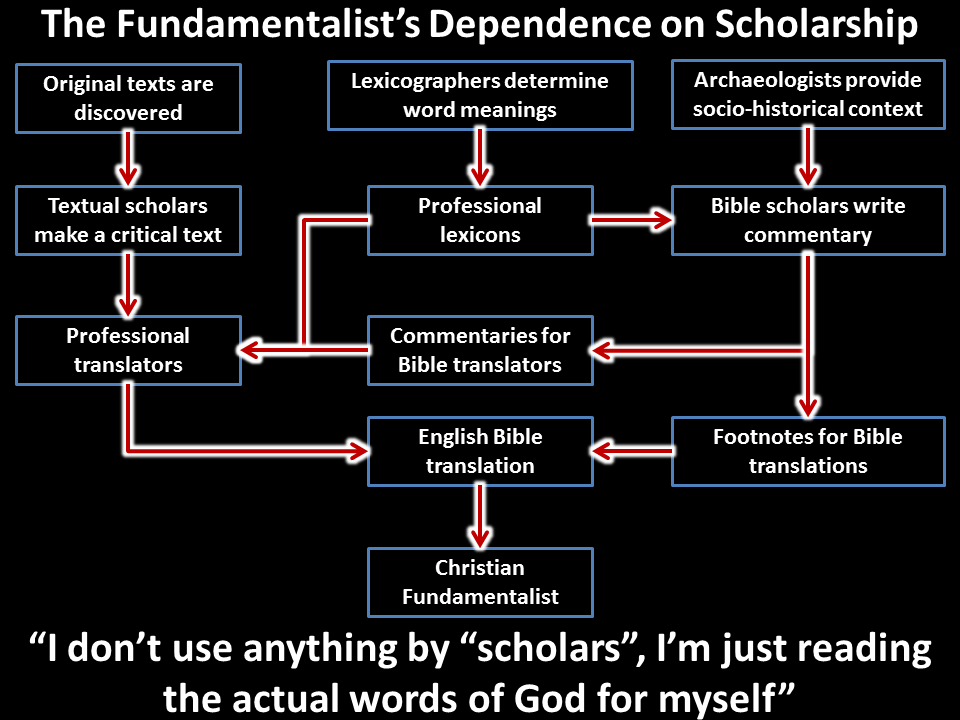
Reading biblical text within its historical, social and literary contexts places it where it was always intended to be, thus bestowing upon it the highest possible honor. Some, who are unacquainted with this as proper treatment of text, choose rather to label it “scriptural elitism” and thereby uncharitably disregard the valiant efforts of multitudes of scholars from varieties of disciplines, stretching years into the past, whose life mission has been to better understand this priceless treasure.

John Walton summarized it well, 

"God is not superficial, and we should expect that knowledge of him and his Word would be mined rather than simply absorbed. This means that all of us will be dependent on others with particular skills to help us succeed in the enterprise of interpretation. This is not elitism; it is the interdependence of the people of God as they work together in community to serve one another with the gifts they have." Walton, The Lost World of Genesis One; Ancient Cosmology and the Origins Debate (IVP Acedemic, 2009), 171.

I have posted this quotation in the past, but James McGrath was also spot on when he said,

"Does someone claim that they simply read the Bible and have no need for scholars, when they are reading the Bible in translation, or reading critical editions of the texts in the original languages, or using manuscripts copied by scribes, having learned Hebrew and Greek with the help of textbooks and lexicons? That person is a liar, plain and simple."

This is not to say that there haven't been or are not irresponsible conclusions or distortions (whether intentional or not is not for me to say). Brent Sandy perhaps has a balanced perspective,

"Evangelicals who support the concept of inerrancy have undoubtedly been guilty at times of claiming too much for the term and claiming that we know too much (e.g., about what historical accuracy demanded and about what authorship entailed). But critical scholarship is not innocent of similar unwarranted certainty and belief in 'assured results' as they apply the surgical knife to biblical books with such self-confidence." Walton and Sandy, The Lost World of Scripture; Ancient Literary Culture and Biblical Authority (IVP Academic, 2013), 276. 

Storied Salvation: Assurance

Salvation According to Paul: Assurance


“Paul would certainly see 'salvation' as secured through 'belief in the Lord Jesus', however much such belief would have to be spelled out in any particular case.”[1]

The book of Jude with its unique content and non-canonical citations contains a noteworthy warning to its readership:

“Now I desire to remind you, though you know all things once for all, that the Lord, after saving a people out of the land of Egypt, subsequently destroyed those who did not believe” Jud 1:5.

The idea that belief and obedience are mutually exclusive or autonomous is not found in the OT or apostolic tradition. God does indeed secure his people, but not without their consent or cooperation. Security and safety are found in continual obedience to God; it’s his word not ours. Once the later idea that grace and obedience are separate from each other is removed – one being accomplished by God’s fiat alone and the other optional by us – Jude’s warning is perfectly appropriate. “Those who did not believe” are not those who wandered into heresy,[2] but rather those who after participating in God’s renewing and restoration power refused to participate and act in the obedience required to be part of that kingdom. This is not a matter of maintaining proper theology, but rather a failure to put into action God’s commands. There are numerous examples of faith as obedience, where those who were once obedient but did not continue on that path were subsequently judged by God.
The psalmist wrote:

“The salvation of the righteous is from the LORD; He is their strength in time of trouble. The LORD helps them and delivers them; He delivers them from the wicked and saves them, Because they take refuge in Him” Ps 37:39-40.

There is no question that Yahweh is the source, character, nature, substance, and reality of salvation. It depends on his faithfulness, consistency and reliability, not our wavering attempts. Does this then describe our eternal security; are we eternally secure? I believe that is the wrong question to ask. A better question is, “Who are the righteous,” which the passage describes? This passage (and others like it) is about the righteous, a topic about which the OT (especially the Psalms) has a lot to say. Jesus came teaching Israel what the actions of a righteous (kingdom citizen) look like. God himself is our guarantee, as Paul said, “by whom you were sealed for the day of redemption” Eph 4:30.[3]

Within the idiomatic way biblical language works, salvation can be spoken of as an accomplished action, although in modern ways of reckoning it causes substantial confusion regarding that from which we are being “saved.”

The proof of spiritual transformation in the Gospels is the confirmation of the people and the spirit of God. There is a sense in which the principle, first taught in the OT, and taught also by Jesus with the witness of at least two, is appropriate. It’s not a matter of self-confirming statements, but rather community affirmation. Obedience is obvious.

“The sorrow that is according to the will of God produces a repentance without regret, leading to salvation, but the sorrow of the world produces death” 2 Cor 7:10.

The declaration by many dedicated men of God should ring in our ear; hineni, “here I am,” your servant waits for your instruction. Obedience is the best gauge in the present regarding one’s salvation being a reality in the future.

“The righteous dead still await the promised resurrection, 'God' has singled out Jesus, bestowing on him, uniquely, resurrected existence and making him thereby the exemplar of what believers can hope for and the assurance that their hope in 'God's' readiness and power to raise the dead is not in vain (esp. 1 Cor 15:20-58; Heb 2:5-18; 1 John 3:1-3). Resurrection, thus, is presented as the essential means by which ‘God’ will demonstrate faithfulness to believers, and their hoped-for salvation/vindication is directly patterned after what 'God' did in/for Jesus. . . . So, 'God' in the NT is emphatically known as the deity who raised Jesus from the dead and exalted him to glory, which justifies and even demands now that Jesus be proclaimed as 'Lord' (e.g., Phil 2:9-11). But God's resurrection of Jesus also serves to signal incomparably this God's great power and purpose, which are to eventuate in a personal/bodily glorification of believers that is patterned after that given to Jesus.”[4]


[1] J. D. G. Dunn, Beginning from Jerusalem, Christianity in the Making, vol. 2 (Erdmans, 2008), 674.
[2] 1 Tim 4:16.
[3] Eze 9:4; Eph 1:13-4; 4:30; 2 Cor 1:21-2; 5:5; 2 Tim 2:19; Rev 7:3; 9:4.
[4] L. W. Hurtado, God in New Testament Theology (Abingdon Press, 2010), 42.