Pages

Showing posts with label Hell. Show all posts

Servetus

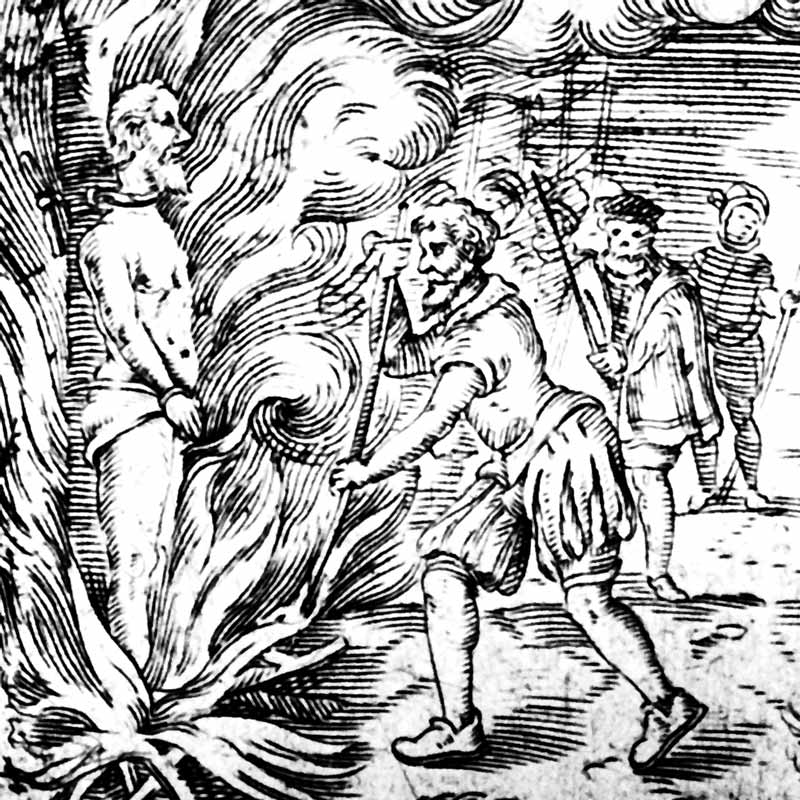
Today marks the 463rd anniversary of the martyrdom of Michael Servetus (October 27th, 1553). I continue to have a hard time comprehending how an individual can feel that they do the work of God when brutal execution is carried out upon individuals possessing "other opinions" regarding doctrinal confessions. In the case of Servetus and Calvin, it was the doctrine of the Trinity.
How are people comfortable with a god who will torture someone eternally for merely having wrong opinions or beliefs about his "nature" or relationship to his son? Those who claim to be people of the Scriptures must bend, twist, copy, paste, contort and distort that to which they pay verbal obeisance in order to come to that perverted conclusion.

Unfortunately, those who wield the metaphorical (and other times literal) sword and spear for the sake of persecuting those having heterodox opinions are convinced they do so with the authority of God and their reading of the Sacred Writings. They feel they stand with the Almighty in the destruction of the "ungodly," i.e. those who don't believe as they do.

Does God disdain all those we do? 

If so, what period of Christianity, and what particular vein? 

Was Christianity (used here anachronistically) in its early form (meaning Jesus and Apostles) a set of creeds and beliefs to which one must subscribe? ("Believing" in the "Lord Jesus Christ" was a recapitulation of Moses' salvation upon his people as well, howbeit with differences -  Ex 14:31).

If so, why is there no record of such? 

Why does the book of Acts depict something quite different as having set their world on fire?

Why is it that the concerns of so many labeled "Christian" today reflect little of Jesus' actual teaching and purpose? 

Why aren't more Christians asking these questions?

The Rich Man and Lazarus

I had written this a few months ago in response to an inquiry made to me regarding the story Jesus told in Luke 16. I had forgotten about it until I read a commentary by a friend of mine, Sean Finnegan called "The Rich Man and Lazarus." This was posted on his new web site Restitutio. In his commentary, he gives far more detail then I do here. So if this subject peaks your interest, check it out.
He has podcasts and explores many other interesting subjects relating to theology and Church history as well. 

The story Jesus told in Luke 16 has been frequently used in an attempt to support the doctrine of conscious eternal torment. There are - in this reading of "the Rich man and Lazarus" - some vital elements missing and assumptions made not inherent within this text or indigenous to the context.

In a brief overview, several observations can be safely made:

First, this is a parable, not history or a factual narrative. This, like many parables or stories Jesus told has borrowed content (i.e. a well-known story tweaked to illustrate his point). "There was a certain rich man..." and "there was a certain beggar..." Two chapters later in Luke, it says, "Now he told them a parable" (Lk. 18) and then the parable in the same form as Luke 16, "in a certain city there was a judge....there was a widow in that city..." (emphasis mine). Unknown to many New Testament gospel readers today is that few of Jesus' parables are actually original to him. He borrowed stories from other Rabbis as well as popular stories or folklore known in his day (Aesop etc.). Therefore, it must be understood that just because Jesus uses a story from his day, does not necessarily mean he endorsed all the elements in the story as fact or theologically sound. That wasn’t why he was using the story. He uses the story to illustrate his own teaching point.

Second, the subject and interaction that culminates in Jesus telling this parable does not concern afterlife, hell, conscious eternal torment, final judgment or anything resembling these ideas. This is important, because a parable is meant to teach a particular principle. Afterlife has nothing to do with the theme of Jesus' context he is communicating to his listeners. Rather, it is a message to the Pharisees about their failure to be good stewards. Luke says "they were lovers of money" and were scoffing at him [Jesus]." Jesus speaks of having ones heart right before God, because he [God] detests what may be seen as "highly esteemed" among men.

Jesus here is threatening the order of civil structure (such themes as “first shall be last and last shall be first”). In the parable, a man who was honored by man and had the luxuries of life now inhabits a lower place than he who was despised. He ends the parable speaking about “those” relatives of the “rich man” (other Pharisees) who would not be persuaded by Moses and the prophets (perhaps this was Jesus’ allusion to the Scripture over their love of tradition and oral Torah) and then gives a hint about not being persuaded even if “one should rise from the dead.” This is of course a preamble to what Jesus was about to do (Lk. 16:27-31). In the story, Abraham’s words “they would not believe,” prove to be true, because after Jesus’ resurrection in Luke, the same attitude is exhibited.

Third, if the setting is examined, the time frame of "here and now," cannot be escaped. It was in the present age, not some distant time in the future. This action has taken place before any type of judgment and is taking place in hades, the realm of the dead (equivalent to Sheol in the Old Testament, the place of the dead, not the place of conscious eternal torment) not Gahanna, the final punishment. It simply refers to the grave.

Fourth and finally, the story is figurative, not literal. If this story were read as literal, some convoluted propositions would be presented:

1. Abraham is in charge and receives all the righteous dead and remains with them.
2. The “righteous” on Abraham’s side can travel back to give messages to the world of the living (opposed to the realm of the dead, hades/sheol).
3. Physical water (a drop) has immaterial properties capable of relieving the anguish or torments of a disembodied spirit in the grave.
4. Disembodied souls or spirits have physical attributes (eyes, tongue, etc.) and can use senses present in corporeal bodies.
5. Angels transport the dead (although in immaterial form – a disembodied soul) from earth to Abraham (wherever that may be).
6. The righteous dead are within audible and visible proximity to each other and have the ability to communicate.

In Jesus’ version this story, the messed-up social structure of the “rich” versus the “poor” man becomes evident. Even in his predicament, the rich man still wants the poor man to serve him (“send Lazarus to me…that he may cool my tongue”).  Jesus is teaching about stewardship and the necessity of his people to take up their God-given responsibilities to care for the broken, hurting sick and torn instead of living vicariously and sumptuously. Jesus exhibited what he taught, he healed the sick and cared for the broken (even at times going against the established “tradition”). This story (parable) is not about final judgment, does not teach the immortality of the soul, conscious eternal torment or any “Heavenly abode” for the saints, but rather was a real message to real people who were missing the calling and mission of their God. This message is just as relevant for people of God today as it was then.

Saul, Saul!

It is shameful the way certain religious Christian (and non-Christian) groups malign and mistreat others in the name of theology, doctrine, love and all that is sacred. The very one to whom allegiance has been pledged and for whom it is asserted a defense is made is the same one upon whom dishonor is brought.

Paul, first known as Saul under seemingly sound and noble motivation was working against the kingdom of his God all the while oblivious to the fact that it was he, not those whom he persecuted who was misaligned with the work of God. Throughout history as religious wars persisted and dissentious sects postulated the “true faith,” a dominant orthodox creature slowly emerged out of the sea of Christianities. As it grew in strength, all who found themselves “thinking otherwise” were cast aside, drawn-out and persecuted by heresy hunters. Did (does) this accurately portray Jesus’ own exemplary model? Was Jesus’ method an imperialistic one; did he teach the necessity of eradicating competing opinions?

With the rise of creedal Christianity and the refining of Christian orthodoxy (which was inadvertently redefining the religion of Jesus) came the need to draw a clearer distinction between soteriological essentials and non-essentials, “What is the ‘correct belief’ one must have in order to be saved?” Indeed, with “correct belief” necessarily came the need to redefine “to what” and “from what” were Christians being “saved”?

Soteriology was given a new face, a new hope and new prerequisites. No longer was this a religion and gospel proclaimed by Jesus, with him as the chosen leader of God’s campaign drawing men to the kingdom with promise of resurrection and glorification on a restored and renewed Edenic earth, but rather a religion about Jesus, where his nature, abstract metaphysical analysis and systematized declarations of belief were essential for acquiescence into the spiritual kingdom of the Universal Church in expectation of an ethereal, spiritual existence in heaven after death.

The heresy hunters in the history of the church left an indelible record, stained with the blood of “heretical” saints, and their successors still roam the edifice of Christian orthodoxy looking for any who threaten the integrity of their bulwark. If you have never been “saved” you are a mission field; a prize to be won. If you have left the solely approved rampart you are an enemy combatant who has a bounty on your head. Never-mind that protestant orthodoxy and heterodoxy is entirely subjective to the whims of denominational segregation and that according to the original Universal Church, whose wake cut the grains of theological fact and fantasy, all who oppose her statements of “right belief”, Canons and clauses are not a part of the true faith. Where does that put those who discard her creeds?
Gandhi wrote and captured this thought in a simple way. It seems to be a fundamentally profound and underlying error in modern Christian orthopraxy:
               “Intolerance betrays want of faith in one’s cause.”
Unfortunately, the downward trend is “anything goes,” but it never should become a point of hatred or ostracism of anyone, Christians should be exemplary models of dealing with situations. Christians of all people should be the ones who can handle someone who does not believe quite like them. What in the world has happened to Jesus followers? Perhaps a better question is, “what on earth have Jesus’ followers done with his teaching? Christians have lost faith in the cause for which we are supposed to stand. We have forsaken and ignored the teaching of our founder and traded it for a bunch of worthless doctrines and traditions. The name we are supposed to uphold has become a reproach and a byword, it is a stench. Christians who claim to be followers of the messiah, and say they want to be like him more than anything else, but yet turn and treat others with contempt, spite and ostracism are liars beyond the pale. It is they who are dragging the name of “messiah” through the mud, and they who have caused the mention of “Christian” in the ears to be abominable and abhorred.
Richard Beck writes, 

“When theology and doctrine become separated from emotion we end up with something dysfunctional and even monstrous. A theology or doctrinal system that has become decoupled from emotion is going to look emotionally stunted and even inhuman. What I’m describing here might be captured by the tag ‘orthodox alexithymia.’ By ‘orthodox’ I mean the intellectual pursuit of right belief. And by ‘alexithymia’ I mean someone who is, theologically speaking, emotionally and socially deaf and dumb. Even theologically sociopathic.

(Alexithymia — etymologically ‘without words for emotions’ — is a symptom characteristic of individuals who have difficulty understanding their own and others’ emotions. You can think of alexithymia as being the opposite of what is called emotional intelligence.)

Orthodox alexithymia is produced when the intellectual facets of Christian theology, in the pursuit of correct and right belief, become decoupled from emotion, empathy, and fellow-feeling. Orthodox alexithymics are like patients with ventromedial prefrontal cortex brain damage. Their reasoning may be sophisticated and internally consistent but it is disconnected from human emotion. And without Christ-shaped caring to guide the chain of calculation we wind up with the theological equivalent of preferring to scratch a doctrinal finger over preventing destruction of the whole world. Logically and doctrinally such preferences can be justified. They are not ‘contrary to reason.’ But they are inhuman and monstrous. Emotion, not reason, is what has gone missing.”

Nibbles of Minnows

When a person (in many religions, but I’m now speaking of Christianity) holds a dissenting view on any given theology or system of belief, that individual is bound to take some heat for it. This is especially true if one has alternative opinions regarding main “pillars” in Christian orthodoxy (e.g. eternal condemnation, election, soteriology, christology, trinitarianism, epistemology and ecclesiology). I have taken my share of flack for heterodox positions on these issues.
What amazes me is that those who have made no effort to see another perspective, studied it out on their own or even attempted a humane discourse on any given “heresy” will charge someone else on grounds from which they have no business doing so. There are some who have strong convictions and although they have never investigated any view but their own will gladly condemn someone else as a heretic on the grounds that it does not agree with what they envision or been taught as “truth”. It is no matter to them that someone may have invested a substantial portion of their life and livelihood seeking answers. They and their denomination, church and Pastor are right and it does not make any difference if scripture, context and fact speak against it.
Now on the logical flip side, I am not saying that “he who studies longest wins”, there is more to consider than that. In “Hell a Final Word”, Edward Fudge states, “I often thought when growing up, and even now still do, that the primary difference between religious teachers is not the views they hold but whether they genuinely desire to understand Scripture in order to teach and to be shaped by it, or if they simply use Scripture as a means to advance their own career and personal interests…Truth does not depend on who believes it or how many people accept it. We all say that, but we sometimes forget to practice it. The only question that counts, the only one worthy of consideration, should be, ‘What does the Bible say?’ This has nothing to do with Roman Catholics or Seventh-day Adventists or Herbert W. Armstrong” p. 54-55.
These people who are fully convinced in their own minds and feel the need to straighten the world out around their specially formed anvil of orthodoxy, I call the “theology police”. In the same book, Mr. Fudge also tells portions of his journey in this area, stories that have resounded all too familiar. Part of his story included reference to a former Professor of his. A group of his (Mr. Fudge’s) peers who “denounced Mr. Fudge as hell-bound” for his radically heretical views on grace and the “one-ness of believers in Christ” also “aimed their guns” at his old Professor. With everything I have seen and experienced, I can identify very strongly with this next statement (I literally laughed out loud and reread it a few times):
“they accused [Mr. Fudge’s Professor] for some supposed error, he would not dignify the attack with a reply, explaining that he didn't mind being swallowed by a whale for his beliefs, but he refused to be nibbled to death by minnows.”
I bring this up because anyone who desperately wants truth over tradition or in spite of the consequences will encounter resistance; people will take shots at you hoping to stop you dead in your tracks. It isn't that accusations should not be thoughtfully and prayerfully considered, but at some point you will have to strap on your armor and let the flying lead bounce off, because most times it will come in the form of personal attack. The reason for this is what I have already stated, most of the attacks do not come from “scholars” or those who have objectively studied things out for themselves, but rather from “hounds” who feel it their duty to track down deserters of what they envision as the “pure faith”. Personal attack is all they can do. They have little or nothing other than traditional rhetoric, dogma and worn out argumentation in their arsenal.  

If you have encountered this opposition, be strong. Stand for what you know is right, but keep your mind open while remaining teachable and humble. Do not let the “nibbles of minnows” discourage or drag you down. I suggest that there would be more with which to be concerned if you encounter no resistance. 

Under the Altar


The book of Revelation is amazing for many reasons. I have a somewhat recent re-infatuation with its content based off of a few points. The first is this; there are some Christians wholly obsessed with eschatological details, and each one of these varying groups feel they have a good working and realistic understanding of the pictures, symbols and metaphors reflected in this apocalyptic piece of literature. I too had a “working understanding” of this book in relation to its “mysteries” until I realized how Jewish it was. It wasn’t until I realized that this revelation is rooted in the Torah, Nevi’im and Ketuvim,[1]that its message started to have an amazing amount of relevance to the rest of Scripture. So much of the imagery recorded for us by the writer[2] is taken from these other divisions of the Hebrew Scriptures specifically in the tradition of the Hebrew Prophets of Israel.
The second reason I have a rekindled love affair with this book is due to the theme which predominately carries through the entirety of the book itself; that being the Heavenly Council/Court/Assembly of God.[3]
The Hebrew Scriptures make reference to this phenomenon often and assume familiarity by its readers because of the extreme relevance in communication from God, His entourage/host, ministering spirits and His declaration about His Holy Habitation. It is very intimately connected to the Temple/Tabernacle and even with the Garden of God in Eden from the early parts of Genesis where God and man’s habitations co-existed in intimacy.[4] The writer of Revelation (in the tradition of Prophets)[5] finds himself in the court/outer court of the habitation of God, which is always the Temple.
The reason I bring this up is because in the place where God dwells, there is frequent reference to the implements of worship represented by the physical utensils found in the earthly representation of the Heavenly Temple/Tabernacle.[6] For instance, in the Apocalypse of Baruch (Baruch III), it is stated that in the “Heavenly Jerusalem and the Temple…the altar is built there, and Michael offers sacrifice upon it.”[7] Isaiah in his vision in chapter 6 “saw the Lord sitting on a throne, lofty and exalted, with the train of His robe filling the temple.” This is a prime example of how the courtroom of the Most High and the Temple are synonymous. These examples could be multiplied, but here are a couple corresponding texts to make my point about Revelation: Rev 7 I looked, and behold, a great multitude, which no one could count, from every nation and all tribes and peoples and tongues, standing before the throne…Salvation to our God who sits on the throne…all the angels were standing around the throne and around the elders and the four living creatures...they are before the throne of God; and they serve Him day and night in His temple; and He who sits on the throne shall spread His tabernacle over them.” Here is a picture of the throne being the Temple. Revelation 11 details the measuring of the Temple (as did Ezekiel). Revelation 11 also lets us in on the fact that the Ark is seen in God’s Temple.[8] This of course corresponds to yom kippur which is mentioned just after the seventh angel sounds his shofar. This event is also known as the “last trumpet”.[9]
In Revelation 14 we are given a surprising piece of information. Jesus had told his followers that the angels were the reapers when it came to “bringing in the harvest at the end of the age”.[10] Jesus also revealed that no one knows when that “time” will come, only the Father knows.[11] Another detail that was provided by “angels” is that the Messiah’s return is going to be like his ascension, with a “cloud”.[12] 
We know that he is going to come with the authority of the Father (his God) and with the angels. [13] This is also spoken of in the book of Enoch,[14] and referenced in Jude 14, the “Lord came with many thousands of His holy ones.” So when Revelation tells us that there was “a white cloud, and sitting on the cloud was one like a son of man, having a golden crown on His head, and a sharp sickle in His hand,” what should we make of it? Who is the/this “son of man”? It does not end there. Next, we find that an “angel came out of the temple, crying out with a loud voice to Him who sat on the cloud, ‘Put in your sickle and reap, because the hour to reap has come, because the harvest of the earth is ripe.’"[15]  As to the logistics of what just happened; a “son of man” sat on the cloud apparently waiting for the command to “reap with his sickle”. An angel (which is a messenger) came out of the Temple with the “word” or “command”. Who is in the Temple? God, the Father, Yahweh of course. So then “He who sat on the cloud swung His sickle over the earth; and the earth was reaped. And another angel came out of the temple which is in heaven, and he also had a sharp sickle.” It is just as all the prophecies and even the words of the Messiah himself revealed. It was God’s authority carried out of the Temple, through angels (ministering spirits) and the “son of man” himself.
In Revelation 15 we see the “Temple is opened” and “angels”[16] on a mission are being dispatched for action, which is how it’s always been. This theme is prevalent all through the Hebrew Scriptures. In chapter 16 we hear “a loud voice from the temple,” twice.
Everything in the real Temple of God[17] is far greatly animated than that which is in the earthly representation. For instance, in Chapter 9 we are told that a voice came from the “four horns” of the altar. God dwells in the Most Holy place (Holy of Holies), and the altars are always in front of that place (directly to the east actually), so it is no surprise when the writer reports, “I heard a voice from the four horns of the golden altar[18] which is before God…saying…release the four angels who are bound at the great river Euphrates.” This is fascinating! At this point, I am not going to write about what is being said, although it may be of interest to note that the “four horns” make reference to “four angels”.
The altar is very significant in the Temple, and has quite a history among the people of God and the pagan societies through the ages. There are two images I would like to give you.
The first image is in reference to what Christians have grown accustomed to acquainting with “hell”. My point here is not to embark on an in-depth investigation of the Christian doctrine of hell, but I would like to draw on some Temple images that may give us some further insights.
As I have already pointed out, the Temple imagery is predominant all though the Scriptures. Some of the terminology used commonly today in relation to soteriological matters derive precisely from Temple symbology. For instance, we are accustomed to calling Jesus our “lamb”. We do this because the Scriptures call him the lamb, do we not? Why does this have significance? Its significance comes right out of the Temple shadows and types. We see him as God’s provision for the people.[19] It corresponds not only to the Passover, but many other festivals as well, including yom kippur (Day of Atonement) with its scapegoat and the daily sacrifices. Most would readily and heartily agree that the Scriptures point us to Jesus as our “atonement”. The stage is set for us very early in fact, in Genesis 22 when the befuddled Isaac asks his father about the sacrifice and the prophetic Abraham responds, “God will provide for Himself the lamb for the burnt offering”. The writer of Revelation also continues this same metaphor when he references the “Lamb slain from the foundation of the world.”[20] There is no point in making a connection to a “sacrifice” without the implements of the sacrifice; the altar. The point of the whole picture is that the lamb of God is sacrificed upon the altar of God for the atonement of all humanity, carried out by the ministering “attendants” or “angels” in the very presence of God. In the first century A.D., it looked like a very bloody, bruised, torn and beaten thirty year old man hanging on an implement of Roman brutality, paying for treason against imperial Rome and betrayed by his own kinsman. But what was more real, that which took place before the Throne of God (of which all physical manifestations follow) in His Temple upon that great altar or the crucifixion of Jesus the Nazarene at the hands of Roman soldiers for crimes against the state? The picture is of God reconciling all things to Himself.[21]
Jesus in one sense became the sacrifice upon that altar so that we don’t have to. The picture of “hell” in this same Temple imagery is that if we fail to accept the sacrifice offered by God on our behalf (Jesus as His lamb),[22] we ourselves will be flung onto that very altar in front of His throne as our own sacrifice, to be incinerated and sent up in smoke creating that sweet aroma spoken of in the Scriptures.[23] There is absolutely no room here for “eternal torment” in the traditional view of “hell”. Jesus’ life was extinguished, he was dead. If God would not have intervened and raised him from the dead, he would still be dead. If not, there would be no point in stressing resurrection as the NT writers all do. It comes down to a very simplistic statement; the only alternative to life is death. The opposite of eternal life is not eternal death;[24] that is an oxymoron. The opposite of eternal life is total annihilation. When sacrifices were offered as “burnt” offerings, the point was in them being consumed; nothing was left. We can find many examples where the Fire of God consumes a sacrifice, even to the point of being told that God Himself is a Consuming Fire.[25] They were utterly and completely destroyed. The smoke may have continued to go up for a while, or even forever, but that is different.
With everything we have discussed up to this point, we are now ready to view the second image of the altar, which starts (with no surprise) in the Torah and continues on into the Writings. In the discussion of the immortality or better said, mortality of the soul, is a passage often used as a proof text for the supposed doctrine of immortality, which comes out of Revelation as well. Everything I have shown about Revelation’s use of the Temple/Tabernacle imagery is connected to this last picture.
In Exodus 27[26], Moses is given the details for the all important altar in service to the God of Israel, depicting a reality unseen in the physical world, a reality that had been at work since before the universe began. Included in the details were four horns, which were to be positioned on the four corners of this altar. They were to be overlaid with bronze,[27] and directly attached as one piece with the altar itself. There are many interpretations as to what these horns may represent, and like many things in the Scriptures, there are multiple pictures and metaphors to be learned, not necessarily just one.[28] One thing is for sure; it was very strongly stressed that the blood of the offering was to adorn these horns come sacrificial time. The priest was to take some of the blood of the animal sacrifice, “and put it on the horns of the altar with your finger; and you shall pour out all the blood at the base of the altar.”[29]
These are the original details concerning the horns. These horns were definitely a representation of God’s governing hand, as seen in their relation to the angels at the four corners in Revelation and the Prophets.[30] What’s also interesting about the horns in the Scriptures is that they are usually symbols of power and might. Even in other writings, such as The Testament of Joseph from the Pseudepigraphal work of the Testaments of the Twelve Patriarchs, dated to the second century B.C., contains the following relating to “among the horns”: “And I saw [in the midst of the horns] that [from Judah was born] a virgin [wearing a linen garment, and from her] was born a lamb, [without spot]; and on his left hand there was as it were a lion; and all the beasts rushed against him, and the lamb overcame them, and destroyed them and trod them under foot. And because of him the angels and men rejoiced, and all the land. And these things shall come to pass in their season, in the last days. Do ye therefore, my children, observe the commandments of the Lord, and honour Levi and Judah; for from them shall arise ⌈unto you⌉ [the Lamb of God, who taketh away the sin of the world] one who sayeth [all the Gentiles and] Israel.[31] Similarly, the Maccabees are symbolized as “horned lambs” in 1 Enoch 90:9.
 In the Torah we find “cities of refuge,”[32] where an accused one could escape unjust retribution on his head. The guilty party would be able to escape to one of these cities if it was not intentional murder[33]. Although not directly stated in the Torah, through the years (perhaps from the natural imagery of what the Hebrews saw in them), the horns also became a refuge for asylum and salvation. It becomes all the more interesting through the course of Messianic prophecy and writing that we find our very Messiah Jesus interpreted as being the “horn of our salvation”.[34]
In the writings we are given a couple examples of this idea of refuge sought from the horns of the altar. In 1 Kings 1:50-53, Solomon’s adversarial half brother Adonijah is afraid of him because of the attempted usurping of his throne. Through the course of events, the text records, “Adonijah is afraid of King Solomon, for behold, he has taken hold of the horns of the altar, saying, 'Let King Solomon swear to me today that he will not put his servant to death with the sword.’” He was then brought before King Solomon for judgment, and for the moment his life was spared.
The other occasion is also in the book of 1 Kings, in the very next chapter in fact. Here we have a different perspective. After Adonijah’s death (for refusing to take no for an answer), we find that Joab (who was an accomplice of Adonijah) “fled to the tent of the LORD and took hold of the horns of the altar.”  In that particular passage we find the same reality connected with the “cities of refuge”; a willful murderer has no salvation from the horns (or in the city of refuge). Solomon’s instructions were to “Go, fall upon him [with the sword]." Joab knew this well, for when the Kings’s emissary approached and declared, “Thus the king has said, 'Come out.'" But he said, "No, for I will die here.” Word was brought back to Solomon, to which he then responded, “Do as he has spoken and fall upon him and bury him, that you may remove from me and from my father's house the blood which Joab shed without cause. The LORD will return his blood on his own head, because he fell upon two men more righteous and better than he and killed them with the sword…”[35]
With that thought in mind, we reach the verse in Revelation for which I have been building a foundation. In Revelation 6 it says, “When the Lamb broke the fifth seal, I saw underneath the altar the souls of those who had been slain [slaughtered] because of the word of God, and because of the testimony which they had maintained; and they cried out with a loud voice, saying, "How long, O Lord, holy and true, will You refrain from judging and avenging our blood on those who dwell on the earth?" And there was given to each of them a white robe; and they were told that they should rest for a little while longer, until the number of their fellow servants and their brethren who were to be killed even as they had been, would be completed also.”
There are a few elements of possibility in this particular passage. First, there is a certain aspect of the “souls” that have been martyred are as “sacrifices” to God. Paul uses this type of language in Romans 12 when he says, “present your bodies a living and holy sacrifice, acceptable to God, which is your spiritual service of worship.” There are other bodies of rabbinic, apocryphal and pseudepigraphal literature that go along these same lines. These ones are slain or slaughtered for reasons that only God, in His divine plan, knows. In the picture, they are offered up, and their blood is thrown against the side of the altar. I don’t think this is the biggest picture we find in this passage, but I won’t say there isn’t an essence of it seen here. Again, it’s meant to correspond to the pictures and metaphors given to us by God in the Tanakh, not with which to build a doctrine or a systematized theological strand. “What do I mean if I say referring to Messiah’s death as sacrifice is a metaphor? The meaning of a metaphor should be sought in what one thing has in common with another. No metaphor is perfect. Things and events used in a metaphor are always both like and unlike what they are compared to. McKnight quotes the words of G.B. Caird, ‘Metaphor is a lens; it is as though the speaker were saying, ‘Look through this and see what I have seen, something you never would have noticed without the lens!’”[36]
Secondly, we find in this passage, through the perspective of this Hebraic minded writer, a thread that goes back to something Jesus himself said. Jesus had made mention, that on his generation would “fall the guilt of all the righteous blood shed on earth, from the blood of righteous Abel to the blood of Zechariah, the son of Berechiah, whom you murdered between the temple and the altar.”[37] Jesus said that Abel was righteous. If we take a peek back at the original context, I think we may find somewhat of a surprise. God was not pleased with Cain’s offering, but was with Abel’s. Gen 4:8-10 “And it came about when they were in the field, that Cain rose up against Abel his brother and killed him. Then the LORD said to Cain, "Where is Abel your brother?" And he said, "I do not know. Am I my brother's keeper?" He said, "What have you done?”  This very next part is the key. “The voice of your brother's blood is crying to Me from the ground.”  Was the blood really crying out to God, or was it justice and recompense by the only one worthy to do so, that was being demanded?[38] Likewise, the writer of Hebrews also picks up on the same thing, “by faith Abel offered to God a better sacrifice than Cain, through which he obtained the testimony that he was righteous, God testifying about his gifts, and through faith, though he is dead, he still speaks.”[39]
Here is the third and final aspect I will share about this passage. I spent some time following the progression of the horns of the altar, from the Hebrew Scripture’s description and usage. When someone refers to the altar, the horns are also a natural part of it (all being made of one piece, not a separate entity).
Revelation specifically references that those “souls” under the altar are waiting and crying for justice, retribution and vengeance. I don’t think that it’s too much of a stretch in this picture to suggest that the writer of Revelation wants us to see these “souls” (although in the ground and awaiting the time of resurrection[40]) as innocent victims, clinging to the horns of the altar. Remembering that Jesus himself is a picture of the horns, it completely fits this paradigm. And for the critic who may bring up the “mixing of metaphors” (Jesus being the horns and sacrifice?), I would also remind you that the Biblical writers did the exact same thing. If that is the criterion, how can one be a priest and the offering at the same time? We need to be careful not to try and carry a picture or image further than the author intended; it is there to show us something. The intent of this passage in particular, was not to try and develop a doctrine of “heaven” (where-in the saints dwell until the return of Messiah), but to show that justice awaits the King’s decree.[41] There is no inherent theme of immortal, disembodied souls waiting for the final showdown to be reunited with an immortal body - that is a subject completely absent from the Scriptural narrative.

Conclusion
There are those who would take certain texts, such as those investigated in this essay, and try to bolster the doctrines brought to us through Socratic and Platonic philosophy, and introduced into Christianity via the early church father Tertullian.[42] The Hebrews have always used picture, symbolic, idiomatic and metaphorical language to describe certain realities; we have seen that. The Scriptures were written by Hebrew people, and as such, it reflects their literary techniques and attributes. With that being the case, it is only through this framework that the original message and intention of the author can be achieved. All else is to lose the message.
Communication is what it is all about. God chose this Semitic worldview to be the avenue by which He would reveal His story of Glory, and ultimate redemption of humanity. We as westerners tend toward grasping onto the metaphors, pictures or symbols themselves, instead of the reality they are attempting to convey. As I have stated numerous times, part of the problem lies in not knowing the story well enough to realize where the authors are getting their context. We need to continually come to a stronger realization that “It’s In The Text.”  


[1] The Torah (five books of Moses) Nevi’im (prophets) Ketuvim (writings) make up the TaNaKh which is the same as the Christian Old Testament with exception to the order of the books.
[2] Traditionally the author is thought to be John, the disciple of Jesus who also wrote the Gospel of John and the three epistles of John.
[3] In Hebrew this is called “sod” meaning council or assembly
[4] It is also interesting to note the “cherubim” that are subsequently mentioned after man’s exodus from God’s presence which guarded the proximity of God’s dwelling/throne/Temple. Isaiah and Ezekiel have similar descriptions.
[5] Think of Moses, Isaiah, Ezekiel and Zechariah and even the prophetic “son of man” in Daniel 7, not to mention extra-biblical literature such as Apocryphal and Pseudepigraphal references of other accounts of standing with awe in this same place.
[6] Moses was to copy the “pattern”. As well as did the pagan deities (other sons of God) who have also been in the same place and seen its “pattern”. This is why the tabernacle, Temple and its contents are found in pagan religion and ritual as well. The size and ratio of the Temple and the horns on the altar are two prime examples which are verified in archaeology. A Canaanite horned altar was found at Megiddo, and other Israelite examples have been found at both Dan and Beer-sheba. 
[7] This is also stated in the Talmud by Rabbi Abba Arikha – M’nachot 110a - dating to the third century A.D.
[8] Of course this is not referring to the “earthly” version of the Ark that was lost in antiquity, which is not to say the physical Ark won’t make an appearance again, but that is not found in this passage.
[9] If there are only seven angels, then logically the seventh one has to be the last one. Paul mentions this as well in 1 Cor 15:52.
[10] Matt 13:39
[11] Matt 24:36, Mk 13:32, Acts 1:7
[12] Acts 1:10-11
[13] Matt 8:38, 16:27, Lk 9:26
[14] Enoch 1:9
[15] Also in verse 18 an angel comes out of the “altar” as well. This one having power over fire. It is reminiscent of Isaiah’s vision in chapter 6 where the seraphim removes a coal from the altar to purify his lips. In chapter 8 we have a similar instance except that this appears to be the altar of incense, as the censer is mentioned along with the fragrance. This is in the Holy Place. Either way, this is Temple imagery that suggests the “incense” is the prayers if the saints.
[16] Angel means messenger, in the ability to not only deliver a verbal message, but also act as an agent on behalf of God who sends them (an example being Ex. 3 and the burning bush – Moses speaks to an angel who represents the full authority of God).
[17] I say “real” because the earthly Temple was a shadow of the Heavenly reality of God’s dwelling.
[18] Just to be clear, this specific passage is referencing the incense alter (golden), not the brazen alter which stands in the outer court. But as it had the same type of horns as part of its composition, the picture and imagery is the same.
[19] Isaiah 42:6, 49:5, 8, 53:6, 12, Rom 3:25, 2 Cor 5:21, Gal 3:13, Heb 10:12, 19-20
[20] Rev 13:8
[21] 1 Cor 5:19
[22] These are not to be interpreted literally, but are pictures to what the sacrificial system had been pointing. Jesus’ life was not literally a “burnt offering”. God is not into human sacrifice. These are metaphors. 1 Cor 5:7, Heb 9:26.
[23] Ex 29:18, 25, 41, Lev 1:9, 13, 17 ect. ect.
[24] Unless of course “eternal” is used to make reference finality or irreversibility.
[25] The point of a consuming fire is that it destroys or devours. Deut 4:24, 9:3, Heb 12:29, Gen 19:24 Deut 4:11, 2 Kings 1:12-14, 1 Kings 18:38 1 Chron 21:26, 2 Chron 7:1, 3, Job 1:16, Lk 17:29, Rev 20:9
[26] Exodus 37 records the carrying out of these instructions.
[27] The altar of incense was to be overlaid with gold and also had the blood smeared on its horns once a year on the Day of Atonement (yom kippur).
[28] Psalm 118:27 may lend some insight to the practical function of the horns which says, “Bind the festival sacrifice with cords to the horns of the altar.” It was used for tying the animal until the appropriate time of sacrifice.
[29] Ex. 29, Lev 4:18, 25, 30, 34 8:15, 9:9
[30] Rev 7:1, 9:14 In the Tanakh, these probably correspond to what most translations translate as winds, being the Hebrew word ruach which is also correctly translated spirit(s) as seen in Jer 49:36, 37:9, Dan 7:2, Zech 2:6. This is also reflected in the Greek translation of Matt 24:31and Mark 13:27. Daniel 8:8 is of special interest because it mentions four horns specifically.
[31] Pseudepigrapha of the Old Testament. 2004 (R. H. Charles, Ed.) (2:353)
[32] Numbers 35, Joshua 21, 1 Chron 6:57, 67
[33] The Hebrew Scriptures make a very clear distinction in this area.
[34] Luke 1:69 corresponding to 1 Sam 2:1, 2 Sam 22:3 and Psalm 18:2
[35] 1 Kings 2:23-34
[36] Leman, Derek, Messianic Jewish Musings Blog, Is the Sacrifice of Messiah Literal, January 29, 2013 entry - http://www.derekleman.com/musings/is-the-sacrifice-of-messiah-literal/ 
[37] Mat 23:35 – Zechariah is the prophet of the book Zechariah in the TNK.
[38] Deut 32:25, Ps 79:10, Lk 18:7-8 also 1 Enoch 47:1-4
[39] Heb 11:4
[40] Num 23, Jos 6, Daniel 12:13, Matt 24, Mk 13, John 6:39-40, 44, 54 11:24, 12:48, Lk 11, 12, Acts 17, 1Co 15, 1 Th 4, 5, 2 Pe 3, 4, Jam 5, Rev 22
[41] Daniel 7, Is 32:1
[42] Edward Fudge, “The Fire That Consumes” Third Edition, ppg. 267-270

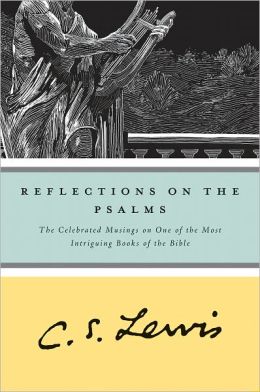
Reflections of C.S. Lewis' Reflections on the Psalms

I started reading C.S. Lewis’ book “Reflections on the Psalms” today. Like classic Lewis, one must pick the meat off the bones (so to speak). Here are some of his “Reflections” that I thought were noteworthy (so far).

On the “good news” (also commonly known as the Gospel)
“We need not therefore be surprised if the Psalms, and the Prophets, are full of the longing for judgment, and regard the announcement that "judgment" is coming as good news. Hundreds and thousands of people who have been stripped of all they possess and who have the right entirely on their side will at last be heard. Of course they are not afraid of judgment. They know their case is unanswerable-if only it could be heard. When God comes to judge, at last it will. Dozens of passages make the point clear. In Psalm 9 we are told that God will "minister true judgment" (8), and that is because He "forgetteth not the complaint of the poor" (12). He "defendeth the cause" (that is, the "case") "of the widows". The good king in Psalm 72:2, will "judge" the people rightly; that is, he will.”
On “Holy Scripture” and “Word of God”
…Holy Scripture is in some sense though not all parts of it in the same sense-the word of God…I take it that the whole Old Testament consists of the same sort of material as any other literature-chronicle (some of it obviously pretty accurate), poems, moral and political diatribes, romances, and what not; but all taken into the service of God's word. Not all, I suppose, in the same way. There are prophets who write with the clearest awareness that Divine compulsion is upon them. There are chroniclers whose intention may have been merely to record. There are poets like those in the Song of Songs who probably never dreamed of any but a secular and natural purpose in what they composed. There is (and it is no less important) the work first of the Jewish and then of the Christian Church in preserving and canonising just these books. There is the work of redactors and editors in modifying them. On all of these I suppose a Divine pressure; of which not by any means all need have been conscious. The human qualities of the raw materials show through. Naivety, error, contradiction, even (as in the cursing Psalms) wickedness are not removed. The total result is not "the Word of God" in the sense that every passage, in itself, gives impeccable science or history. It carries the Word of God; and we (under grace, with attention to tradition and to interpreters wiser than ourselves, and with the use of such intelligence and learning as we may have) receive that word from it not by using it as an encyclopedia or an encyclical but by steeping ourselves in its tone or temper and so learning its overall message. To a human mind this working-up (in a sense imperfectly), this sublimation (incomplete) of human material, seems, no doubt, an untidy and leaky vehicle. We might have expected, we may think we should have preferred, an unrefracted light giving us ultimate truth in systematic form-something we could have tabulated and memorised and relied on like the multiplication table. One can respect, and at moments envy, both the Fundamentalist's view of the Bible and the Roman Catholic's view of the Church. But there is one argument which we should beware of using for either position: God must have done what is best, this is best, therefore God has done this. For we are mortals and do not know what is best for us, and it is dangerous to prescribe what God must have done-especially when we cannot, for the life of us, see that He has after all done it. We may observe that the teaching of Our Lord Himself, in which there is no imperfection, is not given us in that cut-and-dried, fool-proof, systematic fashion we might have expected or desired. He wrote no book. We have only reported sayings, most of them uttered in answer to questions, shaped in some degree by their context. And when we have collected them all we cannot reduce them to a system…He will not be, in the way we want, "pinned down". The attempt is (again, I mean no irreverence) like trying to bottle a sunbeam.”
On the “It’s in the Text” aspect of the NT’s reliance and foundation built upon the OT
“I shall never forget my surprise when I first discovered that St. Paul's "If thine enemy hunger, give him bread", etc., is a direct quotation from the same book (Proverbs 25, 21). But this is one of the rewards of reading the Old Testament regularly. You keep on discovering more and more what a tissue of quotations from it the New Testament is; how constantly Our Lord repeated, reinforced, continued, refined, and sublimated, the Judaic ethics, how very seldom He introduced a novelty. This of course was perfectly well-known-was indeed axiomatic-to millions of unlearned Christians as long as Bible-reading was habitual. Nowadays it seems to be so forgotten that people think they have somehow discredited Our Lord if they can show that some pre-Christian document (or what they take to be pre-Christian) such as the Dead Sea Scrolls has "anticipated" Him. As if we supposed Him to be a cheapjack like Nietzsche inventing a new ethics! Every good teacher, within Judaism as without, has anticipated Him.”
On Hell, Hades and Sheol
“At this point I can imagine a lifelong lover of the Psalms exclaiming: "Oh bother the great scholars and modern translators! I'm not going to let them spoil the whole Bible for me. At least let me ask two questions. (1) Is it not stretching the arm of coincidence rather far to ask me to believe that, not once but twice, in the same book, mere accident (wrong translations, bad manuscripts, or what not) should have so successfully imitated the language of Christianity? (2) Do you mean that the old meanings which we have always attached to these verses simply have to be scrapped?" For the moment I will only say that, to the second, my personal answer is a confident No. I return to what I believe to be the facts. It seems quite clear that in most parts of the Old Testament there is little or no belief in a future life; certainly no belief that is of any religious importance. The word translated "soul" in our version of the Psalms means simply "life"; the word translated "hell" means simply "the land of the dead", the state of all the dead, good and bad alike, Sheol. It is difficult to know how an ancient Jew thought of Sheol. He did not like thinking about it. His religion did not encourage him to think about it. No good could come of thinking about it. Evil might. It was a condition from which very wicked people like the Witch of Endor were believed to be able to conjure up a ghost. But the ghost told you nothing about Sheol; it was called up solely to tell you things about our own world. Or again, if you allowed yourself an unhealthly interest in Sheol you might be lured into one of the neighboring forms of Paganism- and "eat the offerings of the dead". Behind all this one can discern a conception not specifically Jewish but common to many ancient religions. The Greek Hades is the most familiar example to modern people. Hades is neither Heaven nor Hell; it is almost nothing. I am speaking of the popular beliefs; of course philosophers like Plato have a vivid and positive doctrine of immortality. And of course poets may write fantasies about the world of the dead. These have often no more to do with the real Pagan religion than the fantasies we may write about other planets have to do with real astronomy. In real Pagan belief, Hades was hardly worth talking about; a world of shadows, of decay.”